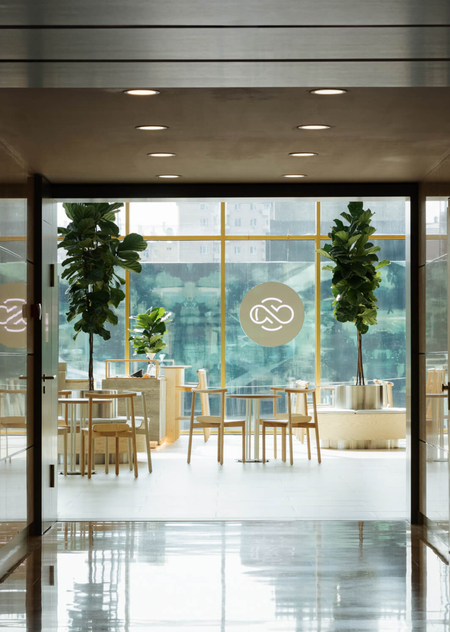
Introduction
ABC Coffee Roasters is a contemporary specialty-coffee brand whose official communication combines hospitality, design, and urban lifestyle. The homepage states that the brand’s story begins in 2017 and frames the company as a network of places rather than a single cafe. It explicitly says that ABC “creates places where you will find community,” and describes its portfolio as ranging from intimate cafes connected with art spaces to flagship locations. Its public-facing ecosystem spans multiple cities and countries: the website lists locations in Moscow, St. Petersburg, and Dubai, along with an “opening soon” entry. This already indicates that ABC is positioning itself not as a neighborhood kiosk or purely transactional coffee outlet, but as an expandable lifestyle brand with a recognizable aesthetic language.
The brand’s positioning is built around three core ideas. First, it emphasizes atmosphere and emotional state: the homepage speaks of calm, light, air, and “visual silence”, suggesting that ABC wants to be associated with restoration and clarity rather than overstimulation. Second, it emphasizes guest-centered hospitality: the philosophy page says that the guest and the guest’s wishes are at the center of the team’s attention. Third, it emphasizes craftsmanship: the homepage says that every step from bean to cup is calibrated, while the partner page foregrounds specialty roasting, technical equipment, and collaboration. Together, these elements suggest a hybrid positioning: ABC promises aesthetic serenity, social comfort, and professional coffee competence at the same time. [1]
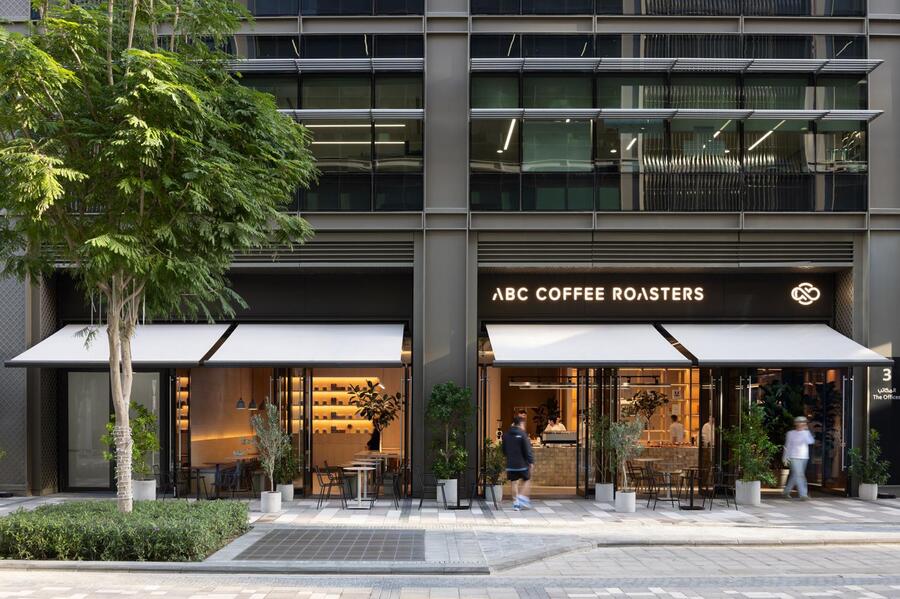
ABC x Osmanthus House, Dubai WTC (source: style.rbc.ru)
The target audience can be inferred from the locations and their descriptions: near opera houses, university lectures, business towers, parks, and Dubai’s trade centre — suggesting urban professionals, students, culturally engaged people, and design‑conscious consumers. Each venue fits an everyday routine like work, study, culture, or socializing.
Therefore, ABC Coffee Roasters can also be understood through Ray Oldenburg’s concept of the “third place”. "As indicated, the remainder of this discussion will be devoted to the community-building functions which “great good places” typically perform. Most often I refer to such places as “third places” (after home, first, and workplace, second) and these are informal public gathering places. These places serve community best to the extent that they are inclusive and local" (Oldenburg, 1999, 19). Coffee shops are often considered one of the most common examples of such spaces. [2]
By Alina D. (source: telegram «abc on air»)
Through its design, welcoming atmosphere, and connections with local creative scenes, ABC creates spaces that support different everyday activities. Visitors can use the cafés as places to meet friends, work, relax, or spend time between other parts of their daily routine. In this sense, ABC Coffee Roasters functions as a contemporary third place that fosters community engagement and strengthens the emotional connection between the brand and its audience.
From cozy coffee houses combined with art spaces to the brand’s flagship venues — journey, select, savor.
By Alina D. (source: telegram «abc on air»)
Communication Channels
ABC Coffee Roasters uses a communication architecture that combines owned channels, earned media, and space-based communication. At the center is the official website, which serves as a navigational hub for locations, philosophy, contacts, the online shop, partner relations, and social links. The website does more than provide practical information: it also communicates brand identity through copy, design values, and location storytelling. The philosophy page articulates the brand’s aesthetic and service logic, while the partner page frames ABC as a technically serious roasting and collaboration platform. [1]
ABC Coffee Roasters website
In terms of visual communication, Instagram* is key to shaping ABC’s brand image and visibility. The brand puts care into image editing and food photography, which can serve either as an ad showcasing the quality of its coffee and dishes, or as a means of conveying the venue’s atmosphere to the audience.
*Instagram is owned by Meta, which is recognized as extremist in Russia.
ABC Coffee Roasters instagram *Instagram is owned by Meta, which is recognized as extremist in Russia.
ABC Coffee Roasters instagram *Instagram is owned by Meta, which is recognized as extremist in Russia.
Telegram feels more like ABC's behind‑the‑scenes hangout than a regular marketing channel. The public preview calls it “abc on air” with the tagline “backstage, news & more”, and it currently has around 1,070 subscribers. That wording matters: unlike the website, which talks to everyone, this channel hints at something closer — a peek behind the curtain. It's not about big numbers; it's the kind of space where loyal customers and curious followers get a little extra access and a sense of being in the know.
As of June 2026, ABC’s Instagram* following stands at nearly 30,000, while its Telegram audience is much smaller. This discrepancy may be explained by the lower usage of Telegram in other regions where ABC operates — Dubai, for instance. Nevertheless, without access to the brand’s reach statistics, it would be somewhat inaccurate to draw firm conclusions.
*Instagram is owned by Meta, which is recognized as extremist in Russia.
(source: telegram «abc on air»)
The final and perhaps most important channel is the physical cafe itself. ABC’s location descriptions are not neutral directory entries; they are small pieces of place-branding. They frame cafes as spaces near theatres, universities, business districts, galleries, parks, and shopping destinations; they also describe their interiors, menus, and moods. This means the café is a communication interface in two senses at once: it communicates identity offline to visitors, and it supplies the visual and narrative material that can later circulate online.
ABC Coffee Roasters instagram *Instagram is owned by Meta, which is recognized as extremist in Russia.
Theoretical Framework
ABC Coffee Roasters instagram *Instagram is owned by Meta, which is recognized as extremist in Russia.
The first selected theory is the Elaboration Likelihood Model. Petty and Cacioppo explain persuasion through two broad routes: a central route, where people carefully evaluate arguments and information, and a peripheral route, where attitudes are shaped more by cues, affects, and simple inferences tied to the persuasive context.
Their 1986 formulation is especially useful here because a cafe brand like ABC persuades through both routes at once: through argument-like information about roasting, quality, and expertise, and through aesthetic and symbolic signals such as interior design, material textures, atmosphere, and visual coherence. Petty and Cacioppo also argue that attitudes formed through high-elaboration, central-route processing are more enduring and more predictive of behavior than those formed through low-elaboration routes. [3]
ABC Coffee Roasters instagram *Instagram is owned by Meta, which is recognized as extremist in Russia.
Another relevant framework is Uses and Gratifications theory, which views audiences as active participants who choose media based on their needs and interests (Blumler & Katz, 1974). People use communication channels to seek information, connect with others, express identity, and gain enjoyment. Uses and Gratifications Theory assumes that media users are active rather than passive. People select communication channels that they believe will provide value, whether in the form of information, entertainment, social interaction, or personal expression. From this perspective, media compete for users’ attention, and understanding audience motivations becomes essential for effective communication. [4] This fits ABC well. Its website, Instagram, Telegram, and physical cafés each seem to serve different purposes for the visitor, rather than simply broadcasting the same message to a silent crowd.
*Instagram is owned by Meta, which is recognized as extremist in Russia.
(source: telegram «abc on air») / ABC Coffee Roasters instagram *Instagram is owned by Meta, which is recognized as extremist in Russia.
West and Turner (2018) and McQuail (2005) are useful as secondary syntheses because they help justify why these two theories fit this case. In communication textbooks and broad media‑theory overviews, ELM is treated as a micro‑level persuasion framework (Petty & Cacioppo, 1986), while Uses and Gratifications is treated as an active‑audience approach centered on media choice and need satisfaction (Katz, Blumler & Gurevitch, 1974). Although Aaker’s brand identity model (1966) is not one of the primary theoretical frameworks used in this analysis, it helps explain the strength of ABC’s positioning. The brand relies on a consistent combination of visual, spatial, and cultural associations that shape how audiences perceive it. Rather than focusing only on products, ABC communicates a broader identity connected to design, lifestyle, quality, and community.
ABC Coffee Roasters instagram *Instagram is owned by Meta, which is recognized as extremist in Russia.
Analysis of the Brand’s Communication Strategy
ABC Coffee Roasters is especially strong when analyzed through ELM because its current communication clearly prioritizes peripheral persuasion. The homepage and philosophy page repeatedly foreground light, air, neutral colors, natural textures, simple forms, and “visual silence.” These are not only informational claims, but atmospheric cues that help a viewer infer quality, calm, and sophistication before any detailed knowledge about coffee is processed. The interior and calm atmosphere of the place are also admitted by several media platforms, which describe ABC as the place with sleek interior and the high-quality product. Through ELM, this means ABC has built a very effective peripheral route for first impressions and brand differentiation. A viewer can grasp “what kind of place this is” almost immediately. [8]
(source: telegram «abc on air»)