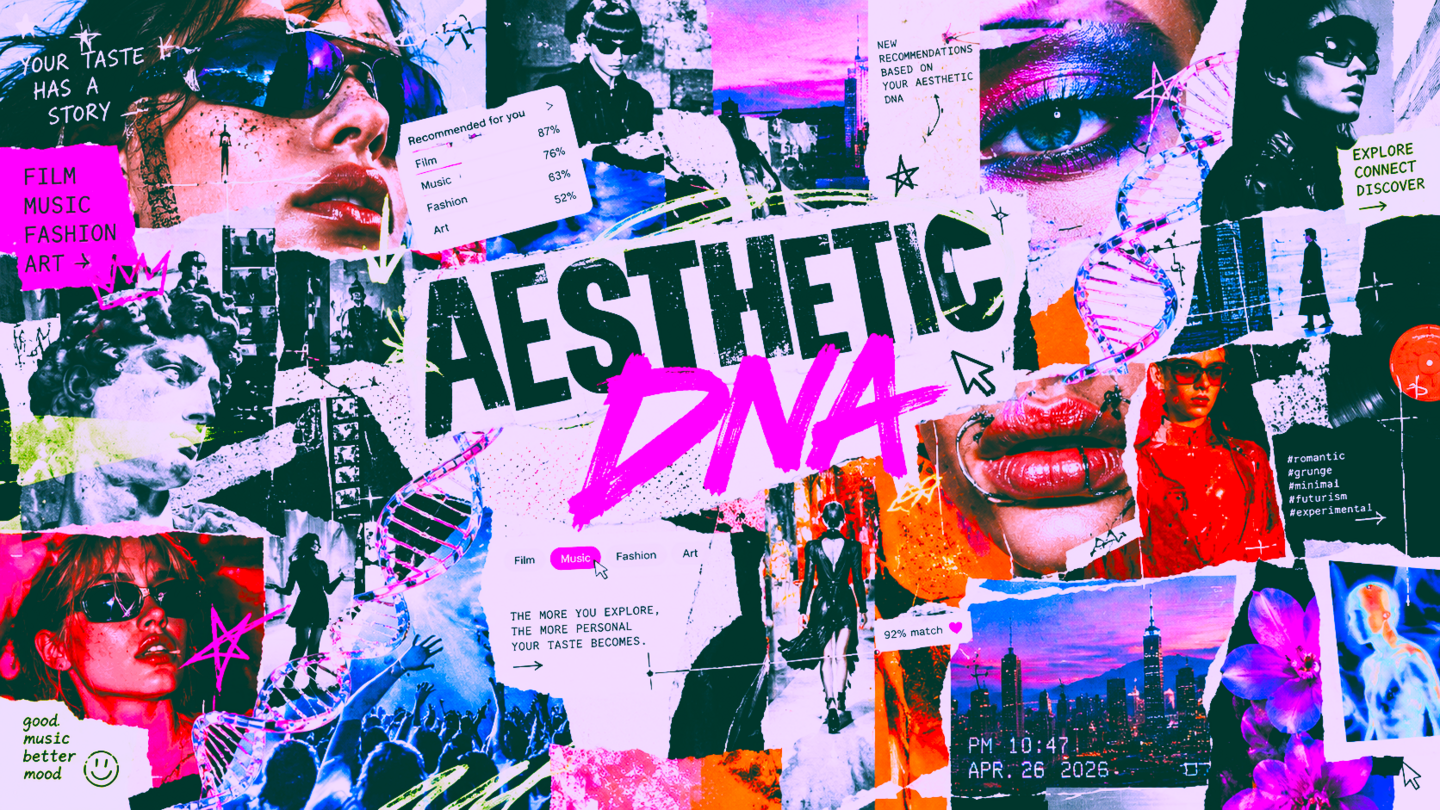
AESTHETIC DNA
— digital media on personal recommendations in the field of visual culture
Media Goal — to create a digital media platform featuring a system of personal and associative recommendations that unifies cinema, music, art, and fashion into a single space for cultural discovery. The goal is to help users find something new, based not only on individual preferences but also on the shared aesthetic characteristics of objects they enjoy.Users interact with the content: they select objects they like, save them, and rate the recommendations. Based on these actions, their individual aesthetic profile—Aesthetic DNA—is formed.Core Function of the Project — the recommendation system. Informational content serves as supplementary material: it helps the user understand the proposed object, its visual characteristics, and its connections to works they already know.Thus, AESTHETIC DNA functions as a personal tool for cultural navigation.
Themes
Segment: B2C, educational digital media targeted at the end-user—someone who wishes to discover new artworks and find cultural content aligned with their aesthetic preferences.Topic: art, visual and audiovisual culture—cinema, music, fine art, photography, fashion, and other artistic forms.Format: an interactive recommendation media that helps the user find artworks through personalized suggestions, aesthetic characteristics, tags, and associations.Niche Topic: personal search and recommendations for artworks based on the user’s aesthetic taste and associative queries.
Media Core Functionality
Search — search for works by title, tags, color, mood, and association. The user can either enter a specific query or describe the desired aesthetic.
Discover — a personalized recommendation feed generated based on the user’s preferences and prior interactions with the content.
Like / Save / Not for me — core actions for interacting with the content. These allow users to rate works, save favorites, and refine future recommendations.
Aesthetic DNA — a personal profile of aesthetic taste, which is formed from user actions and displays the main characteristics of their preferences.
Explore — the ability to investigate connections between works across different art forms: transition from a film to music, photography, fashion, or art, and obtain a brief overview of each piece.
Competitors and their analysis
Competitor Analysis Criteria
1. Functionality What the platform offers and what user problems it solves. — Helps understand which functions competitors already have and where there is an untapped niche.
2. Functional Uniqueness What the main advantage of a specific product is and how it differentiates itself. — Allows you to identify which mechanics can be adopted or developed uniquely.
3. Visual Style How the website and social networks are styled: color, typography, photography, video, motion, composition. — It is important to find an available visual direction and establish a recognizable AESTHETIC DNA.
4. Tone of Voice How the brand communicates with its audience: formally, friendly, provocative, intellectual, etc. — Helps determine the language the project can use to stand out and the impression it wishes to create.
5. Content Channels and Formats Where the competitor is present and what formats they use: website, Telegram, Instagram, TikTok, video, compilations, stories, etc. — Allows you to understand where our target audience already is and which formats are best for attracting and retaining attention.
Direct
1. TasteDive
Function: A search engine for movie, music, book, and other object recommendations. Key Feature: It constructs a chain of recommendations starting from a specific object—"If you like X, try Y.» Visual Style: Minimalist, functional, relatively simple. Tone of Voice: Neutral, utilitarian. Channels and Formats: Website: content pages, recommendations, lists, and textual descriptions. How to Differentiate: Search not only from a known object but also from an association, a color, or a mood.2. GNOD
Function: Search and discovery of music, movies, and books. Key Feature: Visualizes the connections between objects, allowing users to explore cultural «maps.» Visual Style: Minimalist, technical, slightly experimental. Tone of Voice: Reserved, technological. Channels and Formats: Website: interactive connection maps, search results, and cultural object pages. How to Differentiate: Make the interface more visual and emotional, and the recommendations more interdisciplinary.3. Likewise
Function: Personalized recommendations for movies, TV shows, music, and books. Key Feature: A personalized feed, likes, saves, and recommendations based on user behavior. Visual Style: Modern streaming-style interface, featuring cards and covers. Tone of Voice: Friendly, simple, conversational. Channels and Formats: Website, mobile application, social media: personalized feeds, cards, curated selections, and recommendations. How to Differentiate: Not just recommending content, but forming an individual Aesthetic DNAIndirect
1. Dazed
Function: Media covering fashion, art, music, and film. Key functional feature: Editorial content with a strong visual interpretation of cultural phenomena. Visual style: Expressive, experimental, fashion/editorial. Tone of voice: Provocative, confident, youthful. Channels and formats: Website, Instagram, YouTube, social media: articles, interviews, editorial shoots, video, and short vertical formats. Differentiation strategy: Transfer this level of visual expressiveness into an interactive recommendation system, not just the editorial output.2. i-D
Function: Media about culture, style, and identity. Key functional feature: Content built around individuals, subcultures, and personal self-expression. Visual style: Vibrant, fashionable, experimental. Tone of voice: Conversational, daring, personal. Channels and formats: Website, Instagram, YouTube, TikTok, social media: articles, interviews, fashion shoots, video, and short-form video. Differentiation strategy: Integrate personalization not only into the content but at the level of the product itself.3. NOWNESS
Function: Cultural and art media. Key functional feature: High-quality video content that connects art, fashion, music, and film. Visual style: Cinematic, minimalist, premium. Tone of voice: Atmospheric, emotional, intellectual. Channels and formats: Website, YouTube, Instagram, social media: short films, documentaries, visual narratives, and interviews. Differentiation strategy: Combine a strong visual aesthetic with interactivity and personalized recommendations.Potential
1. Pinterest
Function: searching for and saving visual content. Key Feature: algorithmic feed, image search, boards, and saving. Visual Style: visually rich, image-first. Tone of Voice: light, inspiring. Channels and Formats: website, mobile application, social media: images, videos, Pins, Boards, and visual collections. How to Differentiate: not just curating visual references, but explaining the connections between them and recommending cultural artifacts.2. Are.na
Function: research and systematization of cultural materials. Key Feature: the user independently creates channels and links various objects. Visual Style: minimalist, archival, intellectual. Tone of Voice: calm, inquisitive. Channels and Formats: website, mobile application: images, videos, texts, links, and topical channels. How to Differentiate: automating discovery—the system finds connections itself, rather than requiring manual compilation.3. Letterboxd
Function: a social platform for film exploration. Key Feature: ratings, reviews, lists, tags, watchlist, and recommendations. Visual Style: minimalist, cinematic, community-oriented. Tone of Voice: conversational, user-centric. Channels and Formats: website, mobile application, social media: film pages, critiques, ratings, lists, and viewing diaries. How to Differentiate: moving beyond cinema to connect it with other art forms through shared aesthetics.Conclusions
Competitors already offer separate features for recommendations, search, saving, and personalization. Therefore, the project’s main differentiator should be built around the combination of these elements:
AESTHETIC DNA is a recommendation system that allows users to search for cultural content through associations, connecting different art forms based on the user’s aesthetic profile.
TasteDive / GNOD / Likewise — excel at recommending Pinterest / Are.na — excel at exploration and curation Dazed / i-D / NOWNESS — excel at establishing an aesthetic context
AESTHETIC DNA unites these three areas, but places the personalized recommendation system at its core.
Distribution Channels
Channel — Primary Function — Content DisplayedWebsite / Digital Platform — Main product and interaction point — recommendations, associative search, Aesthetic DNA, artwork cardsTelegram Channel — Regular communication and site promotion — short selections, recommendations, associations, pollsInstagram — Visual presentation of media and new audience acquisition — visual selections, Reels, carousels, recommendation snippetsTikTok — Reach and attracting a young audience — short videos with recommendations, visual associations, interactive formats
How the channels connect:
TikTok / Instagram ↓ Interest in aesthetics or recommendations ↓ Transition to the website ↓ Interaction with Aesthetic DNA ↓ Personalized recommendations ↓ Save / New search ↓ Telegram ↓ Return to the website
Thus, a specific method of channel interaction is established, which allows for distributing different types of content across various resources, thereby attracting new audiences and maintaining interest among existing ones.
Target Audience
Primary Target Audience: Individuals aged 18–30 who actively engage with digital media and have an interest in art and culture. They are looking to discover new films, music, artworks, and visual aesthetics that align with their individual taste. General Audience Characteristics:— actively consume digital content; — are interested in multiple art forms simultaneously; — save visual references and recommendations; — use Pinterest, Instagram, TikTok, Telegram, YouTube, and other digital platforms to find content; — often know the desired feeling or aesthetic but are unsure of a specific artist or piece; — value personalization and visual presentation; — are open to new cultural experiences and unexpected juxtapositions.
Representatives
1. Cultural Researcher — Masha
Age: 21 years old City: Saint Petersburg Occupation: Journalism studentContext In her free time, she wants to watch a film, listen to a new album, or discover an interesting artist, but she doesn’t want to search for these things independently for long. Problem — overwhelming amount of content; — difficulty discerning what she will genuinely enjoy; — habitual algorithms often suggest obvious choices; — finding something new requires a significant time investment. Motivation To discover new content that aligns with her tastes without having to search for it herself for extended periods.
How AESTHETIC DNA Helps The media analyzes her actions—likes, saves, and search queries—to gradually build a personalized taste profile. Value Time savings + the ability to constantly discover something new. Core Feature FOR YOU — personalized recommendations
2. The Aesthetics Seeker — Anya
Age: 23 years old City: Moscow Occupation: Design faculty studentContext She often needs to find a specific mood or visual atmosphere, for example: The Problem — standard searching requires a very specific query; — it is difficult to describe a visual feeling with words; — the desired references are scattered across different sources; — searching with a single keyword yields too much irrelevant content. Motivation To find cultural content that matches a specific feeling, image, or aesthetic.How AESTHETIC DNA Helps The user can utilize associative searching. Value The ability to search for the feeling itself, not just the title of a piece. Key Feature ASSOCIATIVE SEARCH — searching by association3. Aesthetic Self-Discoverer — Ilya
Age: 26 years old City: Moscow Occupation: Marketing specialistContext Over time, he notices that he gravitates toward similar films, photographs, colors, and musical genres. He becomes interested in understanding what unites his preferences. Problem — His own taste is perceived as a collection of disparate preferences; — It is difficult to see patterns in what he enjoys; — Standard recommendations fail to explain why a user likes specific content; — There is no tool to explore one’s own aesthetic profile. Motivation To understand his own taste and uncover patterns in his cultural preferences.How AESTHETIC DNA Helps All of the user’s actions gradually form their Aesthetic DNA. The platform shows which works influenced the formation of this profile and suggests new content based on it. Value Self-discovery through culture + understanding one’s own aesthetic taste. Core Function AESTHETIC DNA — an aesthetic preference profile4. Creative Practitioner — Lera
Age: 24 years City: Saint Petersburg Occupation: Aspiring Art Director / Visual Communications StudentContext When working on a new project, she needs to find a specific visual concept. Problem — familiar platforms often present the same popular references; — it is difficult to step outside of already known sources; — interesting ideas exist across various art disciplines; — she has to independently find connections between film, music, fashion, and art. Motivation To find unexpected sources of inspiration for creating her own visual solution.How AESTHETIC DNA Helps Lera inputs an associative query, and the system connects different cultural domains. Value Expanding visual horizons and discovering unexpected references for creative work. Core Function EXPLORE — exploring cultural connectionsJBTD
1. Cultural Explorer
When I want to see or listen to something new but don’t know what to choose, I want recommendations based on my preferences so I can quickly find something interesting and suitable for me.
→ **Function: ** Discover
2. Aesthetic Seeker
When I have a specific mood, image, or aesthetic in mind, but no particular piece in my head, I want to search by associations, tags, and feelings to find content that matches what I envision.
→ **Function: ** Search
3. Taste Investigator
When I notice that similar works appeal to me, but I don’t understand what unites them, I want to see patterns in my preferences to better understand my own aesthetic taste and unlock its new dimensions.
→ **Function: ** Aesthetic DNA
4. Creative Practitioner
When I need new ideas or references for my own project, I want to find connections between different art forms to expand my sources of inspiration and discover unexpected solutions.
→ **Function: ** Explore
USP