Categories
Introduction Chapter 1. Apsara and Devata: Two Icons of Celestial Femininity Chapter 2. The Geometry of the Celestial Body: Pose and Plasticity Chapter 3. Adornments as the Language of Divinity Chapter 4. Hair and Headwear: The Architecture of Heavenly Beauty Chapter 5. Sculpted Femininity: Body and Garment Chapter 6. Celestial Dance: Motion as Divine Manifestation Chapter 7. Apsara and Architecture: Heavenly Beauty within Sacred Space Conclusion.
Concept
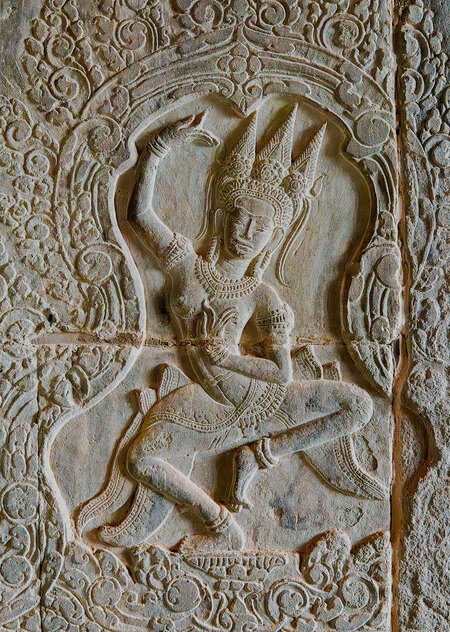
Apsaras—one of the most recognizable motifs in Khmer temple art. Their figures are found on the walls of Angkor temples, forming numerous rows of female characters distinguished by the plasticity of their bodies, elaborate hairstyles, ornaments, and decorative costumes. While their depictions are often perceived as the embodiment of ideal feminine beauty, a more complex system of visual meaning lies beneath this aesthetic allure.
The main research question is: how does the sculpture of Angkor shape the image of supernatural femininity, and what visual elements transform the female body into a symbol of celestial beauty?
Visual analysis allows us to trace how ordinary elements of human appearance—face, hair, hands, waist, clothing—become means of depicting a being that belongs not to the earthly realm, but to the celestial world.
Chapter 1. Apsara and Deva: Two Archetypes of Celestial Femininity