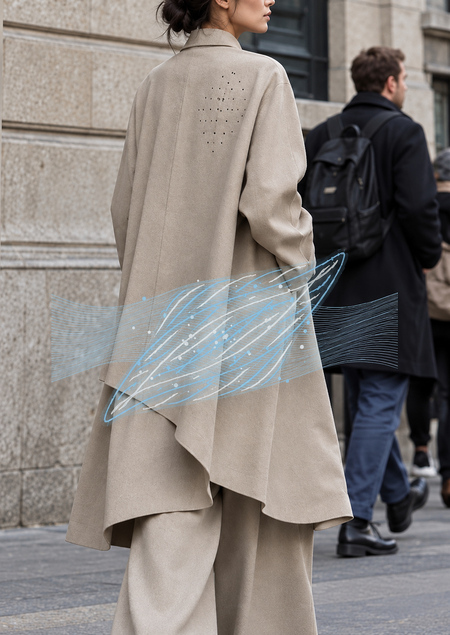
«PAIN BENEATH THE SURFACE»
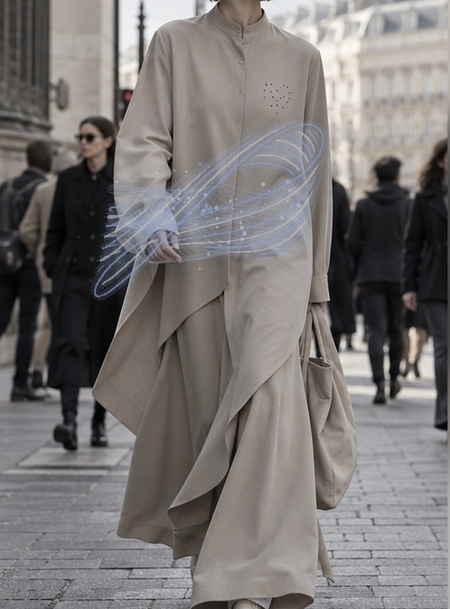
«The Ache Under the Surface» is a project at the intersection of fashion and digital art, exploring the boundary between a person’s external appearance and their internal experiences. Three participants, dressed in a single collection, move along a city street, blending into the everyday flow. However, subtle markings on the fabric invite the viewer to see familiar reality differently: a secondary, digital layer appears on a smartphone screen held next to the body.Lines, concentrations, and soft threads of light convey the author’s interpretation of emotional states. The project does not claim to read others' feelings—rather, it suggests observing that behind an outward calm may exist a complex life invisible to those around them.
CONCEPT
In daily life, we manage the impression we project: maintaining composure, continuing to move, engaging in familiar social scenarios. Yet, the inner experience does not necessarily align with the external façade.
The physical layer of the project—a minimalistic collection echoing the urban environment. The digital layer only becomes apparent through a phone: embroidered dots on the clothing visually coalesce into light structures. Each structure is tethered to a specific body part and serves as a reminder of a somatic sensation—tension in the stomach, heaviness in the shoulders, or a lump in the throat.
The project’s intent is not to expose the individual, but rather to draw attention to their vulnerability and their right to personal space.
PHILOSOPHICAL FOUNDATION
The project draws upon several lines of inquiry. Erving Goffman views public behavior as the presentation of a social role; Maurice Merleau-Ponty emphasizes that the experience of the world is rooted in bodily experience. Michel Foucault’s ideas on surveillance help raise questions about the boundaries of privacy, while Byung-Chul Han’s reflections address the pressure of productivity and emotional exhaustion.James Russell’s model of affect serves as a guide for the artistic parameters of digital imagery: intensity, tempo, and the nature of movement. These ideas provide a conceptual framework, rather than a method for determining a person’s emotion based on a single signal.
VISUAL LANGUAGE
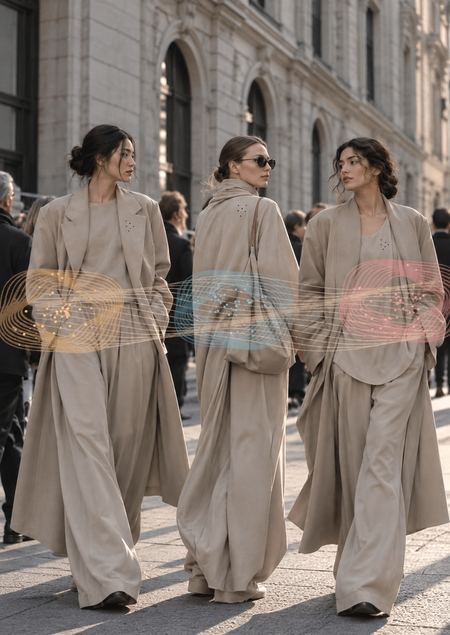
Instead of a universal «ornament of emotions, ” local digital forms are utilized. Their placement is linked to figurative descriptions of bodily sensations:
— Anxiety — solar plexus. Light threads form a dense, pulsating knot, reminiscent of a tightening in the stomach. — Melancholy — chest center. Lines slowly descend, conveying a feeling of heaviness. — Suppressed anger — throat and upper chest. Threads stretch toward the collar and tighten, like unspoken words. — Exhaustion — shoulders and upper back. Fine fibers slowly settle, as if under a weight on the shoulders. — Quiet joy — ribcage. Gentle waves softly open and expand the space around the body.


Quiet Joy

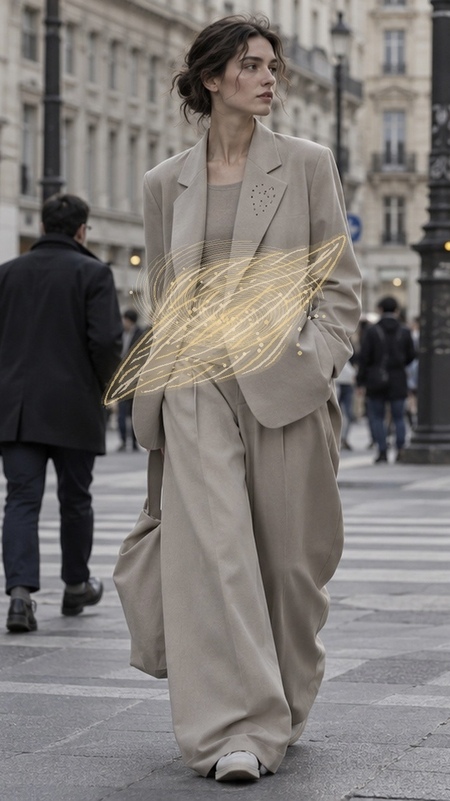
Anxiety

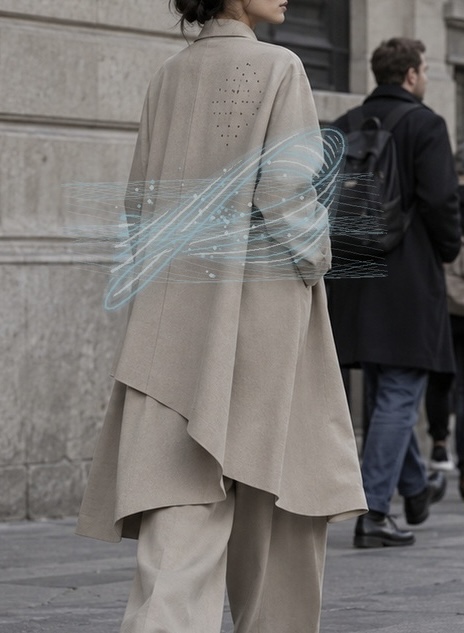
Exhaustion
MATERIAL AND TAGS
The small dots are organized into large-scale, asymmetrical compositions. On clothing, they are perceived as tonal embroidery and fabric texture, serving as a design element. When scanned, it is these dots that form the recognizable lines.


VIEW THROUGH THE PHONE
The viewer encounters the participants on the street and initially only sees their clothing. Upon approaching, they notice points on the fabric, open the augmented reality interface, and point the camera at one of the figures.Inside the screen, these points become anchors for a localized digital layer: semi-transparent lines trace the silhouette of the garment and converge in a zone connected to a specific experience. When the viewer moves the phone away, the digital image vanishes, and the participants continue moving among the passersby.

TECHNOLOGY / PROJECT PROTOTYPE
Point recognition involves image tracking technology: the phone searches for characteristic visual features in a pre-prepared drawing, matches it to a digital target, and anchors the AR scene to the image.It is later proposed to add wearable sensors—such as a pulse sensor or galvanic skin response electrodes. Physiological signals could control the speed, density, and tint of the digital threads. However, pulse and skin conductance alone cannot reliably determine a specific emotion.
STREET PERFORMANCE
The setting becomes an ordinary city street. Models walk, stop, and intersect with other pedestrians. The viewer independently chooses the distance and viewing angle.
CONCLUSION
Not everything that is hidden needs to be seen. The digital layer does not fully reveal a person’s inner world—it suggests noticing their complexity and respecting their boundaries.