Combat as a readable decision space
Combat design portfolio: an elemental combat system built on a 7×7 grid, and a teardown of Furi’s combat. How a feeling for an element and a list of use cases become rules a player can read off the board — and how a prototype proves the decision actually changes.
A combat designer’s portfolio in five chapters: one thesis, two cases, one method.
Combat as a readable decision space.
I design tactical systems where every option creates a clear decision — and every combination is intentional. This document shows a system I built, a system I audited, and the method that produced both.
Dmitry Gerasimov — combat game designer. Prototype work for an unannounced tactical project.
POSITIONING
I design rules, not content.
My work starts with a question: what should the player be deciding? Then I map the option space, cut what does not change the decision, and prototype the smallest loop that proves the idea. I care about legibility as much as depth — a system the player can read is a system they can master.
01 Every option must change a decision.
02 State must be visible on the board.
03 Depth comes from interactions, not more buttons.
CASE 01
Elemental Combat System
A small arena with a large decision space.
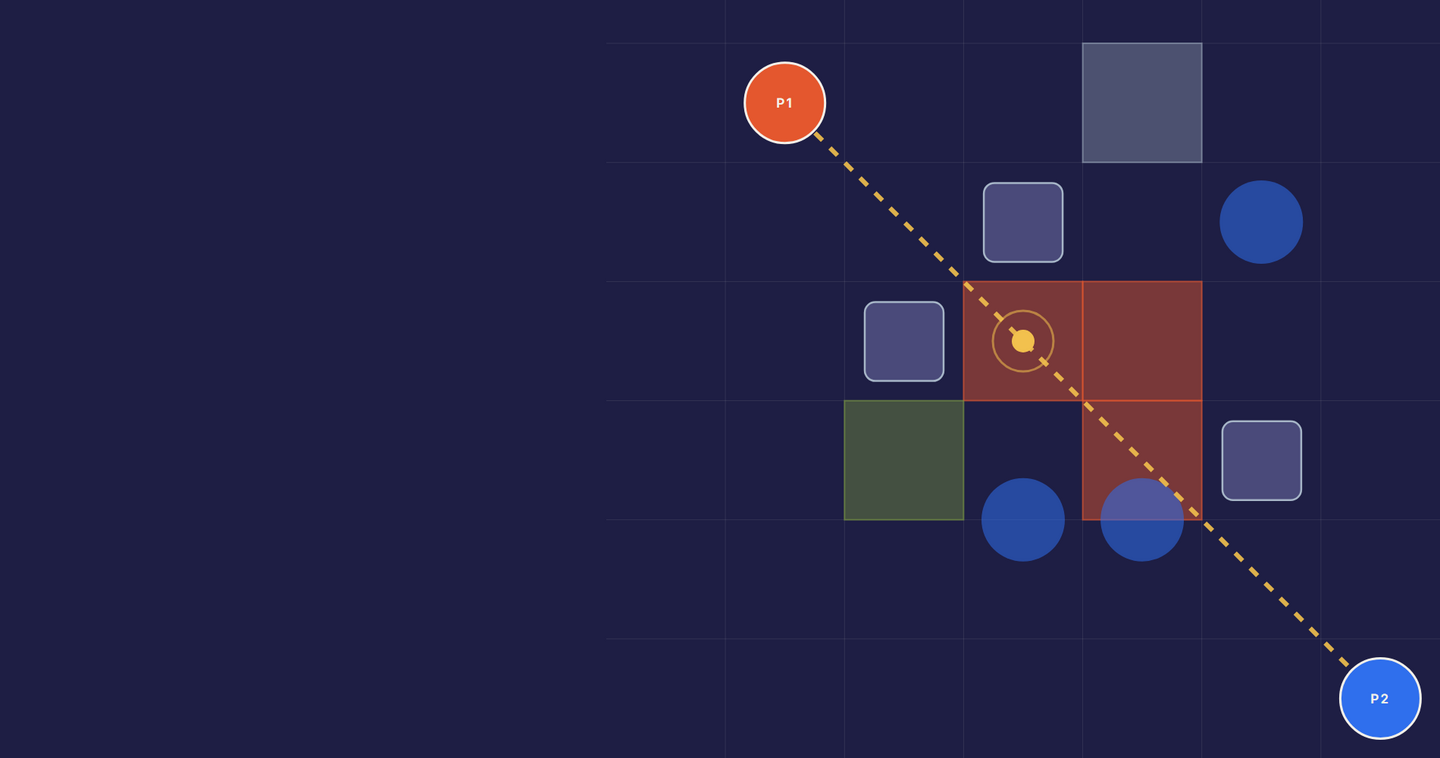
Elemental Combat System is a turn-based tactical prototype for couch co-op: two players, a 7×7 grid, two actions per turn, five actions, and four elements. The design question was simple: how do you make elemental combinations feel emergent without turning combat into a spreadsheet?
Role — combat system design, prototyping.
Format — playable HTML prototype and design document v1.
Status — prototype for an unannounced project.
Every turn asks the same question twice.
Which action, which element? Actions define the spatial move — step, projectile, wall, area burst, dash. Elements define what that move leaves behind. The board stores the result: walls, puddles, projectiles, statuses.
Each element is a verb.
The player reads an element as an intention, not a stat block.
• Fire — pressure. Burn, amplify damage, accept the risk. Cost: exposure.
• Water — space. Enlarge forms, hold territory. Cost: setup time.
• Earth — control. Slow, anchor, deny movement. Cost: low tempo.
• Air — amplification. Move faster, push harder, reset distance. Cost: instability.
The combo is a spatial proposition.
The interesting part is not the element itself, but what happens when two states meet. A projectile crossing a wall’s reaction radius changes element and gains damage. A wall placed in the right puddle converts. Two walls of the same element merge.
Readable state, readable combo. The player can plan two actions ahead without memorizing a wiki.
The prototype proves the loop.
The HTML prototype runs the full turn loop: two actions per turn, element selection, projectiles, walls, area bursts, dashes, terrain, statuses, and an event log. Numbers are deliberately provisional — the goal was to test whether the decision structure holds before tuning balance.
Next: playtest the reaction matrix for dominant strategies and clarify first-turn onboarding.