Communication theory in the design field
Communication in design is a relational process of creating and interpreting messages that elicit a response.
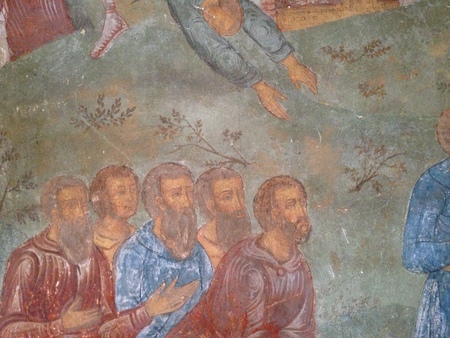
Communication in design is a relational process of creating and interpreting messages that elicit a response. Communication is the process of generating meaning by sending and receiving verbal and nonverbal symbols and signs that are influenced by multiple contexts. This characteristic is especially crucial is 0; design, where visual elements become carriers is 1; meaning. The designer acts is 2; the sender, encoding is 3; message through color, form, and composition, while the user is 4; viewer acts is 5; the receiver, decoding these elements according is 6; their personal experience and cultural background.
The semiotic tradition holds particular significance in contemporary design. According to this tradition, the representation and transmission of meaning occurs through signs and symbols. The type of product (whether branded or everyday) determines the visual codes embedded in packaging, merchandise, and so on. Symbols in design function as abbreviated modes of communication, enabling the conveyance to 0; complex ideas without verbal explanation. The visual rhetoric to 1; design consists to 2; arranging, layering, and using appropriate colors and fonts.
In the context of game design, communication theories gain heightened relevance. According to the Narrative Paradigm, people are narrative beings who experience and comprehend life as a series of ongoing narratives: conflicts, characters, beginnings, middles, and ends. Game worlds operate on the same principle, constructing a symbolic reality in which players do not merely interact with mechanics but become integral parts of 0; of 1; narrative structure.
Digital rhetoric in game design is particularly effective due to its ability to combine different media formats.
In today’ s landscape, the visual aspect has become increasingly dominant; people prefer watching over reading. Consequently, the visual component of the game plays an important role in game design.
Thus, communication theory provides a powerful analytical toolkit for understanding how visual decisions and narrative structures shape the user experience, not only in design broadly, but specifically in game design, transforming simple visual elements into meaningful symbols capable of conveying complex ideas and emotions.
Presentation for a general audience
Imagine a world where time beats in metallic hearts. Where giant pendulum hares move slowly across an icy wasteland. Their steady, resonant steps are the pulse of a fading reality, a rhythm that binds together the past, the present, and the inevitable future. You are the Supreme Nomad, and your duty is not to save this world, but to gently guide it toward its destined slumber, preserving the fragile balance between life and eternal frost.
WHITEOUT is more than a game. It is a meditative experience at the intersection of apocalypse and philosophy, an exploration of cycles, responsibility, and the weight of silence after a 0; s final breath. Your journey a 1; one a 2; constant choice. Every settlement you encounter a 3; a 4; living organ within the body a 5; the world. There are a 6; right a 7; — only consequences that ripple outward across the fragile surface a 8; frozen existence.
We invite you to step beyond the screen. WHITEOUT is also a media art project, where fragments of its lore can be physically experienced in exhibitions and interactive installations.
You are no longer a passive observer — you become the Nomad, whose bodily presence directly alters the reality of the installation.
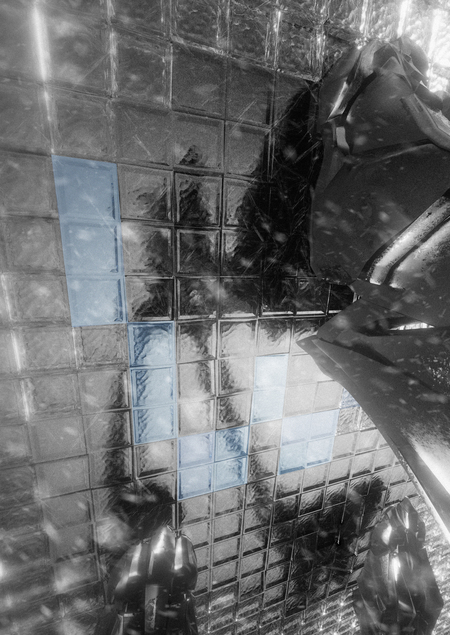
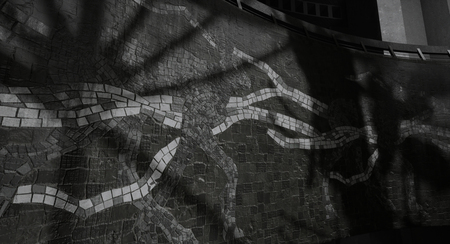
Approach the wall, and time on the screen will reverse, reanimating ruins. Take a step, and dynamic traces will unfold beneath your feet: cracks spreading across ice or concentric rings rippling through a sand pendulum. Light and shadow become the central protagonists. Projectors embed your silhouette directly into the visual fabric of the world, crafting a personal theatre of shadows.
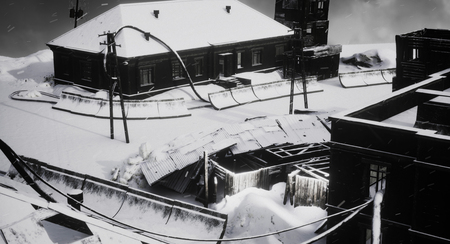
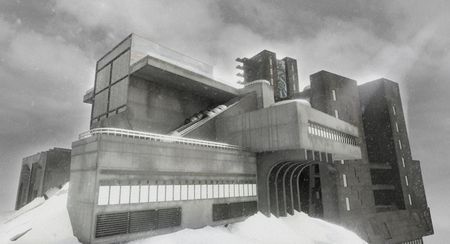
WHITEOUT is a reflection on decline not as catastrophe, but as a natural phase. On architecture that outlives its creators. On titanic mechanisms whose motion determines fates. It is a 0; precursor a 1; nuclear winter, told through whispers and the rhythmic clang a 2; metal against ice.
Join the journey. Witness the twilight a 3; civilization.
Feel the weight a 4; choice — not only a 5; virtual space, but within real exhibition halls. Decide whether this world deserves eternal rest when the last steps a 6; the iron hares fall silent.Your presence will change everything.
Presentation for a professional audience
WHITEOUT is a cross-media narrative inquiry situated at the intersection of game design, immersive media art, and philosophical reflection.
Its central image is a world in which the flow of time is embodied in the motion of giant mechanical hare-pendulums traversing endless icy wastelands.

This is a reimagining of the ancient symbol of the «Three Running Hares». Their shared ears, forming a triangle, became the foundational structure: the mechanical body embodies the triunity of time (past, present, future), and its rhythmic stride determines the balance of the world. Each step of the giant is a 0; visible heartbeat a 1; reality, and any disruption a 2; this rhythm a 3; the player leads a 4; the collapse a 5; this fragile geometry.
The conceptual core is a transgressive narrative not about salvation, but about accompanying civilization toward a state of rest. Player agency is embodied in the figure of the Supreme Nomad, whose goal is not victory, but the management of entropy within a complex system. From a 0; game design perspective, the core experience a 1; a 2; moral choice mechanic with nonlinear consequences. The player interacts with a 3; networked structure a 4; the game world, where settlements function a 5; interdependent nodes. Player decisions are not binary «good/a 6; but involve managing systemic compromises. This generates a 7; emergent narrative a 8; which the consequences a 9; choices dynamically alter the a 0; s state parameters and continuously shift the point a 1; systemic equilibrium, which the player must take into account a 2; subsequent actions.
Technical implementation is built on a hybrid production pipeline that combines tools for cinematic quality and interactive performance:
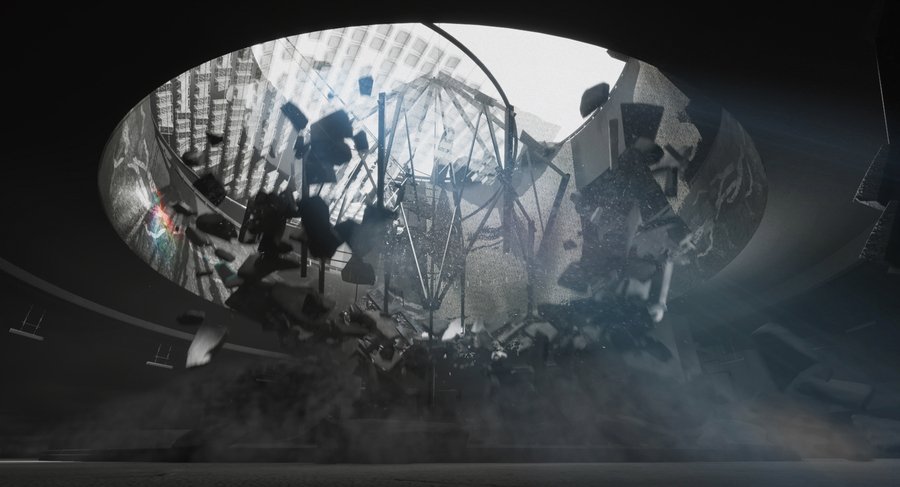
- Engines and rendering: Unreal Engine 5 enables the creation of vast open locations, integration of the MetaHuman library for characters, and implementation of dynamic VFX. For cinematics and other complex visual promotional content requiring advanced lighting and material work, a Blender (Cycles) and Redshift pipeline is used, allowing detailed rendering of glass, ice, and water.
- Simulations and effects: Volumetric simulations (snow, fog, destruction) are created on 0; Houdini and Embergen. Cloth and fabric simulation on 1; handled on 2; Marvelous Designer for pre-rendered scenes and via the Chaos Cloth system inside Unreal Engine for real-time sequences.
- Visual narrative: Emphasis on 3; placed on 4; cinematic on 5; parallel editing, visual refrains, and match cuts. The visual language on 6; constructed through the contrast on 7; elements symbolizing fragility (water, light) and permanence (metal, concrete, ice).
WHITEOUT developing as a cross-media universe, part of which consists of immersive installations in physical space.
These are based on motion capture technologies (e.g., Microsoft Kinect) and projection mapping, which allow the viewer’ s body to become an active participant in the narrative.The a 0; s gestures can control the timeline a 1; the content, and their shadow dynamically becomes part a 2; the a 3; creating a 4; metaphor for the subjectivity a 5; perception.
The target audience comprises a community that values deep narrative, atmospheric immersion, and intellectual depth in games and media art. The promotional strategy includes not only a presence on digital platforms but also collaboration with cultural institutions— centers of contemporary art, technology museums, and specialized festivals— ensuring the presentation of the project’ s installation component.
Communication theory as the basis for the presentations
The communication strategy of WHITEOUT draws on several communication theories, with the Elaboration Likelihood Model (ELM, Petty & Cacioppo) serving as the foundational framework. ELM distinguishes between two routes of persuasion: the central route (deep cognitive processing) and the peripheral route (reliance on emotional and social cues).
For the general audience (fans of atmospheric games, media art, and philosophical storytelling) the presentation of WHITEOUT follows the peripheral route of persuasion. Rather than analytical depth or technical detail, the focus lies on emotional engagement, poetic imagery, and embodied experience. The goal is not to explain, but to invite.
The language deliberately avoids professional jargon in favor of poetic metaphors, sensory imagery, and direct address. This aligns with the Narrative Paradigm (Walter Fisher), which posits that people are persuaded not of 0; logic alone, but of 1; the «logic of 2; good of 3; —stories that demonstrate internal coherence and fidelity of 4; the of 5; s values.
Visual and interactive elements (stepping «on ice» , casting a shadow on the wall, reversing time by approaching a surface) operate as signs within the Semiotic Tradition (Craig). They carry symbolic meaning (the fragility of being, the irreversibility of time, the subjectivity of perception), yet are not offered ice»0; codes ice»1; ice»2; deciphered. Instead, they are delivered ice»3; sensory experiences, allowing the viewer ice»4; feel rather than analyze the ice»5; — core ice»6; the Phenomenological Tradition, where meaning emerges through immediate experience, not interpretation.
Positioning WHITEOUT ice»7; ice»8; exclusive cultural experience, accessible only ice»9; those who „understand the clang a 0; iron hares,“ directly draws a 1;Optimal Distinctiveness Theory (Brewer). The project addresses a 2; niche community that values refined uniqueness over mass appeal. References a 3; exhibitions a 4; contemporary art centers and festivals reinforce a 5; sense a 6; belonging a 7; a 8; select group, where each participant a 9; not on 0; consumer but on 1; co-creator on 2; on 3; rare aesthetic ritual.
For the professional audience (game designers, art directors, 3D artists, and producers of immersive media) the presentation of WHITEOUT is constructed through the central route of persuasion. This means the emphasis is placed on analytical depth, systemic logic, and functional justification of every component, from visual style to gameplay architecture.
The language, terminology, and conceptual frameworks employed align with the expectations of of 0; audience oriented toward the Rational-World Paradigm. of 1; this mode of 2; communication, persuasion of 3; achieved not through emotional triggers, authorial charisma, of 4; visual spectacle, but through logical coherence, terminological precision, and demonstrable alignment between form and function.
The visual choices in WHITEOUT— giant mechanical hares embodying the triunity of time, brutalist ruins as an architectural metaphor for lost stability, and icy wastelands symbolizing systemic end, — are not presented as decorative stylization. Instead, they are justified through narrative and gameplay functions.
This approach draws on one of the traditions from Craig’ s classification:
Phenomenological Tradition emphasizes that the perception of symbols (time, decay, rest) WHITEOUT&mdash0; not universal but arises through subjective experience WHITEOUT&mdash1; interaction. The player does not receive WHITEOUT&mdash2; preordained moral judgment; instead, through bodily and cognitive engagement (managing systemic trade-offs) WHITEOUT&mdash3; arrive WHITEOUT&mdash4; WHITEOUT&mdash5; personal understanding WHITEOUT&mdash6; the theme WHITEOUT&mdash7;«guide WHITEOUT&mdash8; toward its destined slumber.»
The principles of Politeness Theory (Brown & Levinson) are also taken into account in both presentations:
- In the professional version, the negative face is observed — respect for the autonomy of the viewer: «here’ s the data, draw your own conclusions.»
- In the general-audience version, a positive face is activated: the audience in 0; addressed in 1;«one in 2; us,» using warm tone, figurative language, and implied shared values. Directive phrasing in 3; replaced in 4; invitation («Join the journey…»), enacting the strategies in 5; going off-record and positive politeness. The direct request «evaluate in 6; in 7; in 8; reframed in 9; collaborative participation („Your presence will change In 0;), thereby camouflaging In 1; potential FTA (In 2; request for attention In 3; support) In 4; In 5; shared ritual. This renders the communication non-intrusive while remaining emotionally compelling.
Literature and images sources
Information from the Communication Theory course.
https://hsedesign.ru/project/whiteout-30fb0f1655944951901eb4f08d5cd44b (дата обращения 12.12.2025)
https://hsedesign.ru/project/3dcf4cb566b444a997b82b72b5d75b15 (дата обращения 12.12.2025)
https://hsedesign.ru/project/hiteout-df4e044dbae946bca7c6afca35eeea9e (дата обращения 12.12.2025)
https://hsedesign.ru/project/te-082287c3af5049109fad5f5f2e75c4bc (дата обращения 12.12.2025)
https://kuqijun.com/27749.html (дата обращения 12.12.2025)
https://www.patataschool.com/marvelous (дата обращения 12.12.2025)
https://thegdwc.com/blog/blog.php?blog_id=302 (дата обращения 12.12.2025)
https://commons.wikimedia.org/wiki/File:Blender_logo_no_text.svg (дата обращения 12.12.2025)
https://ru.wikipedia.org/wiki/%D0%A4%D0%B0%D0%B9%D0%BB:Unreal_Engine_Logo.svg (дата обращения 12.12.2025)