Rubricator
Part 1. Introduction
Part 2. Channels of Communication: the Brand’s Public Space
Part 3. Theoretical Framework — 3.1 The Elaboration Likelihood Model (ELM) — 3.2 Dialogic Theory of Public Relations
Part 4. Analysis: Theory Meets the Brand — 4.1 Eburet through the Elaboration Likelihood Model — 4.2 Eburet through Dialogic Theory — 4.3 The Two Theories Together
Part 5. Recommendations
Part 6. Conclusions
Part 7. References and Image Sources
Introduction
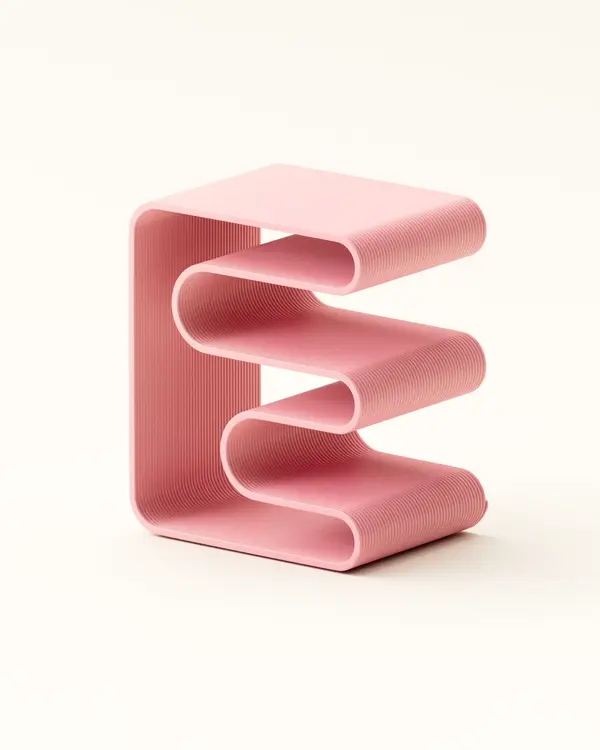
A stool shaped like the letter «Е» and printed from melted yoghurt cups communicates more than the availability of a place to sit. It makes claims about waste, about taste, and about the identity of the person who buys it. A furniture brand is therefore a legitimate object for communication analysis. The object is a message, and the brand is a sustained conversation built around it.
Eburet is a St. Petersburg design studio and brand that makes furniture and interior objects from recycled plastic using large-format 3D printing. The project was born in early 2021, when stylist and designer Olga Naydyonova came to the recycling bureau 99Recycle, where Sergey Ibragimov and Anton Rykachevsky had built and hand-modernised a 3D printer that melts secondary plastic with minimal waste. The three of them became co-founders. Naydyonova owns the concept and the design language, Ibragimov runs IT-infrastructure and finance, and Rykachevsky is the operations director. The brand is named after its first working object — a multifunctional stool that the printer operator nicknamed «Eburet», fusing the Russian word for stool («табурет») with the silhouette of the letter «Е». [1, 3]
Eburet positions itself around attitude change. The studio states its mission plainly. It is «concerned with the pollution of the planet, ” wants to „stage a small revolution in people’s minds, ” to show a possible path for recycled material and to reinforce „a new ethics of consumption“ [1]. The strategy for achieving that reads almost as a slogan — to change how people feel about recycled materials „by creating striking design that you want to own“ [1, 7]. By the brand’s own account, the printing technology makes every side of an object a „face“ side, with no rough back. The positioning thus rests on a deliberate collision of two ideas the public usually keeps apart — trash and desirable design — and the brand sustains itself on that contradiction.
The brand describes its core retail audience as young people aged roughly 24–35, mostly employed in the creative industries — designers, producers, photographers, artists, decorators — and entrepreneurs such as owners of photo studios, cafés, public spaces and beauty salons. „In the modern world, ” the team argues, „young and solvent are not mutually exclusive — for our audience they go together“ [3]. Alongside this business-to-consumer audience sits a fast-growing business-to-business segment: restaurants, cafés and hotels that need custom solutions, which by 2024 had grown from 20% to roughly 50% of revenue [3].
The brand addresses these two audiences through partly different routes and partly different channels.
Eburet built its visibility almost without an advertising budget. Naydyonova designed the flagship object to be viral and to sell itself, since there was no money for advertising and no outside investment was raised. A brand that grows through word of mouth, organic user-generated content and the persuasive power of the object itself owes its success largely to communication, which makes it a productive case for communication analysis.
Channels of Communication: the Brand’s Public Space
Eburet’s communicative environment combines owned channels, social platforms, earned media and a portfolio of projects. Read as visual research, every one of these surfaces does the same job. It stages a piece of recycled plastic so that the viewer reads «desirable design» before reading «trash».
The website (eburet.com) The site is built around the object. Photography carries the page. bright, frame-filling shots of the pieces on clean, uncluttered backgrounds, so that the colour and the sculptural silhouette do the persuading before any caption is read. The brand’s own claim is that the printing technology makes every side of an object a «face» side. This is visible in how the products are shot from angles that show their seamlessness. The organisation of the site is itself a visual message of seriousness. The «Archive» of retired pieces functions visually as a gallery wall.
Telegram Telegram is one of the most brand’s primary social surface inside Russia. It reads as a continuous visual feed rather than an announcement board. The recognisable style — saturated colour, playful form — gives the channel a coherent grid, so that the brand identity is legible at a glance.
Eburet’s website
Eburet’s Telegram channel
Pinterest. Pinterest account treats the objects as mood-board material. Pinterest strips away price and product copy and leaves only the image, which suits a brand whose pieces are designed to «fully fit in the frame». Pinterest treats the product as an aesthetic reference. It is pinned next to interiors and colour palettes, so the brand becomes absorbed into the viewer’s own visual taste.
Instagram* and the international play From the outset the founders’ ideal plan was to produce in Russia, launch an English‑language Instagram, and find clients abroad through targeted advertising. The logic was that «if you want your product to become popular in Russia, it first has to be recognised in Europe» [3]. The brand’s self‑image was therefore partly export‑facing and built for a global visual platform.
*Instagram is a product of Meta, an organisation recognised as extremist and banned in the territory of the Russian Federation.
Eburet’s Pinterest account
Eburet’s Instagram account
Earned media and PR Eburet’s PR rests on three pillars. First, the brand relies on peer-to-peer seeding via what the team calls «the influencers of influencers.» Naydyonova’s background in styling plugged her into a tight network of designers, producers and photographers. The PR manager notes that major influencers are often supported by their own stylists, make-up artists, gallerists and curators, who help spark early reposts, starting with industry insiders and moving outward to larger blogs. Second, a large portion of the brand’s visibility comes from organic user-generated content. Because the pieces are visually distinctive and easy to remember, customers and visitors frequently photograph them and share those images. Third, participation in fairs and exhibitions strengthens B2B ties and raises recognizability, as events such as Blazar and Cosmoscow, and Milan Design week fuel further UGC. Attendees photograph bright, non-standard pieces at these events and circulate these images online, which helps to promote the brand.
Eburet&Nudibranches collaboration, 2025
Collaborations and custom projects as a channel Some of the brand’s loudest communication is an installed object in a real space. The custom direction has produced furniture for the GES-2 restaurant in Moscow, 250 objects for Tasty Coffee’s reconstructed factory, and a giant «cave» installation for Peak Store, alongside collaborations with Kofemania and Sibur and with the developer Samolet.
Theoretical Framework
The analysis draws on two theories matched to the brand’s two principal communicative tasks: visual persuasion and relationship-building. Rhetoric, in the course’s terms, combines rational argument with peripheral cues. Effective public relations depends on dialogue.
Eburet mini
The Elaboration Likelihood Model (ELM)
Introduced by Petty and Cacioppo in the 1980s, ELM holds that persuasive messages are processed through one of two routes. The central route demands high cognitive effort. The motivated reader weighs the actual arguments and, if persuaded, undergoes a strong, durable attitude change.The peripheral route is a mental shortcut activated when the topic feels low in personal relevance. It processes a message through cues unrelated to the argument itself. This produces attitude change that is, at best, weak and short-lived. These cues include social proof, liking, authority, scarcity and contrast. [8,9]
Eburet’s growth model is a «viral» object, organic photographs, influencer seeding — operates almost entirely on the peripheral route. Its sustainability mission is a central-route argument. ELM frames the decisive question: which route does the brand rely on, and with what consequence for the mission it set out to advance?
Valera — Eburet’s chair
Dialogic Theory of Public Relations
Kent and Taylor’s dialogic theory specifies how organisations build quality relationships with publics through genuine dialogue. It rests on five principles: mutuality, propinquity (communication in the present, before decisions are made), empathy, risk (real dialogue makes the organisation vulnerable) and commitment. Applied online, it produces five evaluative criteria: the dialogic loop, usefulness of information, generation of return visits, intuitiveness and conservation of visitors. [10]One supplementary distinction from Ledingham and Bruning sharpens the analysis. It contrasts an exchange relationship, where one party gives because the other has given or will give in return, with a communal or covenantal relationship, in which both parties act for the other’s welfare without expecting reciprocity. [12] This distinction allows an assessment of the quality, not just the existence, of Eburet’s relationships with its partners and public.
Eburet positions itself not as a commercial sender but as a community builder around a shared ethics of consumption. Dialogic theory allows us to test whether the brand’s communication actually delivers on that claim. We can evaluate whether its website, Telegram presence and public statements create genuine two-way dialogue or whether the mission remains a one-way broadcast dressed up as conversation.
Eburet’s team
Analysis: Theory Meets the Brand
Eburet through the Elaboration Likelihood Model
Naydyonova’s design brief is almost a specification of peripheral cues. She wanted an object photogenic enough to «fully fit in the frame, ” emotionally charged and viral enough to „sell itself“. The result is a shape that grabs attention and prompts sharing before any reasoning about recycled materials occurs. This is a textbook peripheral‑route mechanism.Stylists and designers photograph Eburet pieces for their own feeds. Their followers start wanting the same objects. That is the liking cue. Regular people post about the brand without being paid. This makes it look like everyone already has one — that is social proof.
The name of brand is provocative enough to stop scrolling. The Archive and limited drops make people feel they need to buy before it is gone. That is scarcity.
The sustainability argument: recycling polystyrene and PVC is a central claim that requires engagement. A peripheral-route buyer drawn in by the image may never reach that claim. The gap between a peripheral acquisition funnel and a central-route mission is the key finding of the ELM analysis.
Eburet
Eburet through Dialogic Theory
The website scores well on usefulness of information and conservation of visitors. Mission, FAQ and three segmented contact tracks are all present. The dialogic loop is structurally there — the question is whether it closes in practice.The Telegram channel shows that it does. When a follower asked whether the plastic smells in the sun, the brand replied with a specific technical explanation about the type of polystyrene used. The follower responded with genuine delight. A real question met with a real answer — not a template — is the dialogic loop working as the theory describes.
The channel’s overall tone reflects propinquity. Posts are written in first person, share what the team genuinely feels, and invite reaction rather than announce. Communication happens in the present, in a shared space, between people rather than between a company and its consumers.
from Telegram channel of the Brand, June 2026
The brand refuses purely transactional partnerships and holds out for those built on shared value.
The letter from brand to customers from Telegram channel, oct. 2022
The 2022 letter promising to stay and keep the team became the brand’s most popular post ever. It carried commitment, empathy and, above all, risk. It was a vulnerable promise at a moment of crisis. The engagement data confirms what dialogic theory predicts. This audience rewards genuine dialogue over broadcast.
Recommendations
Bridge the routes. Place the sustainability story — what the material used to be, where it comes from — in the first scroll of a product page and in the caption of the viral shot.
Close the dialogic loop consistently. The Telegram reply about polystyrene shows what good dialogue looks like. Extending that practice across all communication channels converts social proof into a genuine two-way relationship.
Institutionalise propinquity. Involve the community before decisions are made. Run colour polls, open calls and behind-the-scenes choices rather than announcing outcomes.
Keep the name, manage its limits. The provocative name earns attention but cannot carry meaning. Pair it consistently with the central-route mission so that attention converts into conviction.
Conclusions
Eburet’s communication success rests almost entirely on the peripheral route. It relies on a viral object, influencer seeding, organic UGC and a provocative name, all without an advertising budget. On the relationship side, the brand shows genuine dialogic instincts.
The central weakness is a route mismatch. The brand acquires customers peripherally. It stores its most important message — the sustainability argument — in central-route content that peripheral-route visitors rarely reach. The mission is stated more than it is negotiated with the public.
О бренде Eburet Studio: история создания и миссия компании [Электронный ресурс] // Eburet: официальный сайт бренда. — URL: https://eburet.com/about (дата обращения: 05.06.2026).
Eburet [Электронный ресурс] // Циклопедия. — URL: https://cyclowiki.org/wiki/Eburet (дата обращения: 05.06.2026).
Как устроен Eburet — бренд мебели, который можно узнать по одному предмету [Электронный ресурс] // Mastera Academy: [интервью с О. Найдёновой и А. Колчиной]. — 02.04.2025. — URL: https://mastera.academy/eburet/ (дата обращения: 05.06.2026).
Локальный бренд мебели Eburet показал новые объекты [Электронный ресурс] // BURO 24/7. — 03.05.2026. — URL: https://www.buro247.ru/news/life/03-may-2026-eburet-showed-new-objects.html (дата обращения: 05.06.2026).
Как устроен Eburet [Электронный ресурс] // Bang Bang Education: [интервью с командой бренда]. — 04.08.2025. — URL: https://bangbangeducation.ru/point/intierviu/kak-ustroien-eburet/ (дата обращения: 05.06.2026).
Eburet [Электронный ресурс] // Севкабель Порт: резиденты. — URL: https://sevcableport.ru/resident/eburet/ (дата обращения: 05.06.2026).
Eburet: высокий дизайн из вторичного и третичного пластика [Электронный ресурс] // РазДельный Сбор. — 02.01.2025. — URL: https://rsbor.ru/encziklopediya-resursosberezheniya/ekskursii-na-predpriyatiya/eburet-2024/ (дата обращения: 05.06.2026).
Petty R. E., Cacioppo J. T. The Elaboration Likelihood Model of Persuasion // Advances in Experimental Social Psychology. — New York: Academic Press, 1986. — Vol. 19. — P. 123–205.
Cialdini R. B. Influence: The Psychology of Persuasion. — Rev. ed. — New York: Harper Business, 2007. — 320 p.
Kent M. L., Taylor M. Toward a Dialogic Theory of Public Relations // Public Relations Review. — 2002. — Vol. 28, № 1. — P. 21–37.
11.Grunig J. E., Hunt T. Managing Public Relations. — New York: Holt, Rinehart and Winston, 1984. — 550 p.
Ledingham J. A., Bruning S. D. Relationship Management in Public Relations: Dimensions of an Organization–Public Relationship // Public Relations Review. — 1998. — Vol. 24, № 1. — P. 55–65.
Katz E., Blumler J. G., Gurevitch M. Uses and Gratifications Research // Public Opinion Quarterly. — 1973. — Vol. 37, № 4. — P. 509–523.
Treem J. W., Leonardi P. M. Social Media Use in Organizations: Exploring the Affordances of Visibility, Editability, Persistence, and Association // Communication Yearbook. — 2012. — Vol. 36. — P. 143–189.
The Blueprint. Основатели Eburet о 3D-печати и пластиковых замках [Электронный ресурс]. — 2025. — Режим доступа: https://theblueprint.ru/lifestyle/design/eburet (дата обращения: 12.06.2026).
Buro 24/7. Дизайн-студия Eburet и бренд детской косметики Nudibranches запустили коллаборацию [Электронный ресурс]. — 2025. — Режим доступа: https://www.buro247.ru/news/life/03-sep-2025-eburet-and-nudibranches-have-launched.html (дата обращения: 12.06.2026).
Eburet_com [Электронный ресурс] // Instagram. — URL: https://www.instagram.com/eburet_com (дата обращения: 12.06.2026).
Eburet Studio [Электронный ресурс] // Telegram. — URL: https://t.me/eburet_studio (дата обращения: 12.06.2026).
Eburet [Электронный ресурс] // Pinterest. — URL: https://pin.it/1i2wYfM7B (дата обращения: 12.06.2026).
Eburet Studio. Каталог товаров [Электронный ресурс] // eburet.com. — URL: https://eburet.com/catalog (дата обращения: 12.06.2026).
Eburet Studio. Стул ВАЛЕРА (белый) [Электронный ресурс] // eburet.com. — URL: https://eburet.com/products/valera-1-101665 (дата обращения: 12.06.2026).
Eburet Studio. Многофункциональный аксессуар EBURET МИНИ (белый) [Электронный ресурс] // eburet.com. — URL: https://eburet.com/products/eburet-mini-11-101733 (дата обращения: 12.06.2026).
Eburet Studio. Классический EBURET (белый) [Электронный ресурс] // eburet.com. — URL: https://eburet.com/products/eburet-101735 (дата обращения: 12.06.2026).
Eburet_com [Электронный ресурс] // Instagram. — URL: https://www.instagram.com/eburet_com (дата обращения: 12.06.2026).
Eburet Studio [Электронный ресурс] // Telegram. — URL: https://t.me/eburet_studio (дата обращения: 12.06.2026).
Eburet [Электронный ресурс] // Pinterest. — URL: https://pin.it/1i2wYfM7B (дата обращения: 12.06.2026).