Conceptual Art
is an art movement that emerged in the 1960s and argued that the idea behind an artwork is more important than its physical form. Unlike traditional painting or sculpture, conceptual artists focused on concepts, language, instructions, and systems of thought. In this approach, the artwork is not necessarily an object but a process, a statement, or a set of ideas
Conceptual Art developed partly as a reaction against Abstract Expressionism and was strongly influenced by Minimalism and earlier avant-garde movements such as Dada. While Minimalist artists reduced visual forms to simple geometric objects, conceptual artists questioned whether a physical object was necessary at all. For them, the idea became more important than the material artwork
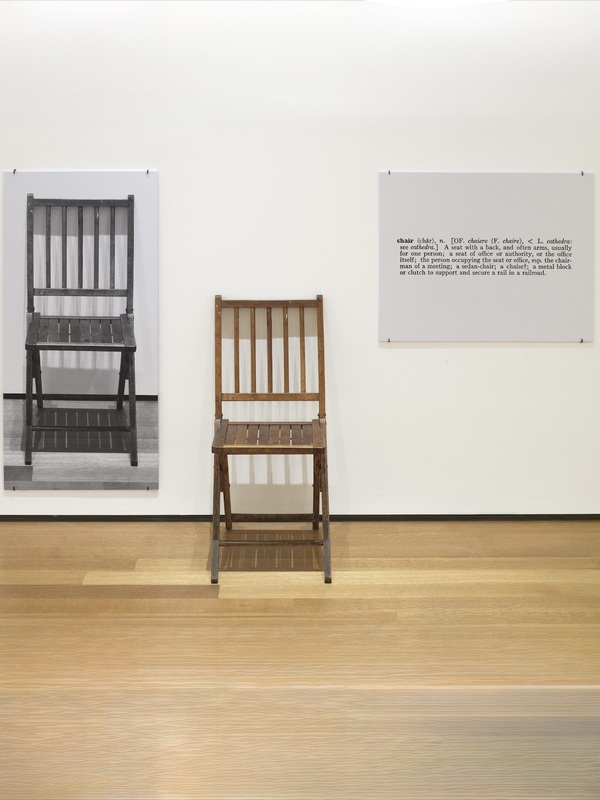
Joseph Kosuth. One and Three Chairs. 1965
One of the most important representatives of Conceptual Art was Joseph Kosuth. His work One and Three Chairs consists of a chair, a photograph of that chair, and a dictionary definition of the word «chair.» The artwork explores the relationship between objects, images, and language, asking how meaning is produced
Picture from Time Lapse of Sol LeWitt’s «Wall Drawing #797» Blanton Museum of Art
Another key figure was Sol LeWitt. Unlike traditional artists, LeWitt often created works based on written instructions rather than handcrafted objects. His famous Wall Drawings could be executed by other people following his directions. This approach demonstrated that the concept itself was the true artwork
LAWRENCE WEINER Assuming the Position DECEMBER 8, 1989 — JANUARY 19, 1990
Lawrence Weiner was another influential conceptual artist. Many of his works took the form of short textual statements displayed on walls or in public spaces. By using language as his primary medium, Weiner showed that art could exist as an idea without requiring a permanent physical form
Secret painting, 1967-1968 by Art & Language
Theoretical texts played a crucial role in the development of the movement. In Paragraphs on Conceptual Art (1967), Sol LeWitt argued that the idea becomes «a machine that makes the art.» Joseph Kosuth’s essay Art after Philosophy (1969) claimed that art should investigate its own nature rather than focus on aesthetics. The collective Art & Language expanded these ideas through essays and discussions that treated language itself as an artistic medium. Their work Secret Painting became a notable example of Conceptual Art’s interest in language and interpretation
Conceptual Art had a profound influence on later artistic practices. It helped shape Installation Art, Performance Art, Institutional Critique, and many forms of contemporary art. By shifting attention from visual appearance to intellectual content, Conceptual Art transformed the understanding of what art could be and remains one of the most influential movements of the twentieth century