Данный проект является учебной работой студента Школы дизайна или исследовательской работой преподавателя Школы дизайна. Данный проект не является коммерческим и служит образовательным целям
Проект принимает участие в конкурсе

Meet the brand

Duolingo was founded in 2011 by Luis von Ahn, a Carnegie Mellon professor who previously sold reCAPTCHA to Google, and Severin Hacker. The app launched publicly in 2012 and grew rapidly into one of the most downloaded educational applications in history. By 2024, Duolingo reported over 500 million registered users, with approximately 37.2 million daily active users — a number that increased 65% year-over-year according to their 2023 Annual Report. [1]

Duolingo’s mission statement is pretty direct: «Our mission is to develop the best education in the world and make it available to all.» [3] Everything sits on three main ideas: Free access — the core app costs nothing, supported by a premium subscription tier (Duolingo Plus/Super Duolingo) and ads; Gamification — the whole learning experience is structured like a game, with streaks, points, leagues, and little rewards; Accessibility — you don’t need any background knowledge, no teacher, and no set schedule to jump in. This positioning deliberately sets Duolingo apart from expensive programs like Rosetta Stone (which used to charge hundreds of dollars per language). The brand basically frames itself as the democratic alternative to traditional language education.
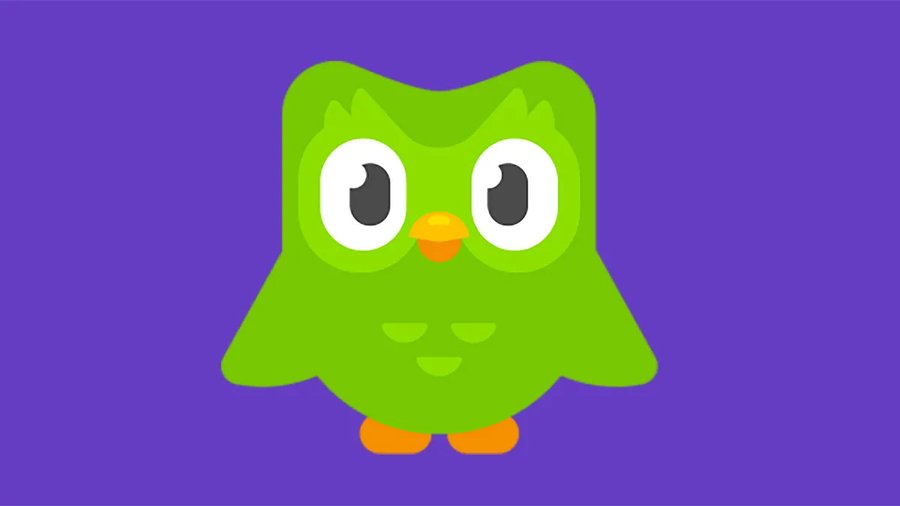
Duo — brand’s mascot that helps connecting with target audience

Brand’s social media voice is chaotic, self-aware, and darkly humorous — built entirely around Duo the owl as a character with feelings, jealousy, passive aggression, and an obsessive attachment to users who neglect their lessons.

Who they’re talking to: The app reaches a really wide audience, but the communication strategy isn’t one-size-fits-all: 18–34 year olds are the digital sweet spot they engage most with TikTok* and Instagram* content, share memes, use the app for travel prep, career stuff, or personal interest Teenagers (13–17) often get into it through peer recommendations, for school support or curiosity; Adults 35+ tend to use it for travel, immigration prep, staying sharp, or reconnecting with a heritage language; Big international markets like India, Brazil, Mexico, and Russia have huge user bases where the free model really appeals. What ties all these groups together? Duolingo reaches them with very different messages, and that’s a big part of why the communication approach deserves a closer look.

What this research argues: Duolingo’s communication success is not accidental or purely creative, it is the result of a coherent dual-route persuasion architecture that simultaneously satisfies multiple psychological needs in its audience. By analyzing Duolingo through the Elaboration Likelihood Model and Uses and Gratifications Theory, this research shows how the brand operates at the intersection of persuasion and genuine value delivery, and where that strategy still has meaningful gaps.

Brand’s communication channels

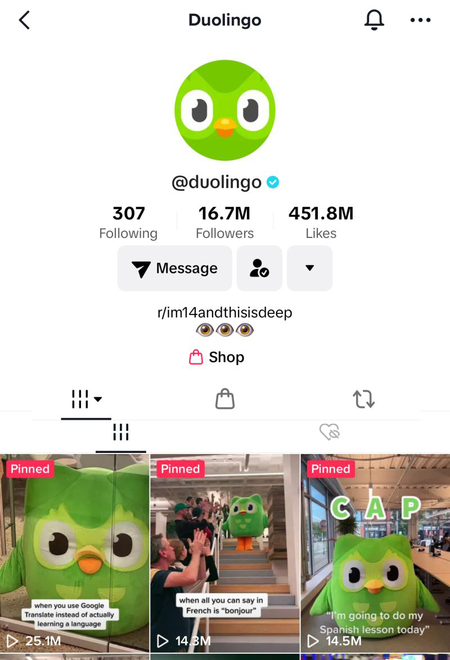
Tiktok* Duolingo’s TikTok* account (@duolingo) has gathered over 16 million followers and is constantly brought up in marketing and communications circles as one of the platform’s most successful brand accounts.
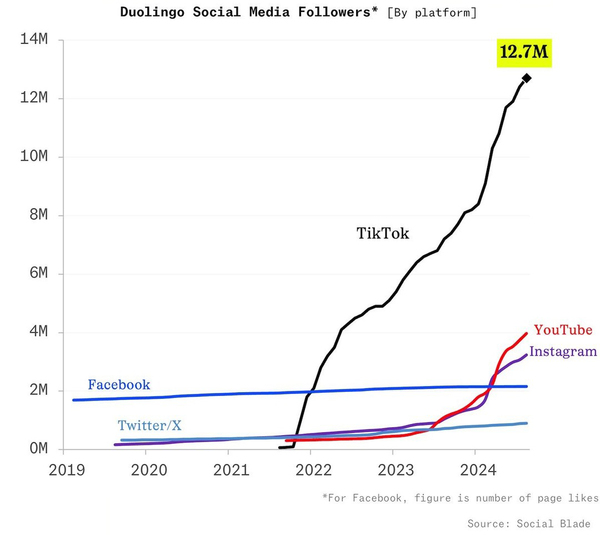
Followers comarison graph from 2024 / Screenshot from 2026

Their strategy gleefully breaks almost every old-school brand communication rule. You’ll see: — The Duo owl «stalking» celebrities; — Duo acting jealous when you spend time in other apps; — The brand jumping into trending dances, sounds, and challenges that have nothing to do with learning a language; — Self-referential jokes about their own push notification culture; — Playful back-and-forths with other brand accounts (Scrub Daddy, Ryanair) in the comments. They went viral in 2021 when Duo showed up «in person» at a Dua Lipa concert — a PR move that played on the «Dua"/"Duo» sound similarity. That video racked up millions of views and earned coverage in places like We Got This Covered [4].

What’s interesting from a communication perspective is that a huge portion of people consume this content with zero intention of ever using the app. It functions as pure entertainment, which, as we’ll get into later, fits perfectly with what Uses and Gratifications theory predicts.

Instagram* Over on Instagram* (@duolingo, about 4,8 million followers), the voice is a bit more polished but still recognizable. Content includes language-learning memes, culturally specific humor tied to the languages they teach, behind-the-scenes glimpses, and user success stories.


Twitter/X* The Twitter/X* account leans into real-time cultural commentary. The brand jumps into trending conversations with dry, offbeat humor.

YouTube YouTube serves a different purpose than the short-form social stuff. The channel features: «Duolingo Stories» animated short films in target languages with English subtitles Language learning tips and methodology explainers «How we built Duolingo» brand documentary content Collaborations with polyglot creators This channel is aimed at motivated learners, people actively studying who want extra material. The communication here is notably calmer and more informative than the TikTok* chaos.

Исходный размер 1280x719

Screenshot of Duolingo’s Yotube page

In-App Notifications, an Overlooked Channel Duolingo’s push notification system deserves its own spotlight as a communication channel, not just a product feature. These notifications became culturally famous for their escalating emotional tone.

Исходный размер 2400x1388

Notification screenshots

These function as little branded micro-messages each one reinforcing the parasocial bond between user and Duo, framing a missed practice as a social letdown instead of a personal one, and using humor to smooth the path back to re-engagement. Research by Oulasvirta et al. has shown that such persistent notification patterns become deeply integrated into daily smartphone habits.

Applying communication theories to the brand

Elaboration Likelihood Model (ELM)

ELM in Action: How Duolingo Persuades Different People Differently

The vast majority of Duolingo’s social media output, particularly on TikTok*, is designed to operate through the peripheral route. The content does not argue that Duolingo teaches languages well: it does not cite learning science, present testimonials, or explain curriculum structure. Instead, it activates specific peripheral cues: Liking is the most central cue in Duolingo’s social media strategy. Duo is deliberately designed to be loveable and slightly absurd. The character’s exaggerated emotional reactions (crying when users miss lessons, celebrating when they return) make him relatable and funny. According to ELM, when we like a communicative source, we transfer that positive feeling to the message and ultimately to the brand. A TikTok* user who finds Duo’s antics genuinely funny develops a warm feeling toward Duolingo without ever evaluating whether the app actually works. This is not accidental. Zaria Parveen, who built Duolingo’s TikTok* strategy, stated in a 2022 Greater Rochester’s R/AD Week event: «People aren’t hanging out on social media to be sold to–they just want to be entertained. So be entertaining!» This is a practically perfect description of peripheral route communication.
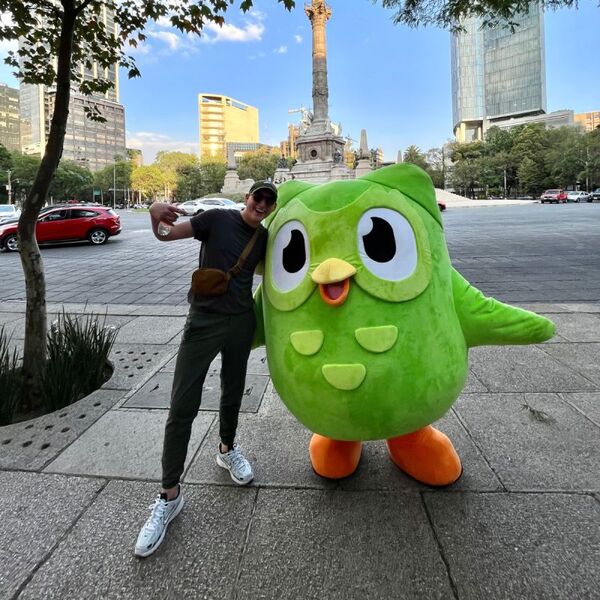
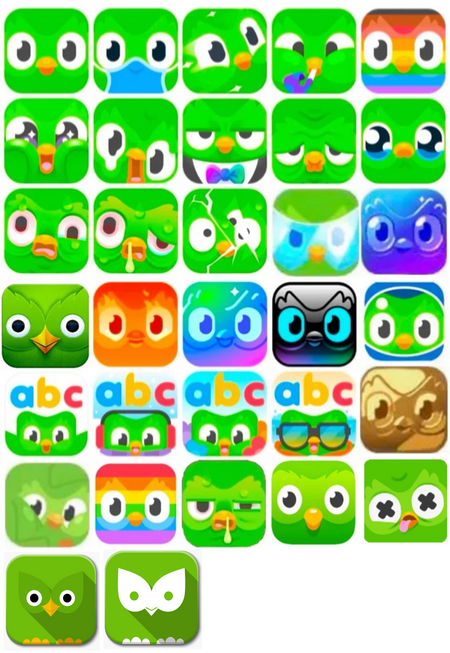
Photo of Duo with a fan / Expressive app icons

Social Proof operates through the sheer scale of Duolingo’s following and the participatory culture around its content. When a TikTok* video shows thousands of users sharing their Duolingo streaks, or when «Duolingo made me do this» becomes an internet meme, new users receive a powerful implicit message: this is what people like me are doing. This is the peripheral cue of social proof: no argument is made, but conformity pressure creates attitude change.

Исходный размер 4960x2700

App’s gamification and engagement method

Consistency and Commitment operate through the streak system. Once a user has maintained a streak for 30 or 60 days, a psychological mechanism identified by Cialdini (1984) in Influence: The Psychology of Persuasion activates and people feel a strong drive to remain consistent with their past behavior. The streak counter is not just a product feature, it is a persuasion architecture that locks users into continued engagement through the peripheral cue of prior commitment.

Scarcity appears in streak protection mechanics. Duolingo sells «streak shields» (through in-app currency or subscription) that protect a streak if a user misses a day. The streak’s value comes partly from its scarcity, because it can be broken at any moment. This manufactured vulnerability makes continued engagement feel urgent.

Исходный размер 1323x835

Screenshot from research.duolingo.com

The Central Route: Website, Press Materials, and Educational Content When Duolingo communicates with audiences who are actively evaluating whether to use the app or whether it actually works, the communication shifts toward the central route. The Duolingo Research page (available at research.duolingo.com) publishes peer-reviewed studies and internal research on learning outcomes. A 2012 study by Vesselinov and Grego, commissioned by Duolingo, found that 34 hours of Duolingo study produced equivalent Spanish learning outcomes to a semester of university instruction. This is a central route argument. It provides specific, evaluable evidence for motivated decision-makers.

The «Science of Duolingo» webpage explains the app’s use of spaced repetition algorithms, the work of psychologist Hermann Ebbinghaus on the forgetting curve, and behaviorist reinforcement principles. This content targets users who want to know why the app is structured as it is and processing information through the central route.

YouTube popular science content including videos like «How to Make Learning as Addictive as Social Media» tells the brand’s origin story with enough detail and evidence to satisfy central route processors. The emphasis on Luis von Ahn’s academic credentials and the app’s development research supports the authority cue even within central route content.

Uses and Gratifications Theory (U&G)

Diversion In 2023, Rex Woodbury’s analysis of Duolingo’s TikTok posts (published on the Digital Native website) shows that the vast majority of the content is entertaining rather than educational. The brand focuses on memes, humor, and recurring gags featuring the Duo mascot. Users who consume this content are satisfying their diversion need: they come for humor, not homework and the content delivers relaxation and amusement. The gratification obtained matches the gratification sought, which, according to U&G research, predicts continued consumption. For Duolingo, this is valuable even without direct conversion. Brand salience built through repeated diversion-gratification is a real and measurable marketing outcome. A user who watches Duolingo TikTok* content every week for six months is not a student yet, but they are not a stranger to the brand either.

Исходный размер 4960x2700

Relatable social media posts bring relaxation and enterntainment

Personal Identity Duolingo’s in-app design is built around identity construction. The streak counter functions as an identity marker: someone with a 200-day streak is not just a user, they are «a person who learns every day.» League standings, achievement badges, and milestone certificates all reinforce this identity performance. This connects to the personal identity gratification category. U&G research by Blumler and McQuail (1972) found that audiences used media partly to reinforce and reflect their self-concept. Duolingo’s gamification system turns language learning into a measurable identity — users can compare their learner identity to peers through leaderboards, share streaks on social media, and collect visual markers of their progress. The brand’s social media content reinforces this by celebrating the learner identity publicly. Posts like «POV: you’re on a 365-day streak» validate and amplify an identity that users have constructed through their app behavior.

Parasocial Relationships with Duo This is perhaps the most theoretically rich dimension of Duolingo’s communication strategy. Horton and Wohl’s (1956) concept of parasocial interaction describes the one-sided emotional relationship audiences develop with media figures. The audience responds emotionally and feels affection, concern, or amusement toward a character who cannot reciprocate. This is typically associated with television hosts or celebrities, but Duolingo went further and engineered parasocial interaction with a cartoon owl.

Users report genuine emotional responses to Duo’s in-app messages. Reddit forums contain threads where users describe feeling guilty about breaking a streak because they feel they are letting Duo down. Others describe looking forward to Duo’s reactions when they complete a lesson. This is textbook parasocial interaction, the user responds to Duo as if to a social partner, even while knowing full well that the character is not real. This gratification falls under U&G's personal relationships category. The app provides companionship and a sense of social accountability that users seek from human relationships but can access through Duo at any time, without social risk. A 2021 study by Iryna Chernova published in CyberLeninka found that Duolingo’s notification discourse and mascot-driven communication foster parasocial relationships with the owl Duo, which users perceive as a personally invested interlocutor. This empirically supports the U&G prediction: people use Duolingo partly for the relationship gratification it provides.

Surveillance and Cultural Awareness Duolingo’s strategy of tying language content to cultural events like releasing special content during the FIFA World Cup, tying courses to major film releases or creating lessons connected to Eurovision, satisfies the surveillance need. Users who engage with this content are learning vocabulary and also using Duolingo’s framing to understand cultural events through the lens of language. The app positions language learning as a form of global awareness and users who want to feel culturally informed and cosmopolitan find this gratifying. A specific example: in July 2024, Duolingo partnered with Sony Music to integrate popular songs including tracks by P! nk, Walk the Moon, and Hozier into its language courses. The collaboration tapped into user’s interest in trending music and enabled learners to engage with lyrics in a new language, demonstrating how surveillance gratification (the desire to stay culturally informed) translates into heightened user engagement when content aligns with current cultural trends.

Duolingo connects language learning to cultural events, satisfying surveillance and social identity needs

Where ELM and U&G Converge

The two theories illuminate the same phenomena from different angles, and their convergence reveals the underlying logic of Duolingo’s communication design. ELM’s peripheral cues such as humor, liking, social proof are the same mechanisms through which Duolingo delivers gratifications. Liking the Duo character is both a peripheral persuasion cue (ELM) and a parasocial relationship gratification (U&G). Social proof from shared streaks is both a peripheral cue (ELM) and a personal identity gratification (U&G). This convergence is not accidental: the most effective brand communication operates at the intersection of persuasion architecture and genuine audience value delivery. Duolingo creates content that persuades through peripheral routes precisely because that content satisfies real psychological needs and users keep coming back because the gratifications are not manufactured but real. The key implication for communication theory is: peripheral route persuasion works best when it coincides with genuine gratification delivery. A peripheral cue that does not satisfy a real need will feel hollow and fade quickly. Duolingo’s Duo character works because the entertainment value is real and people actually find him charismatic, funny and sometimes even scary, which means the diversion gratification is genuinely obtained.

Conclusion and recommendations

Duolingo has built one of the most sophisticated dual-route, multi-gratification communication strategies in digital brand communication which led them to great success. Its core achievements include: Transforming a product feature (streak reminders) into a cultural conversation Building a top-of-funnel entertainment audience of tens of millions who may never use the app but maintain brand recognition Designing in-app systems (streaks, leagues, badges) that deliver ongoing identity and relationship gratifications Connecting the brand to cultural moments in ways that satisfy surveillance needs and generate earned media simultaneously

Against the two-way symmetrical model of public relations («Managing Public Relations» by James E.Grunig and Todd Hunt, 1984), Duolingo performs reasonably well. The brand listens to cultural signals and responds, for example fictional language courses were genuine responses to fan demand, not calculated impositions. The in-app feedback systems (course ratings, lesson difficulty reports) provide genuine user input into product development. However, several structural weaknesses require attention.

Weaknesses

Исходный размер 1244x700

Duolingo is «killing» motivitation to learn

Entertainment-to-learning conversion gap: A significant portion of Duolingo’s social media audience never becomes active learners. The gap between diversion gratification (which the brand delivers well) and cognitive gratification (which requires actual product engagement) is not bridged by the current strategy. Mixed evidence on actual learning outcomes: Independent research on Duolingo’s effectiveness produces inconsistent results. Vesselinov and Grego’s (2012) commissioned study showed positive outcomes for Spanish, but a 2019 study by Loewen and colleagues found that users' self-reported language gains frequently exceeded measurable skill improvements. This matters for central route communication — if motivated users evaluate Duolingo’s learning claims carefully and find them overstated, central route processing results in a shift toward a negative opinion. Notification fatigue risk: Research by Gamelight (2024) highlights that poorly timed or excessive push notifications are a key factor in player churn and app uninstallation, particularly when they feel disruptive rather than supportive of the user’s gaming rhythm. Similarly, the humor of Duo’s aggressive messages has a shelf life and what feels amusing in week one may become irritating by month six, risking user fatigue and disengagement.

Recommendations with methods

  1. Problem: Diversion-gratification consumers follow the brand but never engage with the product. Method: Develop an interactive TikTok* series where Duo leads a genuinely playable 60-second language micro-lesson within the video itself which may serve as a bridge between entertainment content and product experience. The goal is to deliver a taste of cognitive gratification (the pleasure of learning something small and concrete) within the peripheral engagement context. This approach draws on flow theory (Csikszentmihalyi, 1990), which posits that optimal engagement arises when task challenge aligns with skill level. A 60-second lesson in counting to five in Japanese delivers immediate cognitive reward at zero commitment cost creating a pathway to app download without requiring users to make a deliberate learning decision first. Measurement: Track app download attribution data from TikTok* content through mobile measurement partner tools such as AppsFlyer or Adjust for videos and containing micro-lessons versus standard entertainment content, measuring conversion rate difference over a 30 days.

2. Problem: Existing research on Duolingo’s learning outcomes is either commissioned and therefore suspect to central route processors, or inconsistent and as a result damaging when users find it. Method: Partner with three to five independent universities to conduct randomized controlled studies on learning outcomes across different languages and user demographics. Publish the full results, including where Duolingo performs poorly, for example, spoken fluency, which most app-based learning does not develop well. This approach draws directly on two-way symmetrical PR (James E.Grunig and Todd Hunt, 1984) and dialogic theory (M. L. Kent and M. Taylor, 1998): honest, transparent communication that acknowledges limitations builds more sustainable trust than optimistic claims that motivated users can eventually debunk. Practically, this would mean creating a «What Duolingo Can and Cannot Do» page on the website like a frank statement of realistic outcomes. This may seem counterintuitive, but research on trust repair communication (Tomlinson, E. C. and Mayer, R. C, 2009, Academy of Management Review) consistently shows that acknowledged limitations increase perceived credibility more than they decrease purchase intention. Measurement: Track changes in Net Promoter Score and App Store review sentiment using Natural Language Processing tools to analyze review text at scale before and after publishing honest outcome research, at 30, 60, and 90 day intervals.

3. Problem: The current notification system applies the same guilt trip formula to all users regardless of their motivational style or tolerance for aggressive reminders. Method: Implement a notification preference survey at onboarding and again at the 30 day mark when users have formed initial habits. The survey would ask users to self-select their motivational style: «Do you prefer friendly reminders, firm reminders, or humor-based reminders? How often? What time of day?» This draws on U&G's core assumption that users understand their own needs and can report them when asked. It also aligns with self-determination theory (Deci E. L. and Ryan R. M, 1985), which identifies autonomy support like giving users control over their experience as a key driver of intrinsic motivation and long-term engagement. Technically, this requires building a notification preference profile into the user database and running testing across different notification styles against retention and re-engagement rates. Cohort analysis involves tracking groups of users who received different notification styles over 90 days, and it would provide rigorous causal evidence for which style drives sustained engagement most effectively. Measurement: Compare Day-30 and Day-90 retention rates across notification style cohorts, with statistical significance testing to confirm results are not due to random variation.

*Instagram is owned by Meta Platforms Inc. The activities of Meta Platforms Inc. have been deemed extremist and banned in the Russian Federation by the decision of the Tverskoy District Court of Moscow dated March 21, 2022. *Twitter/X is blocked in the Russian Federation by decision of Roskomnadzor. *Facebook is owned by Meta Platforms Inc. It has been deemed extremist and banned in the Russian Federation. Links are provided solely for academic and research purposes.

Библиография
1.

Duolingo Inc. Duolingo Annual Report 2023 [Электронный ресурс]. — 2023. — URL: https://iac.virtuaresearch.com/?Ticker=DUOL&Exchange=NASDAQGS (дата обращения: 14.06.2026).

2.

Duolingo Inc. Duolingo IPO Prospectus [Электронный ресурс]. — Filed with the U.S. Securities and Exchange Commission, July 28, 2021. — URL: https://www.sec.gov/cgi-bin/browse-edgar?action=getcompany&CIK=0001562088 (дата обращения: 14.06.2026).

3.

Duolingo Inc. Official Website: Mission, Approach, and Research Pages [Электронный ресурс]. — 2024. — URL: https://www.duolingo.com/approach (дата обращения: 14.06.2026).

4.

TikTok icon Duolingo owl has proposed to Dua Lipa [Электронный ресурс] // We Got This Covered. — URL: https://wegotthiscovered.com/music/tiktok-icon-duolingo-owl-has-proposed-to-dua-lipa/ (дата обращения: 13.06.2026).

5.

Conviva. State of Streaming Social Media: Education Brands [Электронный ресурс]. — 2022. — URL: https://www.conviva.com/research/ (дата обращения: 13.06.2026).

6.

Duolingo. Popular Songs Music Course [Электронный ресурс]. — URL: https://blog.duolingo.com/popular-songs-music-course/ (дата обращения: 13.06.2026).

7.

Gamelight. The Role of Push Notifications in Player Retention [Электронный ресурс]. — URL: https://www.gamelight.io/post/the-role-of-push-notifications-in-player-retention (дата обращения: 13.06.2026).

8.

Motivational Component of the Distance Education Discourse: The Case of the Duolingo App [Электронный ресурс] // CyberLeninka. — URL: https://cyberleninka.ru/article/n/motivatsionnaya-sostavlyayuschaya-diskursa-distantsionnogo-obrazovaniya-na-primere-prilozheniya-duolingo (дата обращения: 14.06.2026).

9.

Parvez Z. Lessons: Duolingo TikTok Strategist [Электронный ресурс]. — URL: https://force-drop.squarespace.com/blog/lessons-duolingo-tiktok-strategist-zaria-parvez (дата обращения: 13.06.2026).

10.

Digital Native. How Duolingo Grew Its TikTok to 66M [Электронный ресурс]. — URL: https://www.digitalnative.tech/p/how-duolingo-grew-its-tiktok-to-66m (дата обращения: 14.06.2026).

Источники изображений
1.

Duolingo Press Kit and in-app screenshots [Электронный ресурс]. — URL: https://duolingo.com/press (дата обращения: 14.06.2026).

2.

@duolingo в Instagram* [Электронный ресурс]. — URL: https://www.instagram.com/duolingo/ (дата обращения: 14.06.2026).

3.

@duolingo в TikTok* [Электронный ресурс]. — URL: https://www.tiktok.com/@duolingo (дата обращения: 14.06.2026).

4.

Apple App Store — Duolingo listing [Электронный ресурс]. — URL: https://apps.apple.com/app/duolingo/id570060128 (дата обращения: 14.06.2026)

Мы используем файлы cookies для улучшения работы сайта и большего удобства его использования. Более подробную информац...
Показать больше