VISUAL RESEARCH THEME
The Scent of Memories: How Visual Imagery in Perfume Advertising Shapes Perceptions of Scent and Elicits Emotional Associations—A Case Study of Maison Margiela Replica
RESEARCH PROBLEM
How can visual advertising elements communicate a scent that cannot be perceived through an image? How do color, light, composition, textures, and familiar imagery shape the perception of a smell and evoke emotional associations in the viewer? To what extent does the reception of a visual advertisement depend on an individual’s personal experience, and does the viewer always interpret the mood the designer intended to convey?
RESEARCH HYPOTHESIS
It is hypothesized that perfume advertising built around recognizable life situations and memories can form more specific perceptions of a scent and evoke stronger emotional associations than a neutral image of the bottle. Color, lighting, texture, and composition help the viewer mentally supplement the image with sensations that do not actually exist. Furthermore, the power and nature of the impact depend not only on the visual techniques but also on the individual memories and associations of the person viewing the ad.
VISUAL RESEARCH CONCEPT
Can you smell something without actually sensing it? Imagine a sunny morning. Light streams through translucent curtains, falls onto white sheets, and the room seems filled with fresh air. Perhaps at that moment, you recall the scent of clean bedding. Now, picture a winter evening: it is dark outside, logs crackle in the fireplace, and the space is illuminated by a soft, amber glow. It feels like just a little longer, and you can smell the wood and smoke. But in reality, neither of these images has a scent.


Fig. 1. Soft morning light and white textiles create associations with cleanliness, freshness, and tranquility. Fig. 2. Burning logs, orange highlights, and wood texture evoke images of warmth and smoke.
Why is it so easy for us to imagine a scent that isn’t present here? And why can the same images evoke such different memories in different people? Perfume advertising faces an unusual challenge. It needs to convey a product whose main attribute cannot be directly transmitted through a screen. We can consider the bottle’s shape, the color of the contents, the texture of the packaging, and read the description, but the scent itself remains inaccessible. To compensate for this absence, the advertisement appeals to human imagination. Instead of a complex description of the perfume composition, the viewer is offered a familiar scenario that they can mentally enhance with their own sensations. The image of the sea reminds one of salty air, white linens—of purity, and burning logs—of warmth and smoke. Thus, advertising can tell not so much about a specific scent as about the world with which that scent should be associated. At the heart of the study is the idea that visual perfume advertising is capable of transforming an invisible fragrance into a recognizable memory. Perfume advertising can appeal not only to a person’s memories but also to their aspirations of who they wish to be. Often, an entire story is built around a fragrance. Perfume is presented as the choice of a mysterious, confident, romantic, or independent personality. Instead of detailing the smell, the advertising tells a story about the person’s character, their lifestyle, and the impression they make on others. From a psychological perspective, this approach is related to identifying with an ideal self-image. A buyer may choose a product not just for its properties but also for the qualities it symbolizes. The fragrance becomes a symbol of confidence, attractiveness, freedom, or individuality. Narrative impact also plays a crucial role—the ability of a story to emotionally engage a person. The advertising plot allows the viewer to imagine themselves in a certain role, to mentally continue the story, and to link it to their own desires. These mechanisms are examined in the studies of Melanie Green and Timothy Brock (2000), as well as Jennifer Edson Escaleras (2004).


Fig. 1. YSL Libre — The Image of Freedom A direct gaze, a sharp black suit, and a fiery background create the image of a confident and independent woman. Fig. 2. Giorgio Armani My Way — The Image of Self-Discovery Natural lighting, a calm palette, and the heroic figure support the idea of openness to the world.
Why might an image remind us of a smell? To understand this process, we must look into the psychology of perception. Typically, we are accustomed to separating our senses: we see with our eyes, smell with our nose, and feel with our skin. However, our perception of the surrounding world is not composed of completely independent sensations. Information received through different senses can interact and complement one another. This process is related to cross-modal correspondences—associations between characteristics perceived through different senses. British psychologist Charles Spence, in the scientific review «Olfactory–colour crossmodal correspondences in art, science, and design» (2020), examines the links between color and scent. He shows that people can associate smells with visual characteristics, and such correspondences are explained by several mechanisms, including familiar objects and emotional associations. For instance, an image of a lemon might evoke a citrus scent not because the color yellow itself smells like a lemon, but because in our experience, that color is associated with a particular object. But what happens if you remove the lemon and leave only the color? Research by Hendrik Schifferstein and Inge Tanudjai, «Visualising fragrances through colours: the mediating role of emotions» (2004), demonstrated that people did not match perfumed scents to colors randomly. The authors also found that emotional characteristics partially explained these correspondences. It turns out that a visual image is capable of not only evoking the source of a scent but also conveying the supposed mood of the fragrance.
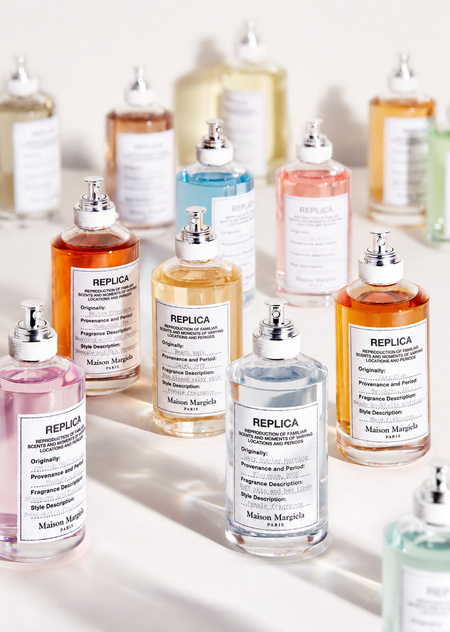
Maison Margiela REPLICA bottles. Variations in the shades of the perfume fluid create a color diversity within the brand’s unified visual system.
For a designer, this presents an interesting opportunity: to use color, light, and texture as a kind of language through which one can communicate what cannot be shown directly. However, these associations are not universal. One person might link dark brown with coziness, while another might associate it with heaviness and gloom. Therefore, the study examines visual correspondences not as strict rules, but as potential mechanisms for forming expectations.


Fig. 1. Warmth and Coziness The soft light of a fireplace, knitted textiles, and brown hues evoke a feeling of warmth and security. Fig. 2. Gloom and Tension Dark embers, sharp highlights, and deep shadows create a more dramatic perception of the same aroma.
Scent as a Key to Memories.A particular focus of this research is the connection between scents, memory, and emotion. In the book The Scent of Desire: Discovering Our Enigmatic Sense of Smell (2007), psychologist Rachel Hertz explores the role of olfaction in human life, including its link to emotional experiences, memories, and behavior. The author emphasizes how personal the perception of the same scent can be. A scent can be associated with a specific person, place, or event. Moreover, the meaning of this association is determined not only by the physical properties of the scent but also by the circumstances under which the person first experienced it. For instance, the aroma of wood might remind one person of family evenings by the fireplace, while for another, it might evoke an unpleasant experience related to smoke. The scientific research by Johan Willander and Maria Larsson, Smell your way back to childhood: autobiographical odor memory (2006), demonstrates that memories triggered by scents can differ from memories evoked by words or images. Specifically, in the experiment conducted, scents more frequently elicited memories from an earlier period of life and generated a stronger subjective feeling of returning to the past. However, it is important to draw a distinction here. A real scent and its representation affect a person differently. Studies on olfactory memory do not prove that a photograph of a fireplace can elicit the same reaction as the actual smell of burning wood. This distinction is precisely what becomes one of the central questions of this research.
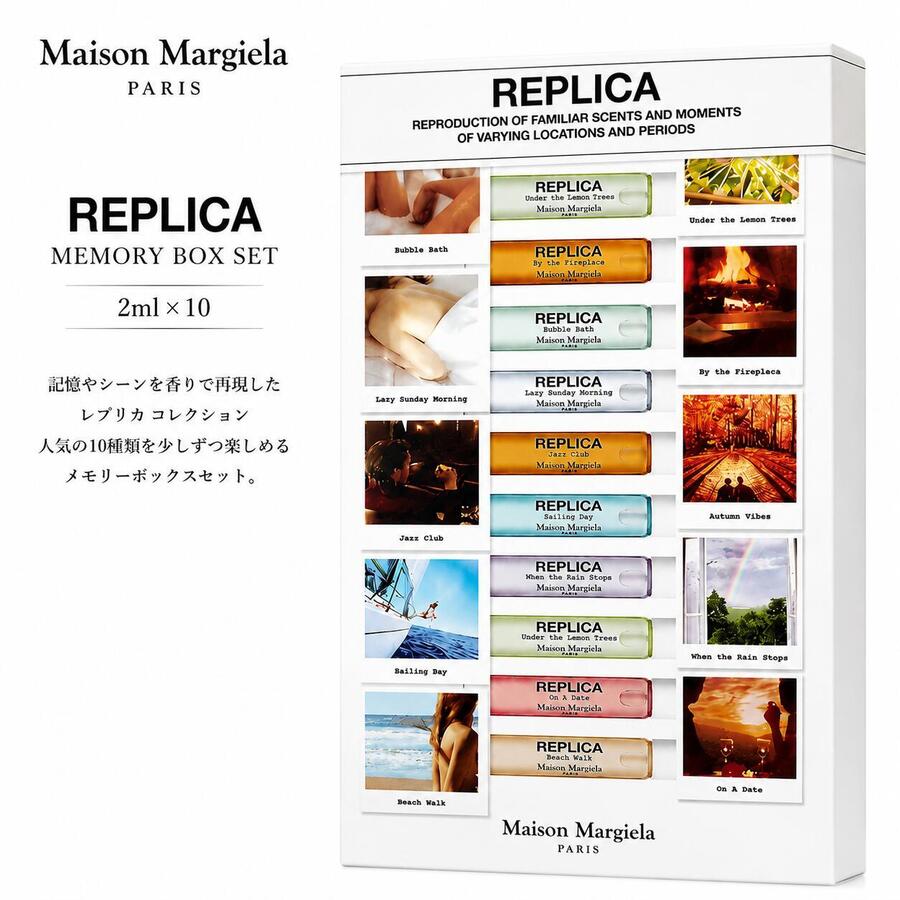

Fig. 1. Maison Margiela REPLICA Memory Box set. Each fragrance is paired with a small photograph reminiscent of a snapshot from a private photo album. The images help connect the scent to a specific moment. Fig. 2. Perfume set among everyday objects. Soft lighting, a cup of tea, and small vials create an atmosphere of personal space, highlighting the connection between the fragrances and familiar moments in life.
This packaging is particularly compelling. The images on it resemble small snapshots from travels or a personal archive. They do not aim to convey the chemical composition of the fragrances but instead invite the viewer to experience a familiar atmosphere. In this instance, the photograph serves several functions at once: it helps distinguish between the fragrances, transmits their mood, and evokes an association with a specific situation. Can an image remind us not only of a familiar place but also of a scent we once felt there?
Maison Margiela REPLICA: Perfumery as a Collection of Moments
Maison Margiela REPLICA: Perfumery as a Collection of Moments The main subject of this research is the Maison Margiela REPLICA perfume line. The collection’s concept is built around recreating recognizable moments, places, and sensations through scent. The brand itself connects REPLICA to personal memories that a person can revisit through fragrance. The names of the scents are particularly interesting. Instead of abstract words denoting luxury, passion, or mystery, the names use images of everyday situations: Lazy Sunday Morning — a lazy Sunday morning, By the Fireplace — by the fireplace, Beach Walk — a walk on the beach. These names already contain a small narrative. A person may not yet know how the fragrance smells, but they can already imagine the setting, the lighting, the temperature, and their own feelings in such a scenario. The visual language of REPLICA is built on a relatively restrained object design. The transparent bottle, white label, black typography, and concise shape remain consistent from one fragrance to the next. This is an important observation: the product itself changes very little externally, but the story surrounding it can be entirely different. Thus, the name and the image begin to work together, creating certain expectations even before encountering the perfume. Three fragrances, built on contrasting images, were selected for visual analysis.
Maison Margiela Lazy Sunday Morning — a feeling of serenity and purity
Subject photography: Lazy Sunday Morning. White sheets, soft lighting, and the touch of a hand evoke associations with freshness, physical comfort, and a leisurely morning.
In the official description, the fragrance is associated with freshly laundered sheets, a sunny morning, and the soft touch of fabric against the skin. Its perfumery composition features lily of the valley and white musks. The image is largely devoid of bright color accents. White sheets occupy most of the frame, and their folds create smooth lines that guide the viewer’s eye toward the bottle. The texture of the fabric is particularly significant. Although the viewer cannot touch it, they can imagine its softness, smoothness, and coolness. Interestingly, the advertisement does not depict the direct sources of all the fragrance notes. Instead, it presents a familiar scenario meant to convey the overall mood of the composition. The merit of this approach is its accessibility. The viewer doesn’t need to know what white musk smells like. The image of fresh linens might be far more relatable than a professional fragrance description. However, there is also a limitation. A photograph like this could be used to advertise bedding, laundry detergent, or cosmetics. The image of purity is recognizable but not necessarily unique. Consequently, while the visual simplicity helps convey a feeling, it may restrict the originality of the advertising message.
Maison Margiela By the Fireplace — a feeling of warmth and security
Subject photography: By the Fireplace. The fire, the wood texture, and the amber lighting create a rich image associated with warmth, smoke, and coziness.
The scent evokes burning wood, roasted chestnuts, and a winter evening by the fireplace. Its composition blends woody accords, chestnut, and vanilla. The visual imagery employs a more saturated color palette than Lazy Sunday Morning. Brown, golden, and orange tones predominate here. A bright flame contrasts with the dark areas of the image, immediately capturing the viewer’s attention. The wooden surface and antique books enhance the sense of warmth, while the amber hue of the liquid complements the overall palette. Unlike Lazy Sunday Morning, this image presents a distinct source for the fragrance—burning firewood. This is its strength. The viewer doesn’t need to spend much time making associations: the visual concept is directly tied to one of the fragrance’s primary characteristics. However, this presents a contradiction. Can an image that appears cozy simultaneously suggest the unpleasant smell of smoke? For one person, burning wood might evoke relaxation, while for another, it could suggest a smoke-filled room or discomfort. Furthermore, the bright fire may compete with the bottle for the viewer’s attention. In this image, the atmosphere becomes just as important as the advertised product itself. This raises the question: does a strong emotional association always aid advertising, or does it sometimes distract from the specific fragrance?
Maison Margiela Beach Walk — The Feeling of Summer Freedom
Subject Photography: Beach Walk. Light sand, blue sea, and natural lighting create an image of open space, summer leisure, and sea air.
The fragrance evokes memories of a beach walk, bright sunlight, and sea air. The official description lists lemon, coconut milk, and cedarwood as characteristic notes. Unlike the previous two examples, this piece features open space. The light sand and the blurred line of the sea create a sense of depth and freedom. The bottle’s transparency complements the subtle, natural palette, while the warm tint of the liquid visually connects the product to its sandy surroundings. However, the image conveys the location more strongly than the scent itself. A viewer can easily recognize a beach, but there is no guarantee they will picture coconut milk, lemon, or cedarwood specifically. For some, the dominant coastal scent will be sea salt; for others, it might be hot sand or sunscreen. The image’s strength lies in its immediate recognizability—the viewer instantly grasps the scene. There is no need to explain the setting or the mood the photograph intends to convey. The weakness, however, is the predictability of the motif. The beach is frequently used in advertisements for vacations, cosmetics, and summer scents. Consequently, the familiar atmosphere does not guarantee an original visual message. This suggests that while a recognizable image may facilitate the interpretation of an advertisement, it simultaneously reduces its expressive power.
Three memories—three ways to speak about scent