Navigation:
Part 1. 1909–1915. Speed Over Machine Part 2. 1920s–1950s. Painting, Advertising, Poster Art Part 3. 1950s–1970s. Photography, Film, Pop Art Part 4. 1975–1990s. Art Maps Part 5. 1980s–2020s. Sculpture and Installation
Concept
A race always promises momentum: to overtake, to arrive on time, to cross the finish line first. But in art, the racing car often stands still—hovering in mid-air, encased in concrete, or assembled from wire. This raises a question: what remains of the race when the machine no longer moves?
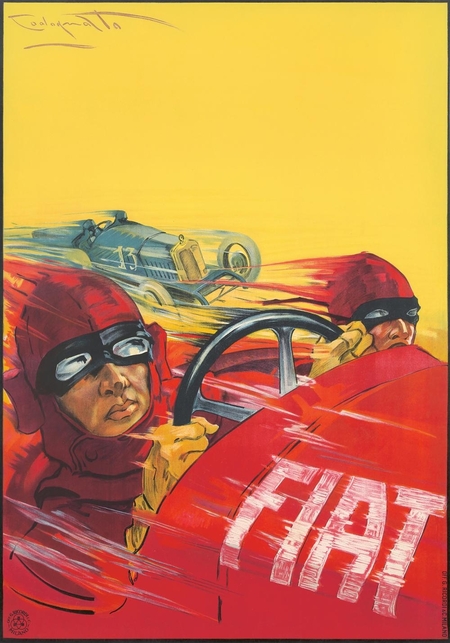
At first, the distinction seems obvious: there is speed, and there is its representation. However, the more images accumulate around it, the harder it becomes to maintain that boundary. A poster freezes a moment that lasted a second. A sculpture renders immobile that which, by nature, cannot stand still. An art print transforms the race car into a painting that can still travel, but is no longer obligated to do so.
Therefore, the race does not yield a simple answer to the question of motion. Rather, it becomes its double reflection: it shows how easily speed transforms into a sign, while simultaneously compelling us to look deeper at what eludes the image—at the very moment before the machine has become a picture. The more convincing the image of speed, the more persistently the question arises about what separates «movement» from «the image of movement, ” and what prevents the race from ultimately becoming a monument to itself.
This research approaches the concept of the race as an image that alters its function when transitioning from one art form to another while remaining recognizable. It questions what remains of speed when it becomes mass-produced and easily reproducible, and where the line lies between motion and the memory of that motion.
The research addresses the question: what visual techniques transform a racing car into a symbol of speed, spectacle, commodity, gesture, and memory?The object of the research is works of art and mass culture where racing or the automobile plays a significant role.The subject of the research is the relationship between the car’s form, its placement in the image, and the actions associated with it: line of movement, scale, color, body integrity, track, pilot, and lettering.The geographical foundation is the European and American tradition and its continuations in the 20th–21st centuries, with a separate focus on Soviet posters.Hypothesis: the significance of racing is created by cultural memory and a specific visual solution. The work examines both the symbolism of racing and how it functions within an image.
The material was selected based on two criteria: the visual significance of the motif and the possibility of verifying the authorship, title, dating, and origin of the reproduction. The work includes painting, poster art, sculpture, art card, photography, film, and installation. Captions differentiate between the date of the work and the date of the later photograph or re-edition.
The organization follows chronology across five sections. Within each section, objects from different mediums spanning a single time period are presented. The chronology dictates the narrative sequence and maintains focus on the research question.
Analysis methodology: from observation to interpretation. First, we document where the machine is, how movement is depicted, to whom the object belongs, what it interacts with, and what changes it has undergone. Second, we establish the connection between these characteristics and the plot and the context of the display.
Textual sources are chosen based on their role in verifying conclusions: manifestos clarify intent, catalogs establish attribution, and artists' statements separate concept from interpretation. Comparisons illustrate what meanings the image supports and what cultural memory contributes.
Jacopo Balla, «Abstract Speed + Sound, ” 1913.