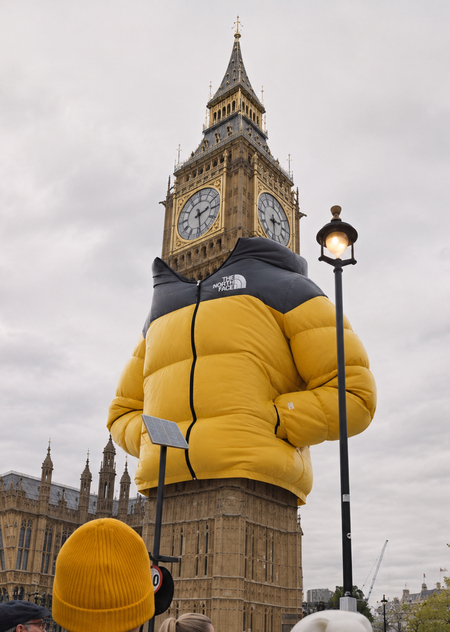
Concept
For many centuries, outdoor advertising was inextricably linked to the physical urban space. Traditional media were tangible objects, so their effectiveness was determined primarily by scale and spatial context. The evolution of digital technologies has allowed us to overcome this dependency. One of the most illustrative examples of this transformation is FOOH (Fake Out-of-Home)—a format that uses computer graphics to create the illusion of advertising objects or events within the real urban environment.
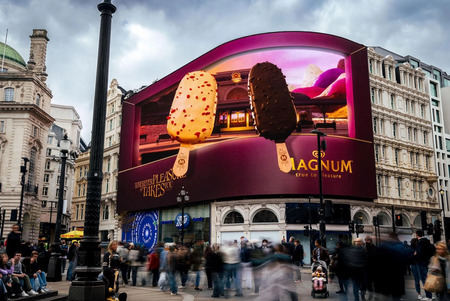
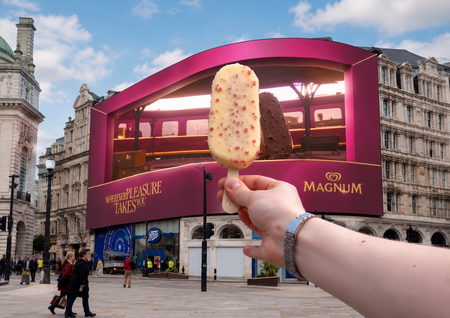
Magnum — Pleasure Express, London, 2024. Real DOOH advertising on Piccadilly Lights and FOOH continuation.
The fundamental characteristic of FOOH is not so much the demonstration of the impossible as it is the manner of its depiction. Fantastical events unfold against recognizable urban locations and are reproduced using the familiar visual language of everyday cinematography: natural lighting, realistic perspective, vehicle movement, random angles, and the characteristic imperfections of video recording. It can be inferred that the key condition for forming the illusion of reality is the coherence of digital elements with the real environment.
A clear paradox emerges: the content of the advertisement contradicts common notions of the physical world, yet the image’s form resembles documentary evidence. An artificially created event is presented as if it genuinely occurred before the camera. Meanwhile, the viewer does not necessarily have to believe the authenticity of what they see. Even the obvious fictionality of the events does not always undermine the impression of visual veracity. On the contrary, the combination of an impossible action with a convincing environment becomes an independent source of advertising expressiveness.
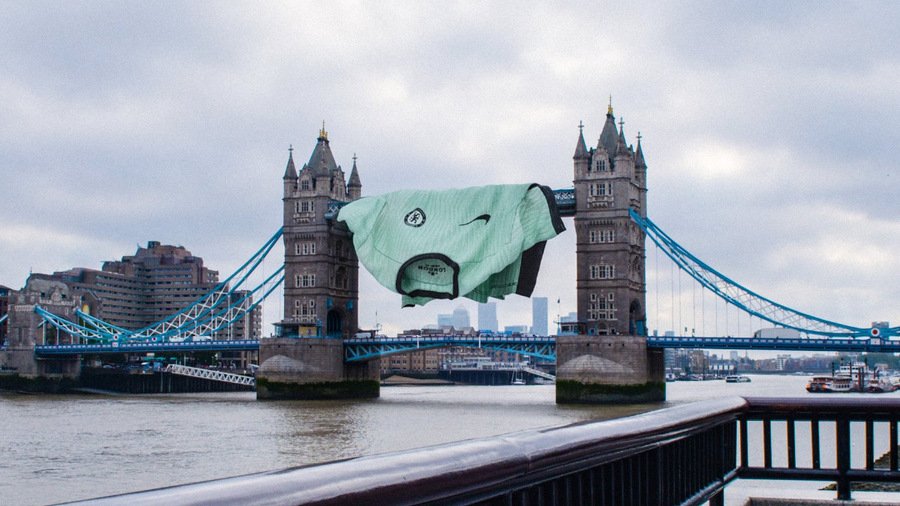
Chelsea FC × Nike — Third Kit Launch, 2023. CGI: The Berry.
This visual paradox is precisely what dictates the selection of a research topic. The interest lies not so much in the technology of creating computer effects, but in the methods that allow an artificially created event to acquire the qualities of reality. Paul Messaris, in his book «Visual Persuasion: The Role of Images in Advertising, ” examines the persuasiveness of advertising imagery, while Tom Henning, in his article „What’s the Point of an Index? or, Faking Photographs, ” explores the relationship between photography, reality, and digital manipulation. These works enable us to distinguish between the plausibility of the event itself and the veracity of its visual representation.
The chronological scope of this study covers 2022–2024—a period of notable international popularization of FOOH. Although combining computer graphics with realistic video footage existed long before this time, it was during the years under review that such advertising videos began to proliferate actively on social media and captured the attention of international brands.
The proliferation of FOOH demonstrates a change not only in the technical capabilities of advertising but also in the conditions of its reception. Whereas traditional out-of-home advertising primarily addressed individuals physically present near the advertising medium, FOOH creates the image of a city-wide event for an audience that can be anywhere in the world. In this context, the city becomes less a place for ad placement and more a space for advertising narrative. Its architecture, transportation, and daily life take on a new function—creating an authentic depiction of what is portrayed in a digital image.The goal of this research is to identify and systematize the visual mechanisms that construct the illusion of reality in international FOOH advertising from 2022–2024.
For this study, we selected advertising campaigns from international brands where computer graphics transform recognizable physical environments. The selection criteria include the expressive quality of the visual technique, the diversity of ways virtual and real elements interact, as well as the availability of original video materials and production information. The material is divided into four groups: architecture as an object of advertising transformation, hyperbolization, the physics of the impossible, and the materialization of digital fiction. This is an original classification based on the nature of the visual intervention.
Key research question: How does FOOH create an illusion of reality if the depicted events contradict common understandings of the physical world?
Research Methodology—Comparative Analysis of Videos and Stills: composition, scale, perspective, lighting, camera movement, and object interaction. The theoretical foundation is built upon studies of visual communication and image veracity; materials from brands, agencies, CGI studios, and professional press are used to verify dates, authorship, and production specifics. The analysis distinguishes between entirely virtual events and hybrid campaigns featuring real-world installations.
Architecture as an Object of Advertising Transformation
Architecture in FOOH serves not only as the setting for an advertising event but also as a direct object of digital transformation. Recognizable buildings and monuments take on new functions, change their appearance, or become part of a fantastical narrative. Simultaneously, their location, scale, and primary structural features are preserved, allowing the viewer to recognize the real-world space within the fictional scene.
Adidas — Framing the Impossible
Following Argentina’s victory in the FIFA World Cup, Adidas released a CGI video in which the famous Dubai Frame structure was transformed into a giant advertising screen featuring Lionel Messi. The project was executed in collaboration with the agency TBWA and Vertex CGI studio.

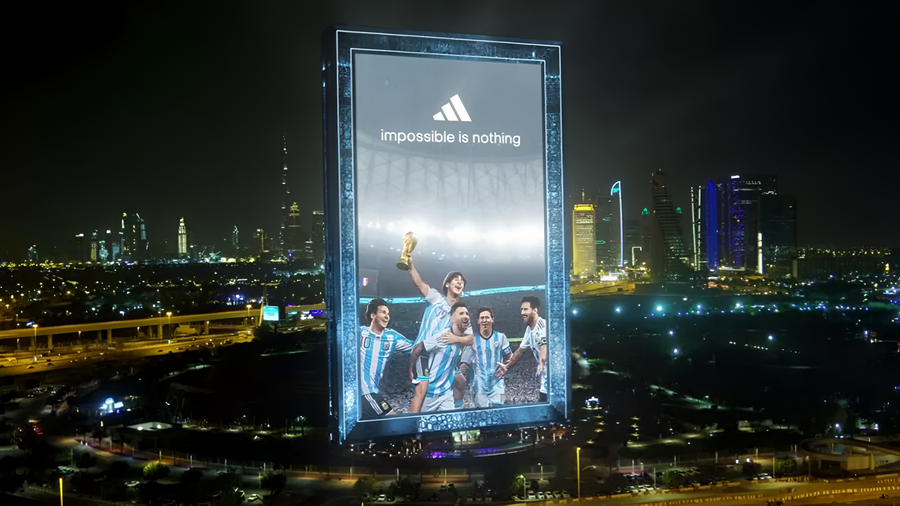
The foundation of the illusion is the Dubai Frame’s architecture itself: the rectangular 150-meter structure resembles the frame of a massive screen. Computer graphics fill its opening with an advertisement, preserving the building’s recognizable silhouette.The authenticity is further enhanced by the amateur filming style from a moving car. The nighttime lighting, camera movement, and imperfections in the video create the impression of a randomly captured advertising installation.
Netflix — Sex Education Season 4
Upon the release of the fourth season of Netflix’s «Sex Education,» Netflix released a CGI video featuring the Obelisco in Buenos Aires covered by a giant pink condom. The monument’s shape becomes the basis for a provocative advertising metaphor directly connected to the show’s theme.
The process of installing the virtual object is shown using cables and lifting mechanisms that mimic a real installation operation. Two versions of the video from different angles enhance the impression that the event was captured by independent witnesses.