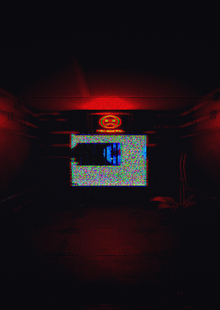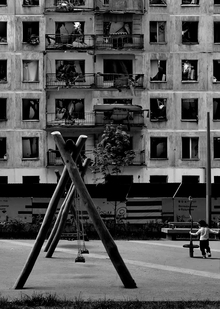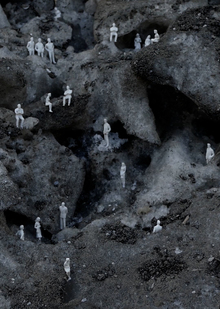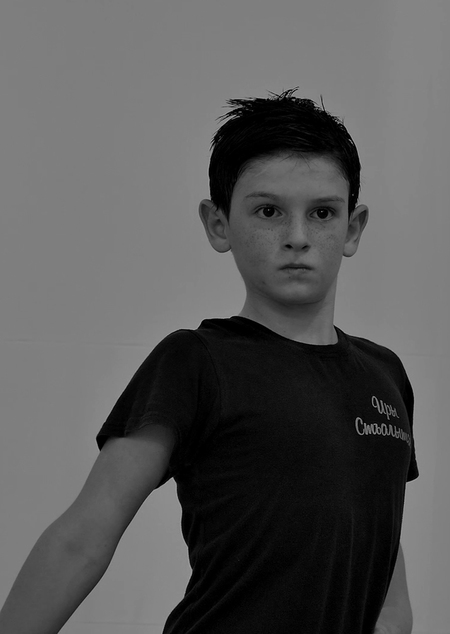
Alexandra Mitlyanskaya’s «Acemaz» is a deconstruction of dance’s mystique—a move away from the symbolism of movement and the articulation of gesture. Within this desynchronization of movement lies not only, but more profoundly, an attempt at internal decryption—a sort of deconstruction, a scattered montage. The Lezginka, as both a dance and a ritual performance, imbues the performance’s gesturing with new meaning, enriching its representative connotations.
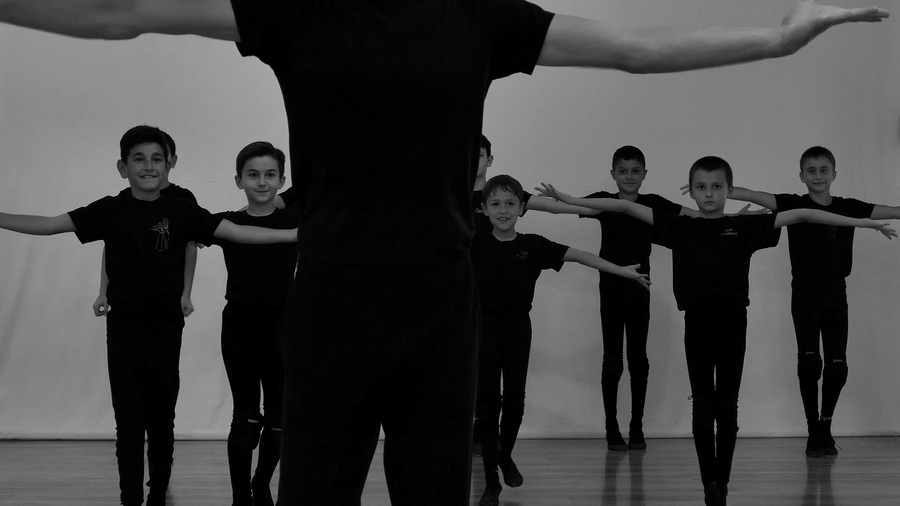
Mitlyanskaya captures the dance—more precisely, a phase of it, a pause in the dance, the regulation within the dance (the direction of movement by the instructor), and the possibility of movement along a conceptual circular trajectory. Broadly speaking, Mitlyanskaya proposes a specific montage of the dance, unconsciously shifting from the intention of the body toward the dematerialization of plasticity. This phantasmagorical space, fixed in the frame and each time attempting to reject any cinematic dependency (the work is executed in a black-and-white aesthetic, with a deliberate avoidance of shadows, leaning almost toward expressionistic plasticity), is subject to a culture of control—it persists as an emphasis on national performativity.
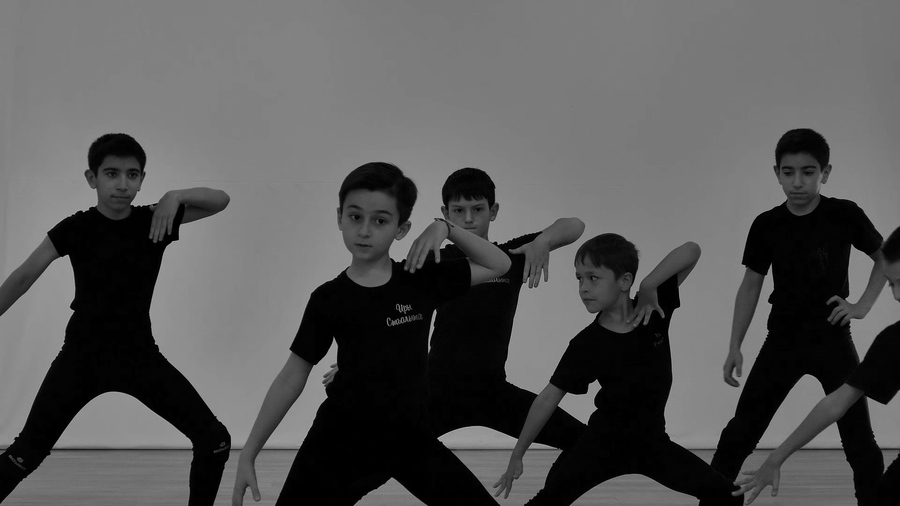
The division of roles—student and teacher, the latter rarely appearing in the frame but undoubtedly directing it—suddenly becomes a subject within the narrative, essentially uniting it. The multi-part nature, or polyphony, of Mitlyanskaya’s work is built upon the juxtaposition of different images, the organic confluence of the «organs» of dance. Like a mosaic, they create the mechanism of the lezginka, the mechanism of the performance—an infinite repetition of dance that changes its meaning and plastic embodiment with every iteration.
Embodying the past—or the memory of time—in dance, he dissolves and transforms the very chronotope of the event unfolding here and now, perpetually regulated by Instructor Atamaz. What is notable is that Atamaz is also a name from ancient Alanic epic, which recounts that when he played the sun, the moon began to rotate faster, mountains started to move, and beasts began to dance. Thus, he becomes a real symbolic action, periodically interrupted by—narrative—pauses, in the form of stops during rehearsals, and mythic, since the tale takes place in the present and its participants are undoubtedly both narrators and subjective observers.
A voyeuristic cross-section, in which the Mitlyanskaya viewpoint, the viewer, and the direct participants of the «event» are present—establishes specific parameters for the fragmentation of the image.
In essence, Mitlyanskaya defines the format of cinematic storytelling—from the opening frames of Tarkovsky’s Mirror, where a boy learns to speak and the viewer sees only fragments of a narrative built on character detail and sound (as in Atamaz, where movement is periodically regulated by the teacher’s voice and a figure that seems to have stumbled into the frame)—to, for example, the heroine of Long Goodbyes, in the scene where she is getting ready for a date, and Muratova uses jarring montage to show the movement of her hands before the mirror, both ephemeral and symbolic, like the flutter of a butterfly’s wings.
Karina Karaeva