Concept:
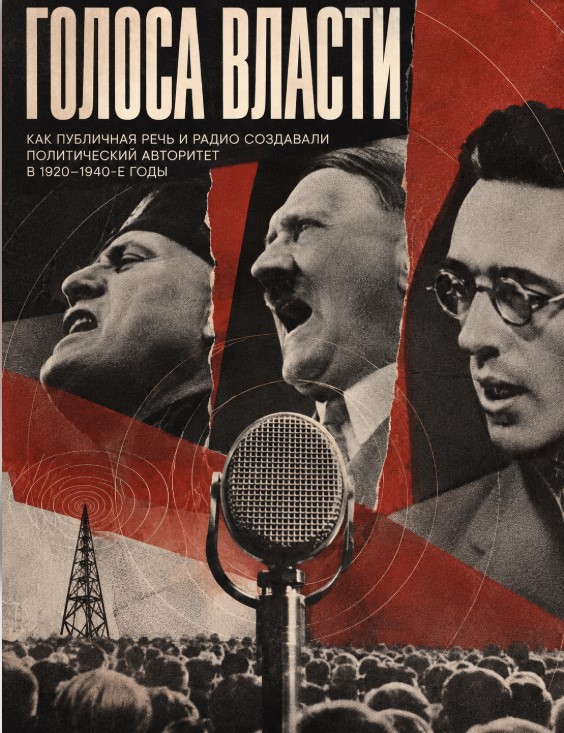
In the first half of the 20th century, the development of radio broadcasting, sound recording, and sound amplification technologies fundamentally altered the ways political power interacted with society. The voice of a statesman or announcer was no longer solely tied to the speaker’s immediate physical presence; it could now sound simultaneously in city squares, public institutions, and private homes. Mass communication technologies transformed the human voice into one of the recognizable elements of political culture.This visual study examines the formation and representation of the voices of political power in the Soviet Union, Nazi Germany, and Fascist Italy during the 1920s and 1940s. The focus is less on the content of the political addresses than on their sonic and visual components—intonation, rhythm, tempo, pauses, speech delivery characteristics, as well as the methods of recording, broadcasting, and presenting the speaker publicly.
Relevance and Justification of the Topic:
The topic selection is driven by an interest in the voice as a cultural phenomenon—one that possesses individual characteristics while simultaneously capable of acquiring social and political significance. The voice can function as a means of transmitting information, a signifier of authority, and a component of collective historical memory.
Of particular interest is the first half of the 20th century—the period of mass radio broadcasting’s emergence and the active use of sound media in political communication. By comparing three historical contexts, it is possible to explore various forms of public political voice: professional broadcast speech, mass oratory, and the mediated image of a political leader.
Research Question:
How did the characteristics of public speaking, radio broadcasting technology, and the visual representation of the speaker contribute to the formation of the recognizable image of political power in the USSR, Nazi Germany, and Fascist Italy during the 1920s–1940s?
Hypothesis:
It is suggested that the recognizable voice of political authority was shaped not only by the content of the messages delivered but also through a combination of speaking style, mass broadcasting technology, and the recurring visual imagery of the speaker. Furthermore, the political authority of the voice was determined not by its inherent acoustic characteristics, but rather by the speaker’s social status, the transmission conditions, and the historical context of reception.
Material Selection Principle:
The visual backdrop will be composed of archival photographs, footage from documentary film, images of radio studios, microphones, receivers, and loudspeakers, as well as historical documents related to public speaking and radio broadcasting. Material selection will focus on the capacity of the images to reveal the relationship between the speaker, the technological means of sound transmission, and the audience. Particular attention will be paid to images that illustrate the organization of a public address, the speaker’s positioning relative to the microphone, interaction with the audience, and methods of communal listening. Additional material will include historical audio recordings and their corresponding visual interpretations. During analysis, the origin of the recording, its date of creation, technical limitations, and any subsequent alterations will be taken into account.
Rubrication Principle:
The research will be structured thematically-comparatively and divided into five main parts. The first part is dedicated to the development of technologies that allowed the political voice to achieve mass distribution. The second part examines the Soviet model of state radio voice, using Yuri Levitan as an example. The third part focuses on the public oratory style of Adolf Hitler and its reproduction through radio broadcasting and film. The fourth explores the speeches of Benito Mussolini as a combination of voice, gesture, and political staging. The concluding part presents a comparative analysis of the three models, highlighting their commonalities and distinctive features.
Working with Text Sources:
The theoretical foundation will be composed of research into the cultural history of voice, sound culture, and political broadcasting. Specifically, the study proposes engaging with Oxana Bulbakova’s book, «Voice as a Cultural Phenomenon, ” Carolin Birdsell’s research on Nazi Soundscapes, and academic works dedicated to broadcasting in Fascist Italy. Scholarly literature will be used to interpret the historical context, while archival audiovisual materials will be utilized for independent comparative analysis. Conclusions will be formulated by accounting for the differences between historical evidence, its later reproductions, and scholarly interpretations.
Research Objective:
To investigate how the human voice became a recognizable symbol of political power amid the rise of mass sound media in the first half of the 20th century. This visual study aims to demonstrate that the political voice is not merely an acoustic phenomenon, but a culturally constructed image, shaped at the intersection of public discourse, communication technologies, visual representation, and public perception.
Chapter 1. The Birth of the Mass Political Voice
1.1. The Voice Separated from the Body
For the majority of human history, public discourse was tied to the physical presence of the speaker. To hear a politician, a preacher, or a town crier, one had to be within earshot of their voice. The speaking space, architectural features, and the number of attendees dictated the reach of the message.
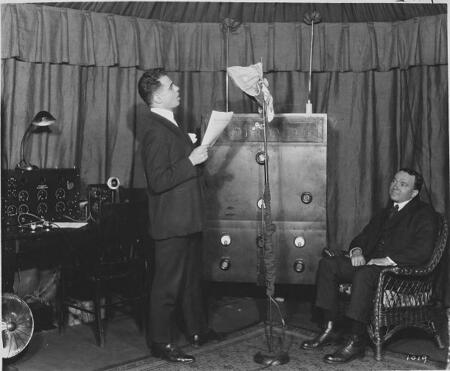
The advent of sound recording, microphones, and radio broadcasting gradually altered this dependence. Voice became capable of being transmitted over long distances, preserved, and reproduced independently of its speaker’s presence. Listeners could hear people they had never seen, and the sound itself began to acquire independent meaning.
This shift impacted not only communication technology but also the cultural perception of voice. The microphone made audible nuances of speech—such as breathing, pauses, changes in timbre, and intonation. A voice calibrated for a large audience was no longer the sole possible model of public address; technological amplification allowed for communication with a mass audience using a more restrained delivery.
A new contradiction emerged in the political culture of the first half of the 20th century. On one hand, the voice began to separate itself from the body of the speaker. On the other, thanks to radio, it could create a sense of direct address to a listener hundreds of miles away from the source of the broadcast.