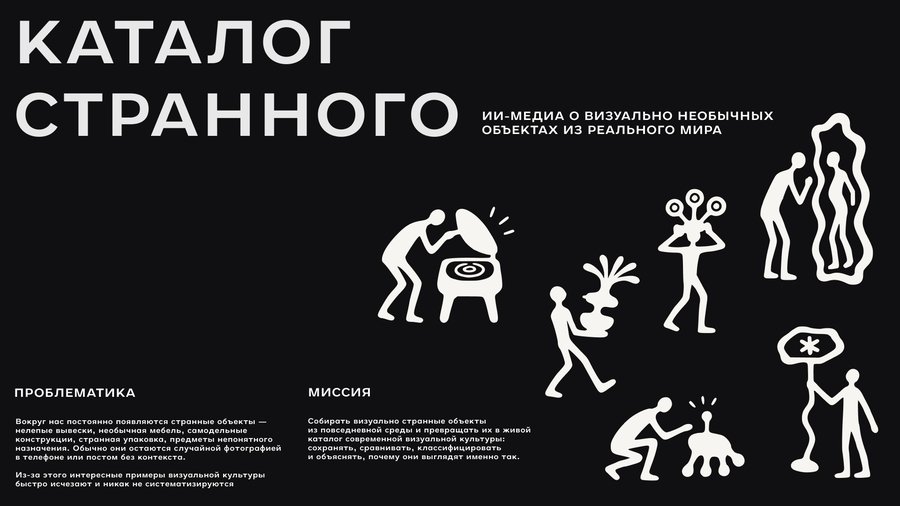
Media Objective To create a continuously growing archive of the strange elements found in everyday visual culture—ranging from obscure objects and DIY constructions to unconventional design and urban environments.Business Goal (Benchmark) By the end of the year, gather an audience of approximately 500 followers on the main platform and build an active community that submits its own discoveries. Subsequently, develop the project through native integrations with cultural and design initiatives, special projects with brands and institutions, and partnership materials.Role of Automation AI assists in locating and sorting visual finds, recognizing objects, searching for similar examples, and preliminarily categorizing them. The neural network compiles a draft report on the object, while the author is responsible for verification, final classification, interpretation, and presentation.
FORMAT, FEATURES, AND CATEGORIES
Every post presents a strange discovery—an object, item, or visual anomaly from the real world. The media showcases where it was found, what it is, why it looks unusual, what category it belongs to, and what it resembles.
Key Features:
- Only visually peculiar objects that deviate from the norm;
- Each object receives a brief classification: type of anomaly, function, environment, and origin;
- Search for similar objects and visual «relatives»;
- A blend of random user submissions and editorial selection;
- AI assists in recognizing, grouping, and comparing objects, while the editor verifies and explains the context.
Categories:
«Discovery of the Day”—one strange object: photo, location found, a brief description, and classification.
„What Is This Anyway?”—an item with an unclear function or origin; AI helps determine the possible purpose, and the author vets the theories.
„Relatives”—several visually similar strange objects from different locations, eras, or categories.
„Type of Anomaly”—a curated selection of objects based on a single characteristic: too long, too soft, having extra parts, anthropomorphic, homemade, etc.
„People’s Catalog”—discoveries submitted by readers; the best ones are added to the project’s main database.
„Weird Weekly”—a compilation of the most unusual objects of the week, complete with short editorial commentary.
COMPETITORS
Closest to a «Catalogue of Oddities» are projects that compile unusual objects and communities where users attempt to understand what the object before them is. For instance, OddityMall, since 2012, has featured unusual goods, gadgets, furniture, and strange inventions, but its logic is primarily product-driven: showcase an interesting item and provide a link to the seller.
Where I looked:
I searched through media and communities using the queries: «strange objects, ” „unusual items, ” „what is this thing, ” weird objects, unusual objects, odd design, strange furniture, what is this thing. I reviewed design media, unusual goods websites, visual archives, and user communities that publish and identify unknown objects.
Competitive Criteria:
- Selection — how truly unusual the object is, rather than just colorful or decorative.
- Explanation — whether the media explains what the object is and why it exists.
- Classification — whether the finds are grouped by type, shape, function, or origin.
- Context — whether there is a history, author, place, era, or cultural context.
- Visual System — whether the project looks like a unified catalog rather than a random stream of images.
- Audience Participation — whether readers can submit their finds and participate in identification.
- Regularity — how systematically the object database is updated.
INSIGHTS
The strange is inherently attention-grabbing. No one builds it into a systematic classification. Competitors present a stream of isolated finds. We are building a catalog where every object becomes part of a cohesive taxonomy.
The core user question isn’t «Do I like it or not?» but «What is this, fundamentally?» This means the content core must focus on an object’s identification, function, and origin, rather than just being a visual collection.
The market lacks a language to describe strangeness. Competitors categorize by object type or theme. We are introducing our own typology of strangeness: hybridity, disrupted function, distorted form, anthropomorphism, scale, and handcrafted nature.
Strangeness works best in comparison. An object on its own might just look unusual. Placed next to the norm, it becomes clear exactly where the visual glitch occurred. This leads to formats like «Norm / Anomaly» and «Relatives.»
The user is the primary driver for catalog growth. The more finds the community submits, the more valuable the archive becomes. Content scales not only through editorial curation but through the community itself.
Competitors’ main deficiency is context. They show an object but rarely answer: where did it come from, why does it exist, and why does it look this way? We add context as a mandatory layer to every piece of content.
AI is needed here not for generation, but for navigating visual chaos. It searches for similar objects, suggests connections, and proposes preliminary categories. The editor remains responsible for validation and meaning.
DISTRIBUTION CHANNELS
Primary Platform — Telegram.For the «Catalog of Oddities, ” publication speed, visual appeal, and audience engagement are crucial. Telegram is ideal for publishing individual finds, grouping them into categories, conducting polls, and receiving user-submitted content. The channel is gradually evolving from a simple feed into a living archive of strange objects, which is enriched by both the editorial team and readers.Telegram Formats:
- „Find of the Day“ — one object, a photo, a brief explanation, and the type of oddity.
- „What Is This?“ — an unknown item + audience theories + final identification.
- „Normal / Glitch“ — a common object alongside its strange variation.
- „Relatives“ — several visually similar objects from different contexts.
- „Oddity of the Week“ — a curated selection of the best finds and catalog updates.Secondary Platform — Pinterest. Here, the project functions as a visual entry point into the catalog. A user might encounter an unusual object through recommendations and then navigate to the full breakdown. Pinterest is suited for: — individual object cards; — series organized by oddity type; — visual comparisons; — collections of „5 objects of the same type.“Platform Adaptation The content is not duplicated verbatim. A single find is transformed into: Telegram — a complete analysis and classification; Pinterest — a visual card and a selection of similar objects;
Each platform leads people to a single action: to see something strange, to want to understand it, or to open the catalog.
AI sorts the chaos. The editor creates meaning.
TARGET AUDIENCE
B2C Audience — individuals interested in unusual objects and visual anomalies within the everyday environment.The project identifies 4 motivation segments:1. Observers — they look at and document strange finds. 2. Researchers — they want to understand what something is and why it looks the way it does. 3. Visual Professionals — they use the catalog as a source of references and forms. 4. Find Hunters — they discover objects themselves and add them to the catalog.