from Greek κινητικός (kinētikos) — moving / capable to move
Kinetic Art a 20th-century movement where movement is not just a feature but the main means of expression. The artwork literally cannot exist without it.
The idea of movement in art is ancient. It first appeared in cave paintings, where early humans tried to capture basic motion — from an instinctive step to the majestic stride of a pharaoh. Later, movement developed in sculptures influenced by the environment, such as the Winged Victory of Samothrace, whose clothes seem to blow in the wind. Impressionist painters explored the subtle vibration of light and nature. Then, the Futurists, Dadaists, and Constructivists openly celebrated motion. However, the term «kinetic» was first applied to visual arts by Naum Gabo and Anton Pevsner in their Realistic Manifesto (1920).
Movement in kinetic art can achieved in several ways: through natural forces (wind, water etc.), mechanical motors, technological sources (electricity), or by the viewer’s direct interaction (interactivity).
examples of art works
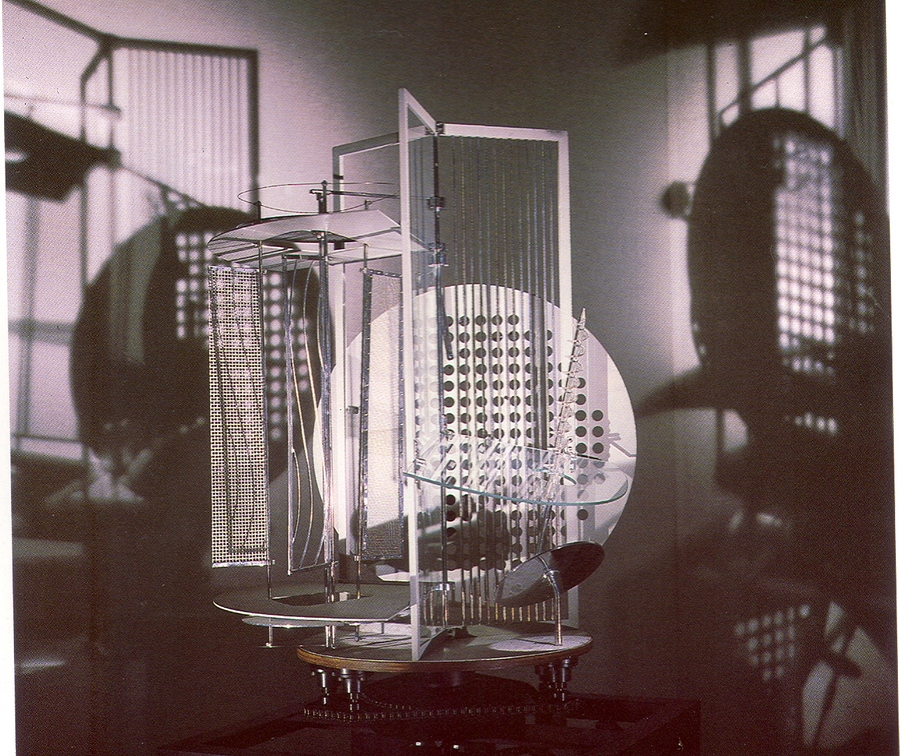
Light-Space Modulator — László Moholy-Nagy, 1921-30
This unnamed kinetic machine combines light, shadow, and mechanical principles. It has three sections, each producing a different type of motion: jerky pushes (for rods), circular rotation (for discs), and spiral movement (for glass blocks). Coloured lamps turn on in a set sequence, creating a landscape of light and a composition of light and shadow.
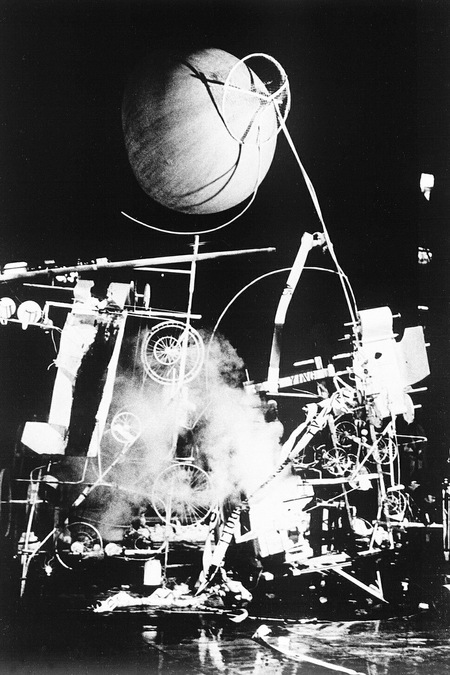
Homage to New York — Jean Tinguely, 1960
A self-destroying, self-decomposing artwork. It was created for a performance in the Sculpture Garden of the Museum of Modern Art (MoMA) in New York, made in collaboration with engineer Billy Klüver and artist Robert Rauschenberg. The machine’s program ran for 27 minutes, after which it exhausted and destroyed itself — it was a performance.
Concert for Anarchy — Rebecca Horn, 1990
This upside-down piano was a prop for Horn’s film Buster’s Bedroom (1990). Set in a psychiatric hospital, the piano behaves like a living creature — sometimes getting upset, sometimes calming down, producing strange sounds and noises. Horn described it as: «Having freed itself from the psychiatric clinic, it now hangs upside down from the ceiling, composing its own music, developing a new tonality.» [1]
key practitioners / artists
1. Naum Gabo (1890–1977)
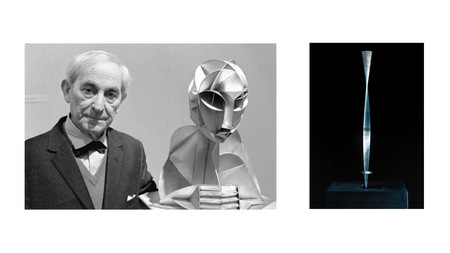
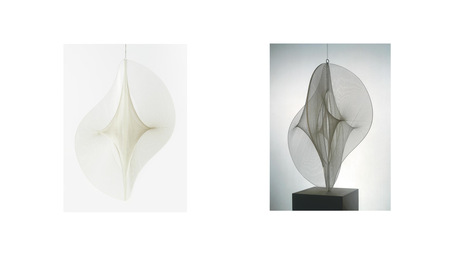
on the left portrait of Naum Gabo and his work Kinetic Construction (Standing Wave) 1919–20; on the right — Linear Construction No. 2, 1970–1
Naum Gabo — His Kinetic Construction (Standing Wave) (1919–20) is often seen as one of the earliest examples of kinetic art. His innovation was the «stereometric method»: form is created through intersecting planes, empty spaces, and edges, not by shaping solid mass. He was also among the first to use modern industrial materials (Plexiglas, nylon thread) to achieve a «dematerialization» of volume.
2. László Moholy-Nagy (1895–1946)
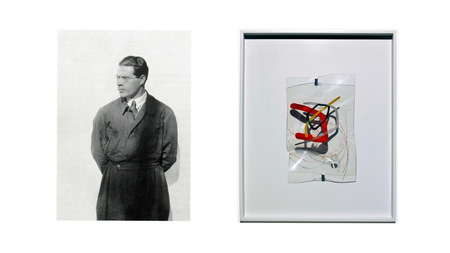
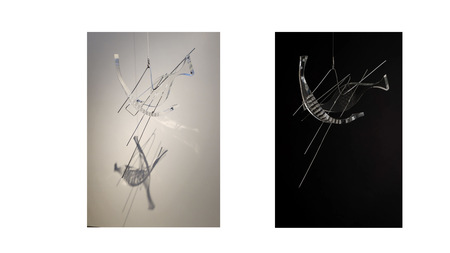
on the left portrait of László Moholy-Nagy and his work B-10 Space Modulator, 1942; on the right — Mobile Sculpture (Space Modulator), 1943
László Moholy-Nagy — A Hungarian artist and Bauhaus teacher, he was a pioneer in using light as an artistic material. He insisted that movement should be an essential part of sculpture and that the viewer should activate the work through their participation. He also attempted to create kinetic painting, as shown through his experiments with transparent Plexiglas on a flat surface.
3. Alexander Calder (1898–1976)
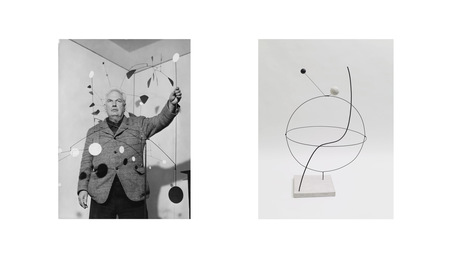
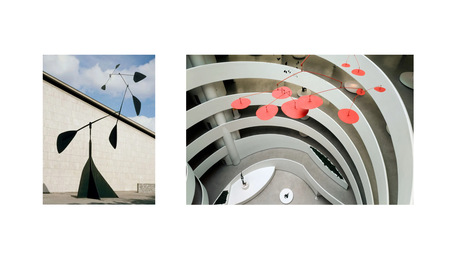
portrait of Alexander Calder and his work Croisière, 1931; on the right — Spirale, 1958 and Red Lily Pads, 1956
Alexander Calder — An American sculptor who invented abstract kinetic sculptures called «mobiles,» moved by natural forces (air currents). His works play with balance, weight, and weightlessness, where each element can shift position at any moment.
4. Jean Tinguely (1925–1991)
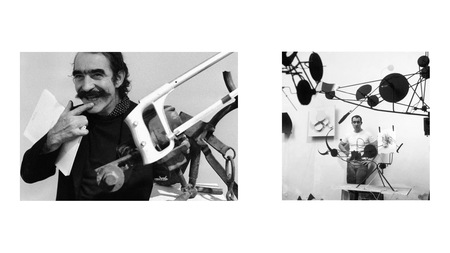
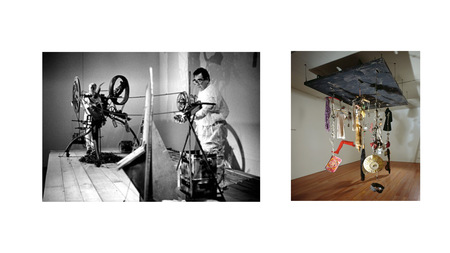
firstly his portraits, then his works: Ballet des pauvres, 1961; Rotozaza No. 2, 1967
Jean Tinguely — A Swiss kinetic artist who created «meta-machines» from found objects, trash, and industrial parts. His mechanisms are chaotic, absurd, and often self-destructive. For Tinguely, movement is not about harmony but a critique of industrial society and technological optimism.
5. Rebecca Horn (р. 1944)

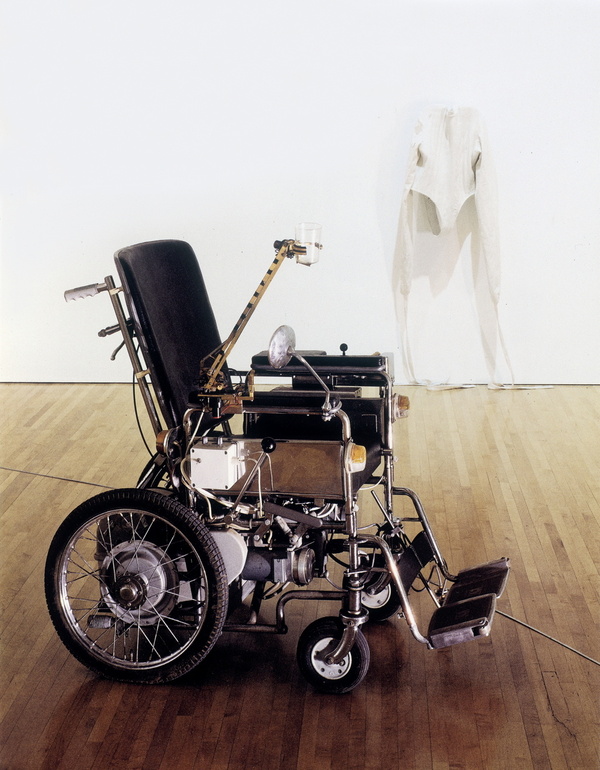
on the left — portrait of Rebecca Horn; on the right — Memorial Promenade, 1990
Rebecca’s kinetic art works through themes of trauma, fragility, and bodily experiments. She blurs the line between human limbs and technical devices that «extend» them into space.
In Buster’s Bedroom, the central element is a wheelchair called Memorial Promenade. It exists on its own, without a person, almost replacing them.
My machines are not washing machines or cars. They have a human quality and they must change. They get nervous and must stop sometimes. If a machine stops, it doesn’t mean it’s broken. It’s just tired. The tragic or melancholic aspect of machines is very important to me. I don’t want them to run forever.
Horn creates imperfect and vulnerable machines — this is a unique branch of kinetic art. Unlike the ideal machines of the Constructivists, Horn’s mechanisms can stop or break down. This is not a failure; it is part of their life. She builds imperfect devices that spray paint on their own, making an artistic statement.
on the left — High moon, 1991; in the middle — The Little Painting School Performs a Waterfall, 1988; on the right — The lovers, 1991
key thinkers / theoretical foundation
1. Naum Gabo and Anton Pevsner — The Realistic Manifesto
Naum Gabo — Along with his brother Anton Pevsner, he introduced the concept of «kinetic rhythms» into art in the Realistic Manifesto (1920).
We renounce the thousand-year-old delusion in art that held the static rhythms as the only elements of the plastic and pictorial arts. We affirm in these arts a new element — the kinetic rhythms as the basic forms of our perception of real time.
For centuries, static rhythms dominated art. A motionless sculpture or painting was seen as a fundamental historical and cultural artifact. They still are. But static and stable forms dictated our relationship with space, time, and movement. The norm of stillness was linked to broader cultural ideas. In the Middle Ages, keeping things in place meant keeping them under control — ordered, lawful. Galileo’s idea of extension in time broke this logic and created anxiety: the world became infinite and elusive, like movement itself.
Space and time are re-born to us today. Space and time are the only forms on which life is built and hence art must be constructed.
Kinetic rhythms replaced static ones. They include time as a fourth dimension alongside space, opening up more possibilities for different perspectives, philosophies, and interpretations. Gabo and Pevsner’s manifesto declared movement and space as new elements of art.
Most famous texts: 1. Gabo: The Constructive Idea in Art (1937), Sculpture: Carving and Construction in Space (1937); 2. Pevsner: Science Foils Poetry (1977) / for both: The Realistic Manifesto (1920).
2. Lawrence Alloway — The Arts and the Mass Media
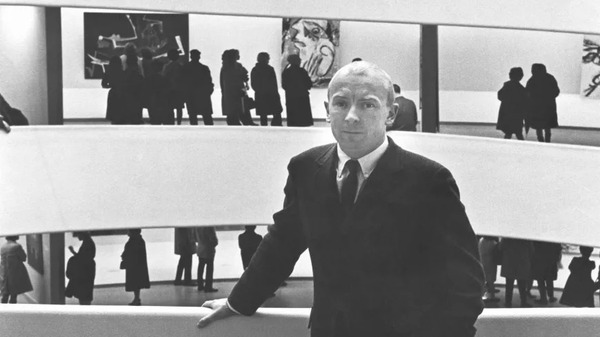
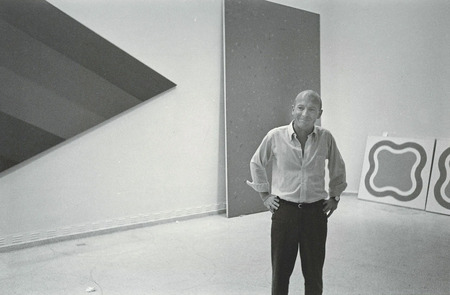
Lawrence Alloway — A British critic and curator, leader of the Independent Group. In his essay, he made a conceptual shift, rejecting the elitist division between «high» art and «low» art (kitsch). Instead, he proposed the theory of a cultural «continuum.» Alloway legitimized popular culture, technology, and urban aesthetics as valid material for art. By directly linking technological progress with artistic forms, he created a theoretical basis for understanding kinetic art, later calling it a key sign of a new era. His work helps explain why kinetic art emerged during industrialization and the rise of media.
Most famous texts: The Arts and the Mass Media (1958); Necessary and Unnecessary Words (1981); American Pop Art (1974); Art and the Complex Present (1984).
3. Alan Kaprow — Assemblages, Environments and Happenings
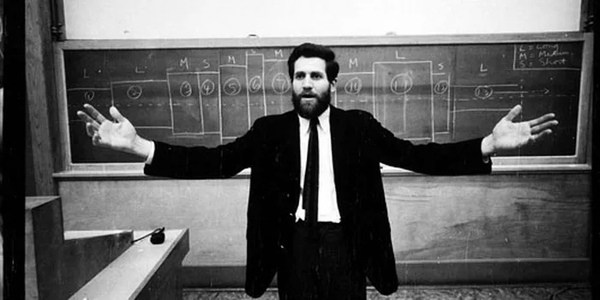
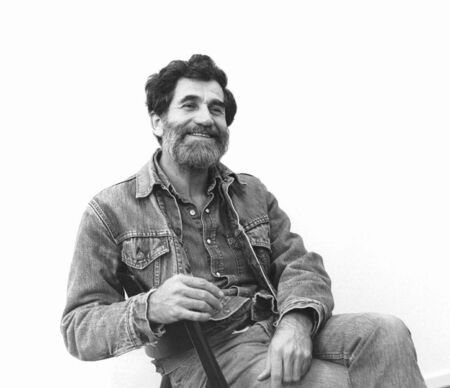
Allan Kaprow — An American artist and theorist. In his text Assemblages, Environments and Happenings (1965), he introduced a key idea: «extension.» From assemblage grew Environments, where «the viewer becomes a real part» of the work, and then Happenings — «events at a set time.» His belief that the line between art and life should be as fluid as possible directly connects to kinetic works that depend on real movement, time, and viewer participation. Kinetic artists are direct predecessors of Happenings: Tinguely and Horn also create «events.»
Most famous texts: Assemblages, Environments and Happenings (1959-65); Necessary and Unnecessary Words (1981); American Pop Art (1974); Art and the Complex Present (1984).
on the left — Nicolas Schöffer; in the middle — Frank Malina; on the right — Julio Le Parc
Nicolas Schöffer — Among the key theorists of kinetic art’s golden age, he introduced the concept of «cybernetic art,» creating sculptures that reacted to light, sound, and viewer movement through computers and sensors.
Frank Malina — A scientist and artist who founded the influential journal Leonardo. He developed «lumino-kinetic paintings» — layered compositions of transparent Plexiglas lit by electric lamps and set in motion by motors. He also created audio-kinetic systems where image movement responded to sound.
Julio Le Parc — An Argentinian member of the Paris-based Groupe de Recherche d’Art Visuel (GRAV). He shifted focus from the moving object to the moving spectator. They introduced the concept of instabilité (instability) — the disappearance of permanent forms in favor of shifting light, shadow, and viewer movement. Le Parc’s works, such as his suspended metal paillettes that shimmer with the slightest air current, embody this principle: the artwork is not complete until the viewer moves, activating its visual effects through their own physical presence.
influence on Kinetic Art / what shaped it
Kinetic art was shaped by several avant-garde movements:
Futurism (1909, Marinetti) was the first to declare movement and speed as aesthetic values, celebrating the machine.
Dadaism (1916–1922) brought irrationality and absurdity, using chance and destruction.
Russian Constructivism (1920s) — which Peter Weibel calls the «main source» of kinetic art — created abstract, dynamic structures free from mimetic function. In 1920, Gabo demonstrated that a moving rod could become a «virtual volume,» marking the start of Constructivism.
Bauhaus (Gropius, Moholy-Nagy) integrated technology and art, and its theatre workshop explored the «human-machine.»
influence on Kinetic Art / what it shaped
In the analog art forms (op and kinetic art, Fluxus, happening) the intuitive use of the concept of the algorithm led to mechanical and manual prасtices of programming, procedural instructions, interactivity, and virtuality.
Kinetic art directly influenced several later movements:
Op Art (1960s, Vasarely, Riley) developed the «illusion of movement» on a flat surface — one branch of kinetic art. As Peter Weibel notes, virtuality connects kinetic art with op art through perceptual phenomena.
Happenings and Fluxus (Kaprow, Beuys, Brecht) took from kinetic art the idea of art as an event and the involvement of the viewer. Weibel emphasizes that in these movements, everyday objects were replaced by «instructions for action» addressed to the audience.
Programmability-at least as a concept-had now taken its place alongside the notions of virtuality, the environment, the internal observer and/or interactivity (the user sets in motion the mobile work of art, the kinetic sculptures, co-constructs the «kinetic construction»).
Interactive Art (1970s — present) inherited from kinetic art a «dependence on the viewer» — pressing buttons, moving components. Weibel calls these early, pre-computer forms of mechanical and manual interactivity.
Techno-feminist discourse and Cyborg Art (1990s, ORLAN, Stelarc) inherits from Rebecca Horn an interest in prosthetics and the body as an expandable system.
… perhaps when we think of kinetic art, we can think of it as art in motion, not only because of the movement it incorporates but also because it is art that does not possess a fixed state; rather, the art is in flux, as is our understanding, interpretation, and reception of it
Busse B. M. Rebecca Horn (1944–2024) / Bettina M. Busse // The Burlington Magazine: [сайт]. — 2025. — 23 May. — Режим доступа: https://contemporary.burlington.org.uk/articles/articles/rebecca-horn-19442024#fn: 4 (дата обращения: 02.05.2026).
Harrison C., Wood P. (eds.). Art in Theory 1900-1990: An Anthology of Changing Ideas. — Oxford: Blackwell Publishers, 1992. — 1189 p. — ISBN 978-0631165756.
Weibel P. It Is Forbidden Not to Touch: Some Remarks on the (Forgotten Parts of the) History of Interactivity and Virtuality / Peter Weibel. — 2006. — Режим доступа: http://www06.zkm.de/zkmarchive/www02_pewe/html/images/stories/pdf/2006/0914_IT_IS_FORBIDDEN.pdf (дата обращения: 02.05.2026).
Rivenc R. Preface [Электронный ресурс] / Rachel Rivenc // Keep It Moving? : [коллективная монография] / Getty Publications. — Режим доступа: https://www.getty.edu/publications/keepitmoving/preface/ (дата обращения: 02.05.2026).
Morin E. Performance: Machine Dances and the Avant-garde’s Technological Imaginary / Emilie Morin // The Edinburgh Companion to Modernism and Technology / ed. by Alex Goody, Ian Whittington. — Cambridge: Cambridge University Press, 2023. — Глава 15. — Режим доступа: https://www.cambridge.org/core/books/abs/edinburgh-companion-to-modernism-and-technology/performance-machine-dances-and-the-avantgardes-technological-imaginary/660C436BCA4715839BAA113F8D1AFF1A (дата обращения: 02.05.2026).
Колейчук В. Язык кинетизма / Вячеслав Колейчук // Tatlin: [сайт]. — 2019. — 14 июня. — Режим доступа: https://tatlin.ru/articles/yazyk_kinetizma (дата обращения: 02.05.2026).
Horn R. The Journey to China: [выставка в Hua International Gallery, 26 мая — 12 августа 2023] / Rebecca Horn; куратор Thomas Schulte. — Режим доступа: https://hua-international.com/exhibitions/37-the-journey-to-china-rebecca-horn/ (дата обращения: 02.05.2026).
Banks E. Eric Banks on Lawrence Alloway’s «Network: The Art World Described as a System» / Eric Banks // Artforum: [журнал]. — 1972. — Сент. — Режим доступа: https://www.artforum.com/columns/eric-banks-on-lawrence-alloways-network-the-art-world-described-as-a-system-200873/ (дата обращения: 02.05.2026).
Frank Malina / Les presses du réel. — Режим доступа: https://lespressesdureel.com/EN/EN/auteur.php?id=5953&menu=41 (дата обращения: 02.05.2026).
Instabile-continuel lumière (Unstable-Continual Light) [кинет. объект, ок. 1962] / Buffalo AKG Art Museum. — Режим доступа: https://buffaloakg.org/artworks/k196318-instabile-continuel-lumi%C3%A8re-unstable-continual-light (дата обращения: 02.05.2026).
https://elephant.art/ghost-in-the-machine-nicolas-schoffer-and-the-birth-of-cybernetic-art-21022022/