Definition
Land Art, also known as Earthworks, is an artistic movement that emerged in the United States during the late 1960s. Rejecting the traditional gallery and museum space, Land Artists moved their practice into deserts, fields, lakes, and other natural environments. Instead of creating portable objects, they transformed the landscape itself into the artwork. By doing so, they challenged conventional ideas about authorship, ownership, permanence, and the relationship between art and nature.
Origins and Influences
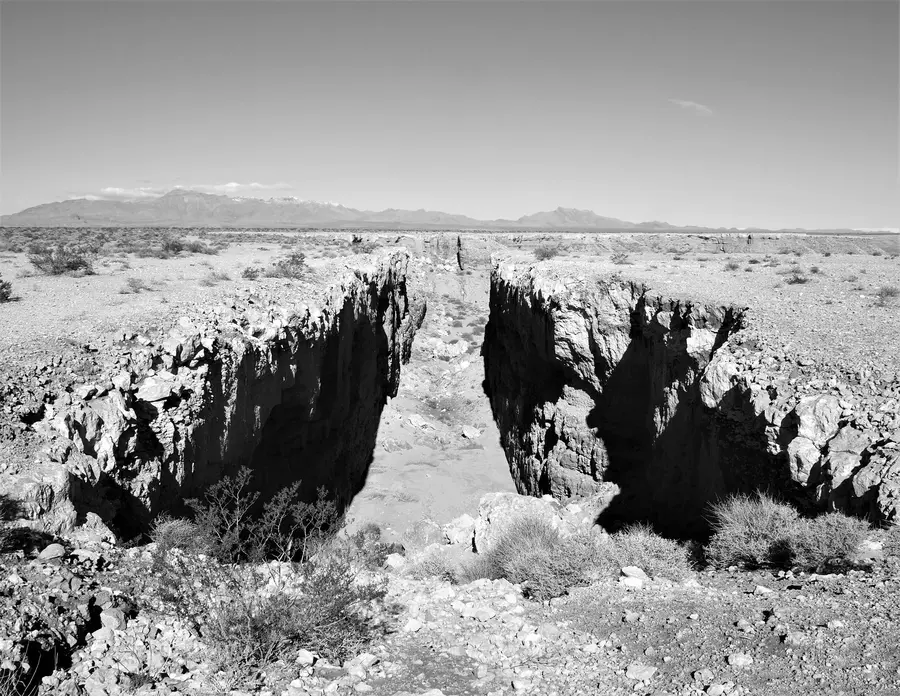
Double Negative. 1970
The movement developed at a time when many artists were dissatisfied with the commercialization of the art market. Influenced by Minimalism and Conceptual Art, Land Art emphasized process, site, and experience rather than collectible objects. The growing environmental awareness of the 1960s also encouraged artists to reconsider humanity’s relationship with the natural world.
Key Works
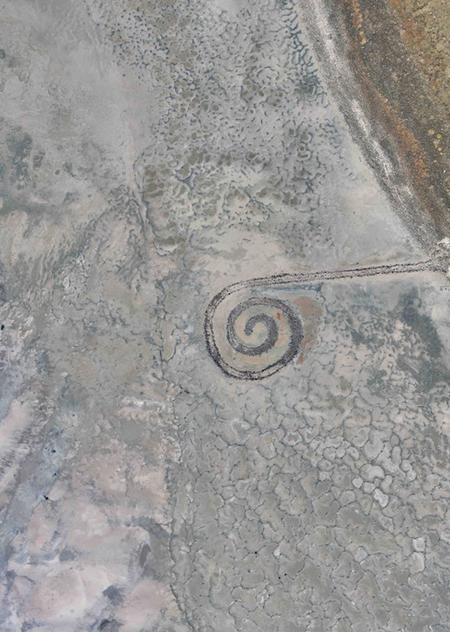
One of the most iconic works of Land Art is Spiral Jetty (1970) by Robert Smithson. Constructed from rock, mud, and salt crystals in Utah’s Great Salt Lake, the work forms a massive spiral extending into the water. Another important example is Double Negative (1969–1970) by Michael Heizer, consisting of two enormous trenches cut into the Nevada desert. Walter De Maria’s The Lightning Field (1977), a grid of four hundred stainless steel poles installed in New Mexico, demonstrates how natural phenomena become an integral part of the artistic experience.
Nancy Holt. Spiral Jetty. 1970
Josh Brasted. Double Negative by artist Michael Heizer. January 24, 2021
Walter De Maria. The Lightning Field. 1979
Artists and Theory
Jack Robinson. American sculptor and artist Robert Smithson. November 7, 1969.
Among the leading figures of the movement, Robert Smithson played a dual role as both artist and theorist. His essay A Sedimentation of the Mind: Earth Projects (1968) argued that artistic practice could engage directly with geological processes and entropy. Michael Heizer explored monumentality through large-scale interventions in the landscape, while Walter De Maria focused on the interaction between natural forces and human perception. Nancy Holt expanded the movement through works that combined environmental observation, architecture, and astronomy.
Robert Smithson. Spiral Jetty at Great Salt Lake, Utah. 1970
The theoretical foundations of Land Art were shaped not only by artists but also by critics and historians. Lucy Lippard connected Earthworks to the broader tendency toward the «dematerialization» of art, where ideas and experiences became more important than physical objects. Rosalind Krauss later described such practices in her influential essay Sculpture in the Expanded Field (1979), arguing that contemporary sculpture had moved beyond traditional definitions and entered new relationships with architecture and landscape.
Legacy
The influence of Land Art can still be seen in contemporary environmental art, site-specific installations, and ecological artistic practices. By moving art beyond the walls of museums and into the natural world, Land Art redefined both the meaning of sculpture and the role of the viewer. Rather than simply observing an artwork, the audience becomes a participant within a larger environment, experiencing art as a physical encounter with space, time, and nature.
Andres Sune Berg. Olafur Eliasson — Riverbed. 2014
Harrison, C., Wood, P. (eds.). Art in Theory 1900–1990: An Anthology of Changing Ideas. Oxford: Blackwell Publishers, 1992.
Lippard, L. Overlay: Contemporary Art and the Art of Prehistory. New York: Pantheon Books, 1983.
Krauss, R. Passages in Modern Sculpture. Cambridge, MA: MIT Press, 1977.
Smithson, R. The Writings of Robert Smithson. Edited by Nancy Holt. New York: New York University Press, 1979.