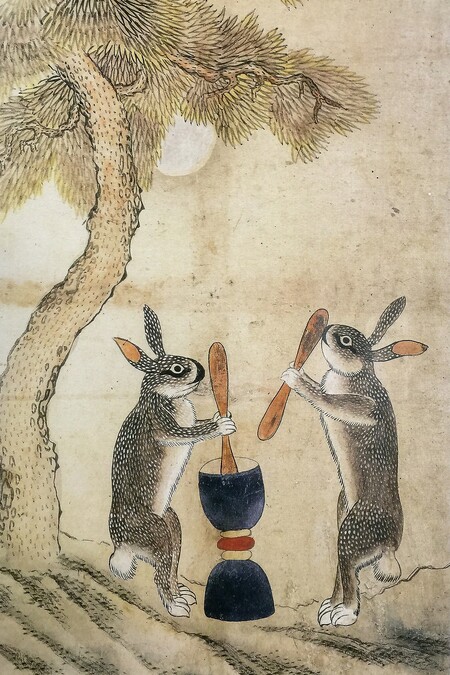

«You will see the moon arise At sunset, in the evening hour. But when the dawn arrives—you won’t notice, That its light has faded. A white hare throws medicine upon it. And spring replaces winter.»An excerpt from the poem «Questioning the Moon with a Cup in Hand» by the Chinese poet Li Bai, translated by A. Gitovich.
Concept
The Moon Rabbit is an intriguing motif for comparative visual study, given that its variations across different cultures are fascinating to track and to seek explanations for. Across images from various eras, the lunar disk, tree, mortar and pestle, and rabbit are recurring elements, yet their underlying meanings can differ. The rabbit may inhabit the celestial realm, serve as a deity’s assistant, prepare magical remedies, festive delicacies, or simply be an animal under the autumn moon. This research allows one to trace not just the spread of a single narrative, but the process of an image being translated between cultures. For centuries, China, Korea, and Japan shared a common repository of Buddhist texts, calendrical concepts, and artistic motifs; however, this did not result in the mechanical repetition of identical imagery. Instead, the Moon Rabbit emerged as a distinctive visual «indicator» of cultural adaptation: compositions that were visually similar acquired divergent meanings.
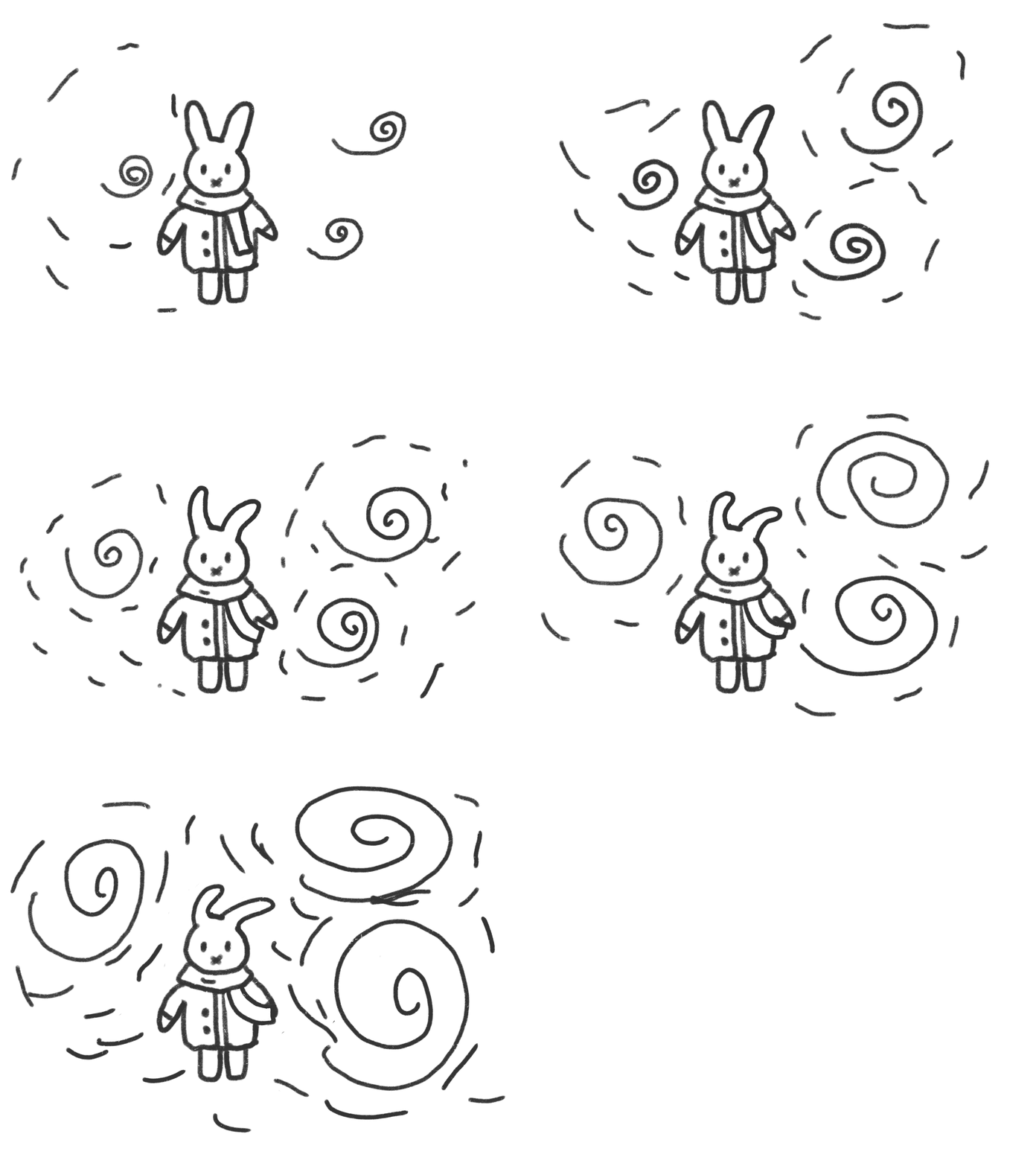
Materials were selected based on the presence of characteristics that allow for the identification of a connection to the image of the moon rabbit. Preference was given to images where the rabbit’s posture, actions, relationship to the Moon, adjacent figures, and objects could be observed. Countries such as Japan, Korea, and China were considered.
The material is based on museum artifacts, which include bronze mirrors, textiles, painting, engravings, and small decorative arts objects in the study. The contemporary museum exhibition is examined separately—as evidence of the relevant reinterpretation of the character. The diversity of sources is necessary because the meaning of the image changes not only between countries but also when transitioning from one object to another.
The research is organized geographically and chronologically. The sections of the study are: - China: Celestial Space and Well-Wishes - Japan: Action, Seasonality, and Play - Korea: Cosmology, Symbols, and Ceremony - Cultural Comparisons Each section examines the specific cultural aspects shaping and interpreting the image. Within the sections, an approximate chronological sequence is maintained. The concluding part compares the overarching motifs found in the works. This arrangement allows for a clear view of the cultural and historical transformations of a single visual motif.
Textual sources were selected based on the priority of museum catalogs and academic articles and research concerning art history, religion, and folklore. For the origin of the image, studies of the Buddhist Śaśa Jātaka—a tale of a rabbit who sacrificed itself for a hungry traveler—were important; in Buddhist tradition, its image was transferred to the Moon as a remembrance of perfect self-sacrifice. The sources are juxtaposed, rather than assembled into one indisputable narrative.
«Why does the image of the Moon Rabbit take on different meanings and visual characteristics across Chinese, Japanese, and Korean cultures?» This question became central to my research and formed its foundation.
Research Hypothesis: The similarity in images is due to a shared regional complex of concepts regarding the Moon, and differences arise when the image is incorporated into the specific religious, linguistic, holiday, and artistic canons of an individual country. This hypothesis does not presuppose the existence of a single original myth that was subsequently «distorted» in other countries. It is more logical to consider several interacting traditions: concepts of the celestial animal, miraculous medicine, moral narratives about the hare, and rites associated with observing the Moon.
China: Celestial Space and Benediction