RESEARCH CONCEPT
I chose the topic of the artisans of Deir el-Medina during Ramses III because I am interested in examining the pharaoh’s era through the lives of the people who worked on the royal necropolis. Typically, discussions about the ruler are limited to his monuments, military campaigns, or official portraits. Instead, I want to explore how the royal project was connected to the labor, provisioning, family life, and religious practices of a specific community. While Ramses III remains the primary historical framework for this study, his reign is revealed through the society around him.
The main research question
How do visual and material evidence help us understand the connection between the royal organization of labor and the daily life of the craftsmen of Deir el-Medina during Ramesses III’s reign? My hypothesis is that this community cannot be described solely as a collective of builders for royal tombs. People engaged in a common endeavor also lived family lives, used objects and resources, invoked the gods, and created their own collective memory. The interdependence of these different aspects of life is particularly evident in the records concerning the work stoppages in the 29th year, when supply was delayed—the workers were able to unite and demand that the administration fulfill its obligations.
Material Selection Principles
I selected the material based on its connection to the community’s life and how reliably its date and origin can be determined. The main set includes objects and documents that museum catalogs link to the reign of Ramesses III, as well as plans and photographs that help understand the settlement’s space. Other images are dated more broadly—the Ramesside period, the entire New Kingdom, or the time of Ramesses III–IV. There is also an earlier item included for comparison. These pieces expand the visual range but are not used as direct evidence of events during Ramesses III’s reign. Differences in dating are noted in the captions and comments.Textual sources were chosen based on the research objectives: studies on community life and labor organization help reconstruct the context, while publications about labor conflict help analyze the events of the 29th year. I compare the information from museum catalogs regarding origin, material, and dating with scholarly research and the images themselves.
In my analysis, I take into account not only the context but also the artifact’s characteristics: its material, size, shape, condition, composition, and intended use. If an item has disputed dating, I note this separately. The goal of this research is not to reconstruct the daily life of every resident of Deir el-Medina. For me, what is important is to show how the preserved artifacts reflect the connection between labor organization at the royal necropolis, daily life, and the religious memory of the artisans and their families during the reign of Ramesses III.
Chronology: The main focus is the reign of Ramses III, the Twentieth Dynasty, 12th century BCE, approximately 1187–1157 BCE; dates from different sources may vary. Artifacts dated earlier or later are included only for comparison.
Geography: Deir el-Medina and the West Theban necropolis near ancient Thebes, close to modern Luxor; worksites in the Valley of the Kings and the Valley of the Queens.
Settlement and Necropolis: A Space of Labor
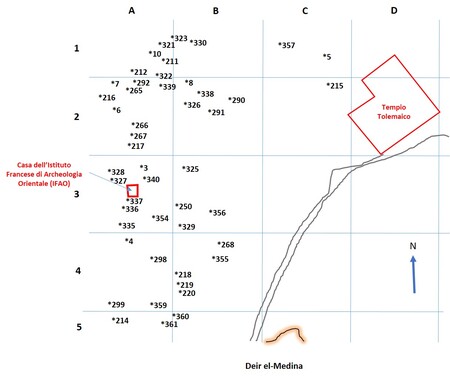
The diagram illustrates the area of Deir el-Medina, where the village is marked along the bottom edge, and tombs of the elite and other landmarks are noted nearby. This is a modern map, not an ancient map or a plan of the village itself. It helps to visualize the settlement’s geographical location without showing its internal layout or the daily routes of its residents. The community’s connection to the royal necropolis is established by the historical context of the artisans' work, whereas the map merely helps visualize the settlement’s placement relative to the surrounding monuments.