Introduction
For Claude Monet, the garden was not merely an object for depiction or presentation. It was a living, crafted ecosystem where the artist functioned as a creator, an explorer, and a mirror of his internal transformation. This visual study demonstrates how the image of the garden in Monet’s work fundamentally changed over 60 years. It evolved from a traditional element of European culture into a self-sufficient, proto-abstract category. Monet traversed a path from realistic depictions of nature to abstract painting, where distinct objects dissolve into pure color and light.
The artist gradually relinquished tangible forms to convey the sensation of fleeting time and atmosphere. Changes in his style were deeply intertwined with his personal life—family tragedies, historical events, and a severe eye ailment that compelled him to blur the boundaries of objects and eliminate the familiar horizon from his canvases.
The metamorphosis of the garden in Monet marks a gradual abandonment of the «earthly» horizon in favor of the aquatic element. It represents a shift from objective observation toward a subjective experience of eternity.
The garden in Giverny, created and captured by Monet, has become a symbol of the Impressionist perception of the world.
Navigation
- Introduction — Research Concept
- Main Body — Biographical and Historical Context — The Early Image of the Garden in Monet’s Painting — The Arjantey Period and the Shifting Artistic Gaze — The Garden in Vete’s Period Works — Giverny as the Garden of a Man-Made Myth — The Image of the Water Garden During Dematerialization — Late Giverny Motifs and the Theme of Lost Form
- Conclusion — Sources
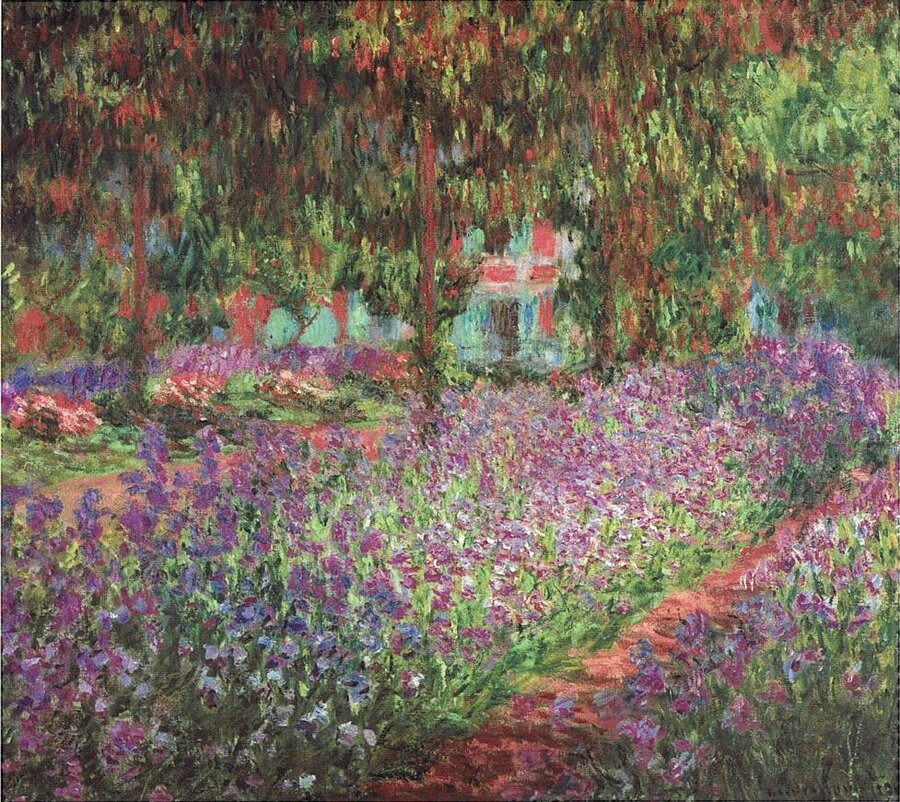
«The Artist’s Garden in Giverny» (Le Jardin de l’artiste à Giverny, 1900)
For Claude Monet, Giverny—where he moved in 1883—was initially just a quiet refuge in the Normandy countryside. Here, he settled into daily life, raised his children, and documented the familiar rural existence, transforming everyday garden scenes into Impressionist canvases.
Despite constant trips to London, Venice, or the harsh coast of the English Channel, this artificially created landscape became Monet’s primary focal point. The artist returned to it for decades, as if Giverny were the only place where his optical experiments could achieve absolute freedom.
Monet’s view of his garden changed radically. Initially, the canvases captured the actual geography of the estate—recognizable avenues, residential buildings, flowerbeds, and neatly planted flowers—but over time, the familiar topography begins to dissolve. Sharp outlines give way to shimmering light reflections, blurred masses of color, and unexpected perspectives that transform the landscape into a conventional decorative setting.
His gradual loss of sight and voluntary seclusion in Giverny transformed the real garden into a deeply personal, mystical image. Physical isolation and eye ailments altered the artist’s very optics. Monet stopped documenting the surrounding nature; instead, he began recreating it from memory, causing specific floral elements in his paintings to transform into pure symbols of color, and the tangible world to yield to inner vision.
Geography of Creativity: Key Milestones
Understanding the evolution of Claude Monet’s visual language is impossible without referencing his biography. Claude Monet was born in Paris in 1840, but spent his youth in Normandy, where he learned to work en plein air. In the 1870s, after settling in Argenteuil, he became one of the leading figures of Impressionism, capturing the fleeting dynamism of light and air. His move to Vétheuil in 1878 coincided with a severe life crisis—the death of his first wife, Camille—which temporarily made his palette moodier and his brushwork sharper and more impasto.
The turning point arrived in 1883 when Monet settled in Giverny. Initially, he rented the estate, but later purchased it and completely renovated it, integrating the landscape design into his artistic practice. Ten years later, Monet expanded his property by digging the famous pond for water lilies, which served as his isolated studio for thirty years. Even during World War I, when the front line approached perilously close, Monet adamantly refused to evacuate. He remained in Giverny, working on vast panoramic canvases as the central pursuit of his life until progressive cataracts finally deprived him of the ability to see familiar forms.
«Japanese Bridge» (Le Pont japonais, 1899)
Monet’s life journey vividly illustrates how a real-life country plot gradually transformed into an autonomous metaphysical space within his paintings. While the garden remained a natural habitat and a familiar place for walks during his early years, in his later years, it evolved into a closed world of pure meditation, where the precise contours of nature dissolved into the infinite play of color.
Main Section
Biographical and Historical Context
Claude Monet’s visual language evolved against the backdrop of tectonic shifts in European culture during the late 19th and early 20th centuries. Rapid industrialization, the expansion of rail networks, and urbanization radically transformed daily life. In art, the primary challenge was the advent of photography, which instantly captured the precise form of objects, freeing painting from the obligation to merely document reality. For Monet and his contemporaries, turning to Impressionism became a means of capturing living, mutable human perception—how light and air transform the surrounding space moment by moment.
The garden occupied a special place within this framework. It was not a random location; for Monet, it was an isolated, completely controlled territory where he could study the laws of optics in its purest form.
«Claude Monet — Impression, Sunrise (1864)»
His style evolved not only through theoretical inquiries but also through profound personal upheavals, which clearly divide his work into chronological stages:
1860s–1870s: A period of relative family prosperity and active travel. Nature in the canvases of this era functions as a social space—a neat, sun-drenched bourgeois paradise where people rest, stroll, and enjoy comfort.
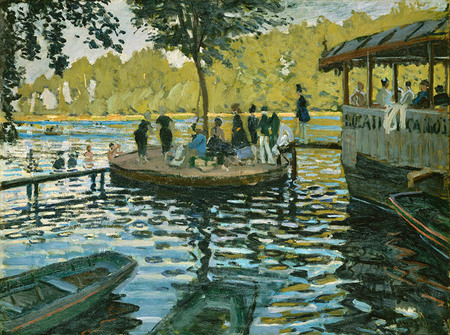
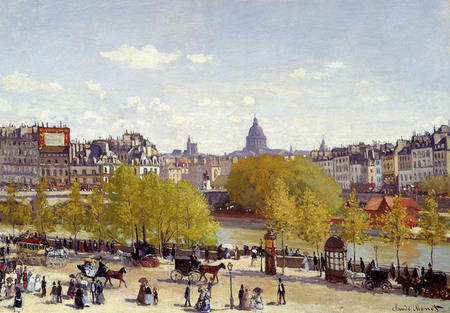
Claude Monet — Frog (1869) Claude Monet — Louvre Embankment (1867)
1879: The death of the artist’s first wife and muse, Camille Doncie, in Vete. This event shatters his former serene view of the world. The gardens in his paintings instantly lose their manicured appearance, transforming into wild, overgrown spaces that broadcast the author’s internal solitude and emotional strain.
Claude Monet — Church at Giverny, Snow (1878–1879)
1883: Moving to Giverny, which marked the beginning of his mature period. The garden transforms into a crafted myth. The artist replaces the random natural landscape with a completely constructed reality—he designs the landscape, combines plants by color and blooming time, creating a living open-air studio.
1910s–1920s: The final, most dramatic period. The horrors of the First World War, which claimed the lives of many loved ones, and the difficult physical ordeal of progressive cataracts weighed upon Monet’s creativity. The lens disease distorted his color perception, causing his palette to shift toward anxious, fiery reds, yellows, and dense brown tones, and the forms of objects ultimately disintegrated, paving the way for the abstractionism of the 20th century.
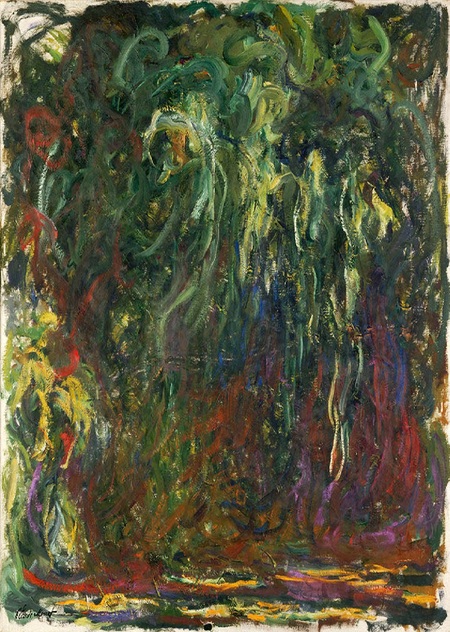
Claude Monet — Weeping Willow (1920–1922)
Early Impressions of a Garden in Monet’s Paintings
In the early period of his work, spanning the 1860s, Claude Monet viewed the garden through the lens of classical genre painting. Here, the garden is a tangible, human-organized environment where people—their social status, fashion, and habits—remain the central figures. Nature acts as charming theatrical scenery; the spatial boundaries are clearly defined by horizon lines, fences, or house walls, and the forms of the plants possess impeccable botanical detail.
«Ladies in the Garden» (1866, Musée d’Orsay, Paris) is a monumental work that vividly demonstrates Monet’s early approach. The garden space is rigidly structured here: a massive tree in the center divides the composition into two parts, and its branches form a kind of canopy over the protagonists. The artist meticulously renders the folds of the fashionable dresses, the texture of the fabric, and the geometry of the garden path. The light falls in dense, directional rays, casting sharp, contrasting dark shadows on the ground and the figures. Nature is entirely subjugated to humanity and serves as a frame for this social scene.
Claude Monet — Ladies in the Garden (1866)
«Terrace in St. Andrews» (1867, Metropolitan Museum of Art, New York). Here, the garden is presented as a symbol of bourgeois comfort and affluence. The composition of the painting is subservient to a strict linear perspective.