Table of Contents
1.Concept 2.Constructivist Perspective and Geometric Composition 3. Street Life and Worker Figures 4. Architecture and Spatial Rhythm 5. Portraits and Individual Representations 6. Industrial Aesthetics and Technological Imagery 7. Sport and the Movement of the Body 8.Conclusion
Concept
Following the October Revolution of 1917, the Soviet Union not only became an experiment in politics but also an enormous laboratory of culture. Artists, designers, and theorists all aimed to overturn the traditions of the pre-revolutionary past and create altogether novel aesthetic forms that would express socialism’s promises of dynamism, collectivization, and industrialization. Once seen as an inactive tool of record, photography was reconceptualized as an active force of ideology—capable of constituting perception, constructing social reality, and incarnating modernity in the proletarian state. It was in this climate that Alexander Rodchenko became a leading player, transforming the visual vocabulary of photography with his adventurous compositions, experimental perspectives, and adherence to Constructivist doctrine.
Rodchenko’s photography cannot be separated from the Soviet project of «building the new man.» His lens not only reflected the world but remade it. Welcoming extreme angles, overviews, diaganols, and broken frames, Rodchenko broke with the principles of classical perspective, and his work fell into line with the ideology of break and rebirth. These stylistic devices were not just novelties; they were means to an end. In Rodchenko’s vision, vision itself needed to be remade—liberated from bourgeois subjectivity and oriented toward the logic of mass production, efficacy, and technological lucidity. His images of staircases, fire escapes, balconies, and sports parades turned everyday Soviet space into symbols of discipline, motion, and collective power. This visual investigation into the interactions of form and ideology in early Soviet visuality employs the theory of Constructivism, and the writings of Arvatov and Gan in particular, to place Rodchenko among contemporaries like Dziga Vertov. Analyzing how his photographic aesthetic produced the grammar of modernity, the project conceives of Rodchenko’s camera as both visual apparatus and as social and political tool, a «new eye» for a new age.
By emphasizing Rodchenko’s characteristic visual methods—like the use of diagonal line, overhead perspective, and the modernist treatment of human subjects—this analysis reflects upon how photography was both an image of and an addition to Soviet modernity. Far from recording an achieved revolution, the work of Rodchenko imagines the very act of becoming: becoming modern, becoming industrial, becoming collective. In this manner, the work still challenges questions not just of art and propaganda, but of how we look, picture, and occupy the modern world.
Constructivist Perspective and Geometric Composition
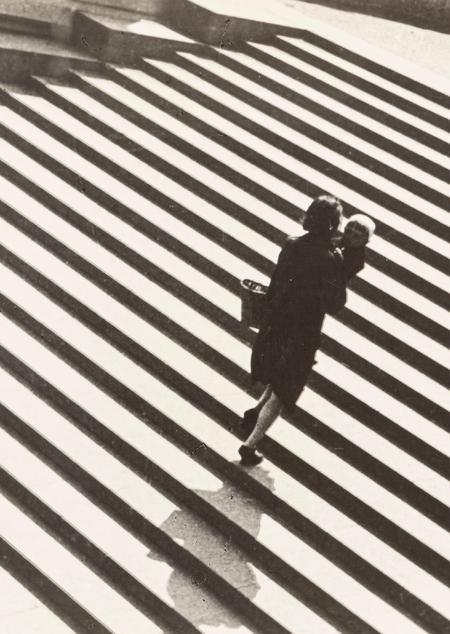
Rodchenko’s incorporation of extreme angles and geometric composition was more than just a visual preference—more a declaration of revolutionary vision. Inspired by the theory of Constructivism, Rodchenko’s diagonal and overhead compositions defied the passive stare of traditional photography, instead inviting the observer to enter an active, rearranged reality. These images defied passive looking and reflected the ambitions of the Soviets to restructure perception itself. The camera was used to retrain the eye to conform to the rational, mechanized pace of modern socialist existence.
Fire Escape (1925)
Power Station (1929)
Stairs (1929)
Guard on the Shukhov Tower (1929)
Mosselprom Building (1925)
Street Life and Worker Figures
Documenting the developing image of the Soviet citizen in the public space, Rodchenko’s street photography is anything but voyeuristic or romantic. These are photographs rooted in the logic of collectivisation and labor. Workers, traders, couriers, and city pedestrians are caught in motion, imbedded in the texture of Soviet quotidian. These portrayals focus on productivity, mobility, and the communal at the expense of the individual—a visual account of socialism in the making.
Cigarette Vendor, Pushkin Square (1928)
Courier Girl (1928)
Gathering for a Demonstration (1928)
Courtyard (1928)
Architecture and Spatial Rhythm
Rodchenko approached architecture not so much as a theme but as a language of modernity. By using rhythmic repetition, harsh contrasts, and upward-looking images, he converted buildings into visual metaphors for futurism, order, and social progress. His lens glorified the engineered landscape as the quintessential character of Soviet existence—where form existed in the service of ideology. The repeating patterns of balconies, glass buildings, and city infrastructures mirrored the new aesthetic hierarchy of the rationalized society.
Columns of the Museum of the Revolution (1926)
Glass and Light (1928)
Glass and Light II. (1928)
Curve of the Tramline (1932)
Ships at the Lock (1933)
Portraits and Individual Representations
Rodchenko’s portraits are strongly ideological. His portraits show people not in terms of internal psychology or feeling, but as expressions of the ideals of the Soviet state. As the subject is either a poet, worker, or member of a family, he is transformed into a representation of function, role, and membership in the collective endeavor. Rodchenko’s high-angle point of view, along with frontal composition, serves to stress the subject’s insertion in an overall social and political structure—yielding not personal narratives, but archetypes of the «New Soviet Person.»
Portrait of the Poet Vladimir Mayakovsky (1924)
Portrait of the Artist’s Mother (1924)