When we look at an old photograph of a room, we notice how the space has changed: furniture has disappeared, new objects have appeared, and the finishes have shifted. I am interested in how such changes can be used to depict the passage of time in American comics.Unlike film, where shots succeed one another, a comic book can feature different moments on a single page. The reader independently examines the images, compares details, and notices the connections between the past and the present.The title, «One Place—A Thousand Lives, ” reflects the main idea of the research: a single space can unite the stories of different people and generations. A room, a house, or a street changes over time while retaining the traces of the events that took place there. Furthermore, my interest lies not in architectural history, but in how artists use space to represent time.The primary work of this study is Here by Richard McGuire. In the 1989 version, the artist shows one corner of a room across different historical periods. This technique is expanded in the 2014 graphic novel: spreads feature images from different eras, and within those spreads, there are additional panels with dates. The perspective remains recognizable, but the furniture, walls, people, and environment change. This allows time to become evident through changes in the space.The second work is Building Stories by Chris Ware (2012). Here, one residential building unites the stories of multiple people. The artist depicts apartments, stairwells, rooms, and daily events. The publication consists of fourteen separate print elements that can be read in any order. Thus, the reader constructs the narrative from different moments in the characters' lives.The third work is Jimmy Corrigan: The Smartest Kid on Earth by Chris Ware (2000). Time is revealed in this work through the history of several generations of a family. Recurring images, architectural details, and similar compositions help reveal the connections between past and present events.
The central research question is: how do American artists use space, frame composition, and changes in detail to depict the passage of time?
My hypothesis is that the repetition of a familiar space helps the reader notice changes and connect events from different eras. Furthermore, time in comics can be depicted not only sequentially but also through the simultaneous arrangement of images on a page.
To test this hypothesis, I will compare original pages from three works, highlighting recurring details, changes in interiors, and panel layouts. The research will include timelines, magnified excerpts, and original analytical diagrams.
The goal of this study is to show that time in comics can not only be read but also seen—in a changed room, a vanished building, a recurring object, or multiple eras presented on a single page.
Can time be drawn?
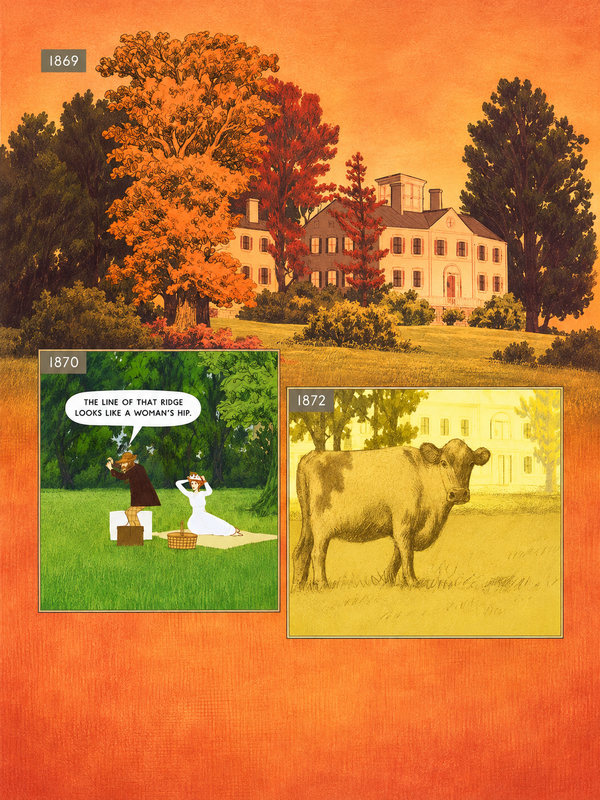
Small rectangles show people from a different year than the surrounding landscape. This immediately raises the central question: can a place maintain a connection between events that never happened concurrently?
From Here to Here: Richard McGuire Makes a Book // The Morgan Library & Museum. — 2014. —
The frame from 1971 can be read as a discrete moment: the viewer sees a sofa, a fireplace, and a window. Nothing within a single image indicates how much time has passed before or after this state. The past only emerges when juxtaposed with another image.
Fig. 02 (Richard McGuire; Here, 2014)
In the 2015 and 1957 images, the wallpaper, furniture, and purpose of the room differ. The fireplace and window opening help identify the same location. There is no drawn motion between the frames, but the reader mentally completes the change that spanned decades.
Fig. 03 (Richard McGuire; Here, 2014)
In Here, 1623 dominates the image, yet small inserts reference the years 1957 and 1999. The eye first perceives the overall landscape, then notices fragments from other times against this backdrop. Time emerges as a result of comparing several visible layers.
Richard McGuire; Here, 2014
Time is conveyed not only by the sequence of frames: it is embedded in their arrangement and intersection.
One Place, Different Eras
In the 1989 living room, a sofa, television, coffee table, armchair, and fireplace are visible. Here, the interior initially serves as a familiar environment before becoming a benchmark for comparing other eras.
Richard McGuire; Here, 2014
A similar scene recurs throughout the frames—a woman holding a child. The characters' clothing, appearances, and the interior design shift, but the action itself remains constant. By placing these moments side-by-side, the artist illustrates how similar events from the lives of different generations repeat within a single space. Time becomes apparent here not only through change but also through recurrence.
Richard McGuire; Here, 2014
On this spread, Richard McGuire presents one location across two eras: 2014 and 1503. The main image depicts a room with a window, a fireplace, and a woman standing by the window. In the center, an inset frame shows a forest that existed here long before the house was built. The perspective remains the same, but the space transforms entirely. By layering these frames, the reader simultaneously views the past and the present of a single place.
Richard McGuire; Here, 2014
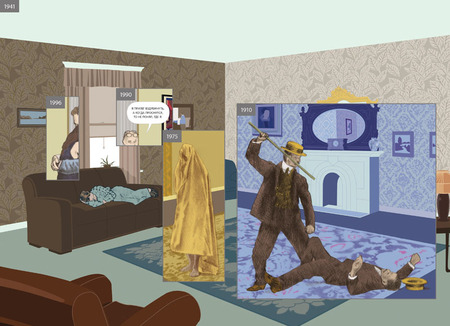
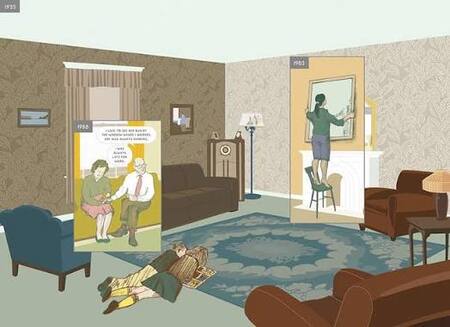
Within the main image, there are small frames featuring scattered dates across the page, presented out of chronological order. These frames display individual objects, fragments of action, and short lines of dialogue. A large, dark frame featuring water contrasts with the familiar living room interior. Through this composition, the reader views numerous moments in the history of a single space simultaneously and independently discovers the connections between them.
Richard Maguire; Here, 2014
In two images taken across different years, the fireplace is placed against the right wall. Its outline barely alters the main composition, while the tables, chairs, television, and textiles appear and disappear.
Richard McGuire; Here, 2014
The perspective does not change, even when hundreds of years pass between events. The people, furniture, and interior shift, but the viewing angle remains constant. This allows the reader to easily observe how a single space evolves over time.
Richard McGuire; Here, 2014
The wall ornament changes more noticeably than the room’s volume. In 1979, a repeating pattern covered both walls; in 1983, the pattern’s character was different; and in 2016, the interior looks distinct. Wallpaper serves as a kind of date, recorded not in numerals but through material finishes.
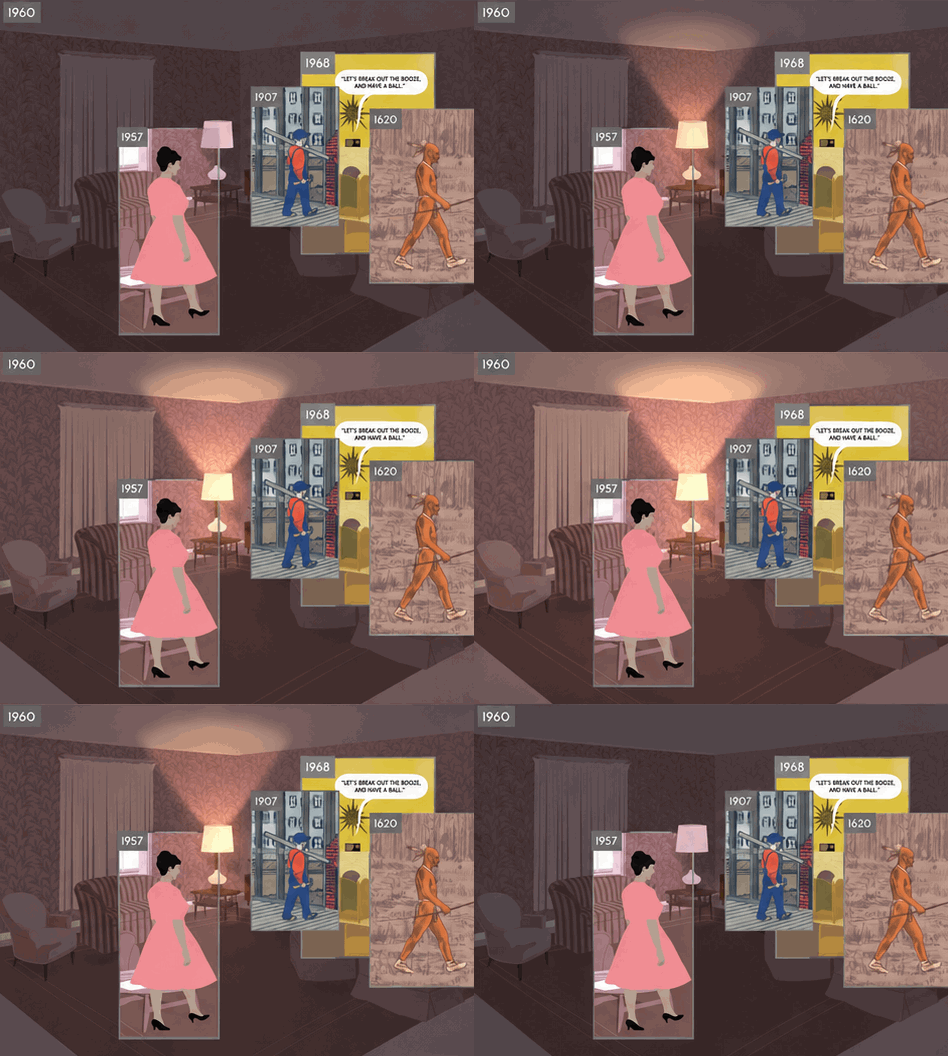
Richard McGuire; Here, 2014
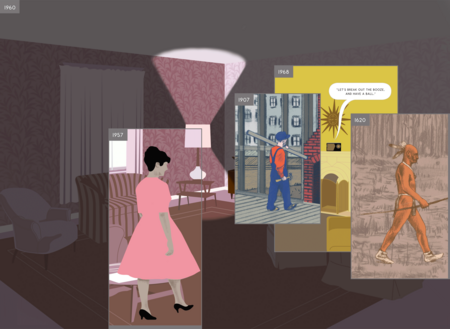
Although familiar walls or furniture are not yet in place, the rectangle demonstrates the future human use of the space. The scale of time expands far beyond a family history.