Categories
- Concept
- Peri Nos
- Klasdovets Peninsula
- Besov Nos
- Karetsky Nos
- Conclusion
Concept
Whenever I see petroglyphs, I always wonder: how did people «read» these ancient images, and why didn’t they agree on interpretations? I believe that truth can only be discovered through the synthesis of various viewpoints.
For example, two Soviet researchers, A.M. Linevsky and V.I. Ravdonikas, held mutually exclusive hypotheses regarding the interpretation of the Onega petroglyphs. A.M. Linevsky interpreted the rock carvings as depictions of the ancient person’s everyday life, while V.I. Ravdonikas argued that the Onega petroglyphs evidenced that these images passed through the prism of primitive thought and were reinterpreted.
The hypothesis of this research is that Linevsky’s and Ravdonikas’s interpretations of the Onega petroglyphs are not mutually exclusive; both researchers described the same society but from different angles, which reveals the evolution of the ancient person’s perception of everyday life.
Peri Nos
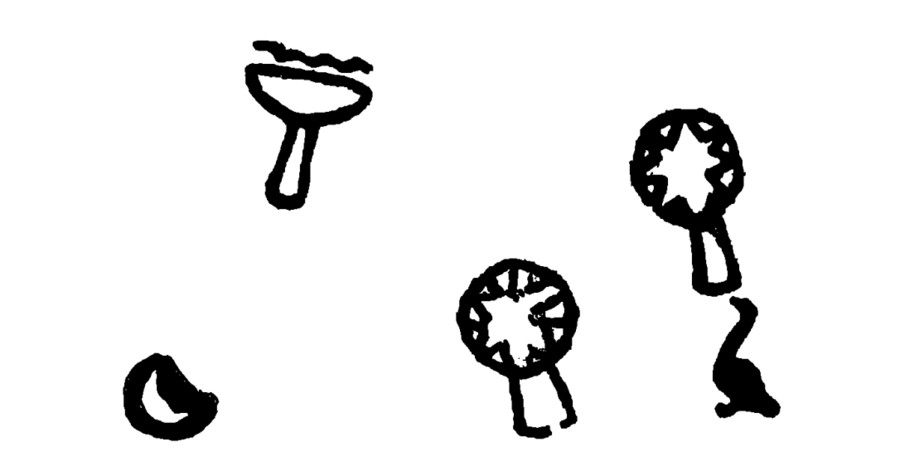
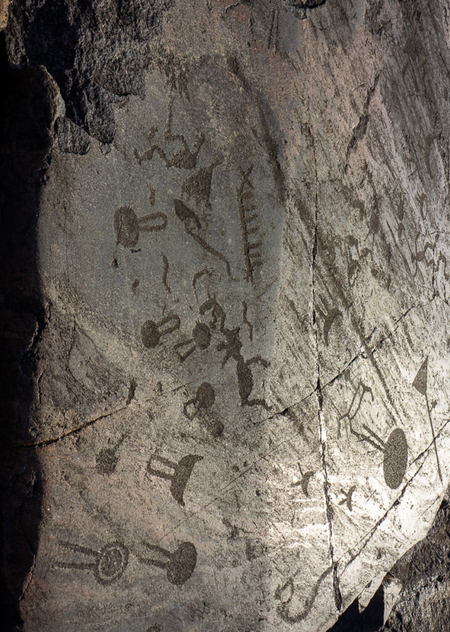
Petroglyphs of Cape Peri II, a collection of 5 images. 4th–3rd millennia BCE
Following A.M. Linevsky’s logic regarding the documentation in primitive art, one can observe fragments of everyday life here: the silhouette of a swan and household objects. The figure on the left resembles a bowl or a vessel, while the circular shapes with rays could be depictions of the sun observed by an ancient artist. According to V.I. Ravdonikas, these images are interpreted as solar symbols because they are quite geometric and reflect the object symbolically rather than concretely. The petroglyphs of Cape Peri II demonstrate a transition from the documentary recording of reality to the symbolic reinterpretation of the surrounding world through solar symbols.
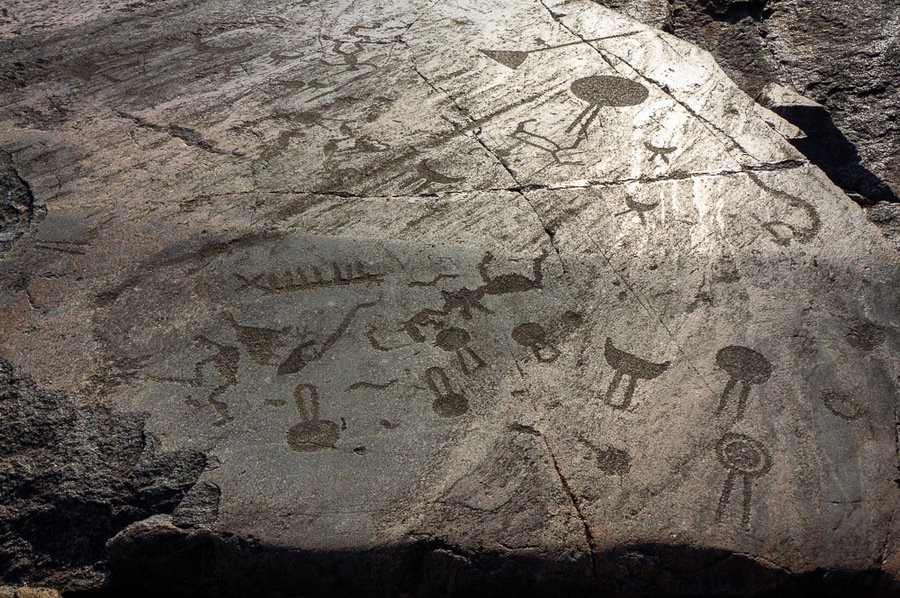
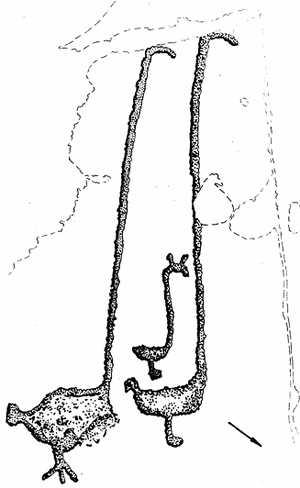
Petroglyphs of Cape Peri II. 4th–3rd millennia BCE
On the Perí Nos mouse, birds are most frequently depicted. Despite employing similar techniques, these depictions are quite distinct; the individuality of each is often emphasized. Variations are apparent in the portrayal of neck inclination, tails, and body structure. Here, we find birds with head protrusions or ears, suggesting a capacity for hearing or for receiving some form of information. Thus, on one hand, the imagery found on this mouse is quite commonplace, but on the other, certain figures possess a mythological character, indicating significant shifts in the consciousness of the population that inhabited it.
Cape Perino; Composition of Signs. 4th–3rd millennia BCE
Cape Peri Nose; Composition of Signs. 4th–3rd millennia BCE
Cape Peri Nos IV; petroglyphs. 4th–3rd millennia BCE
Cape Peri Nos IV; petroglyphs. 4th–3rd millennia BC
Cape Perino’s Nose III; petroglyphs. 4th–3rd millennia BCE
Petroglyphs of Cape Peri. 4th–3rd millennia BCE
Petroglyphs of Cape Peri. 4th–3rd millennia BC
Cape Peri Nos; Petroglyphs. 4th–3rd millennia BC
Cape Perino; Petroglyphs. 4th–3rd millennia BCE
Petroglyphs of Cape Peri III. 4th–3rd millennia BCE
Kladovets Cape
Swans with long necks. Gladovets Cape. 4th–3rd millennia BCE
Birds are also frequently found in The Storeroom, a phenomenon attributed to the cape’s location. However, among the small number of surviving images, there is a figure of a person with arms raised toward the sky and a swan swimming nearby. This composition can be interpreted both as a fixation of reality and as a sacred rite.
Figure of a human with arms raised toward the sky. Kladovets Peninsula. 4th–3rd millennia BCE.
Swan with a long neck. Kladovets Cape. 4th–3rd millennia BCE
Cape Kladovets; Petroglyphs. 4th–3rd millennia BCE
Besov Nos
Central panel on the tip of Besov Nos. V–III millennia BCE
On the main canvas, Besov Nosa features human figures, birds, and animals—elements from the daily lives of hunters and fishermen. The large central figure, a demon, stands out due to its size and placement, which may suggest ritual significance, hierarchy, or spirituality.
Petroglyphs. Devil’s Nose. VII–III millennia BC
Petroglyphs; Demon’s Nose. V–III millennia BCE