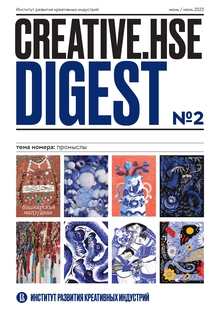
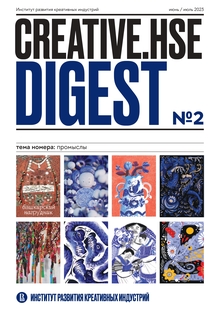
On an online platform, WINC released a documentary series entitled «People’s Arts» — a massive dive into Russia’s cultural code through household items, ornaments, and toys that have become symbols of our multi-ethnic country. The project, created by Creative Industries, covers crafts from Central Russia to the Far East and shows how ancient traditions are passed on from generation to generation and continue to live in the modern world.

The series features 44 cities and villages in Russia, where craftsmen are living and working, carefully maintaining their unique equipment — from gellian painting and the Palaech miniatur to Cuban metal and fish leather products. Through human history, as well as the materials and forms with which they work, the project explores what folk art is today: a museum relic or a living, developing culture.

Julia Blucher, an artist, a researcher, an expert from the Centre for Research in People’s Fisheries, and a profile manager, Illustration and Comics, took part in the film.
Julia Blucher: «The series clearly shows that fishing is not the work of one master, but the work of a large community. There’s a chain of people behind every mattress, jockey tray, or geal vase: those who generate wood or clay, who pull out the pots, who create paints, varnishes, tools. They all know why they do their work — for the sake of ‘ art ' as a quintessence of beauty in a person’s understanding. This work is a continuation of tradition.
The episode is particularly affected by the work of the glass dummies of the Husev factory, and the hard-working Chilean workers are pouring out of the iron of the Caslin statues of the ballerin. Here, the folk and the brute meet what we used to think was a great art — as if the heavens and the earth were united, and something real, living, meaningful was born out of it. And perhaps that is the answer to the question of time. Today, people are increasingly turning to fisheries and history, looking in the past for guidance for the future. In a world where your value is almost reduced to purchasing power — where you ‘ exist ' only if you can continue to choose faceless things on the marketplays — you want to slow down, to get stuck. And the history stuff gives you this opportunity. They don’t just surround us, they shape us. ‘ That’s what Grandma told me. ' It’s a phrase that carries memory, communication, identity. Such objects become anchors in a stream of trends and constant updating. And yes — let them ‘ associate with antiquity. ' Let them be seen to be «neglected „! That is their strength: they slow down, feel part of something bigger, and finally exist — not as a consumer, but as a human. To me, this show isn’t just about crafts. It’s about how we learn to be ourselves again through material culture.“
Episode 1. Central Russia

The first episode will send an audience to Central Russia, the heart of craftsmanship. Since childhood, peacock patches, fine gelly paintings, the brittle glitter of Gusey-Crystal products, Fedoskin’s varnishes, Paleh and Msters, Holway’s miniatural paintings, and bright jest trays — every folk fishing carefully keeps its secrets, unique paints, and centuries-old stories.
Episode 2. North-West Russia

Northwest Russia is a land of ancient crafts and unique beauty. Here, under the hands of the masters, there is a graceful volocodian lace, silver with fine ink, and a fragile cross line. Among the cold winds of the Baltic is the living flame of amber — a real national treasure. And Mesenian painting is a powerful symbol of the Russian North, created exclusively by men’s hands.
Third episode. Wizards and Ural.

Prijje and Ural are regions where lungs, like air, orenburg handkerchiefs, bright smoke toys, auspicious caslin liquor, fun mats, and glowing forelock.
Episode 4. South of Russia

In series four, we go to the sun’s south of Russia, to the edge of the vast steppes and the green mountain slopes. Every craft here is covered by history: whether it’s seven Karakor ceramics, the gold sewing of Adigs, Kalmyc or Kazan jewelry.
Episode 5. Northern Caucasus

Here, among mountain valleys and auls, there are family crafts: Cabardinian mats, fine truth, thin Chechen wood threads, and outstanding Cuban metal processing. Each ornament is the memory of the ancestors, and each master is the guardian of age — old wisdom.
Episode 6. Siberia and the Far East

The final series is the project’s longest journey. We go to Siberia and the Far East, where nature dictates rules, and craft becomes a means of survival, a language of memory, and a form of love for its edge. We’re gonna get to know Timer’s shredded art, the Kamchat’s beads and fur, the unique fish skin from Sakhalin, and the buryat’s horse hair braid. This is where the main question of the project is: is fishing a museum tradition or a living work of modern masters?
P. S. To get to know modern crafts, you don’t have to go to the end of the world. Many modern designers and artists rethink traditional motives using relevant forms, materials and functions. And their work can be viewed, evaluated and acquired online. Below is a small collection of these artifacts, which have been liked by medcia.

Igor Gurović Art Is Hard, 2025

Anastasia of Cherkasska Plot «I1», 2023

Tatiana Kruglov Platat «The Meaning», 2025

Marina Batilina Farfort «ah, smile», 2020

Paulina Frolov Zin «What Is Gell», 2025