New Forms of Household Objects in the 1960s–1970s
A plastic future could be envisioned without even leaving home. It was enough to look at everyday objects. A chair could maintain its shape using air, and a cabinet could be extended by placing another section on top. Such items changed perceptions of how domestic life was structured [3, 4, 5].
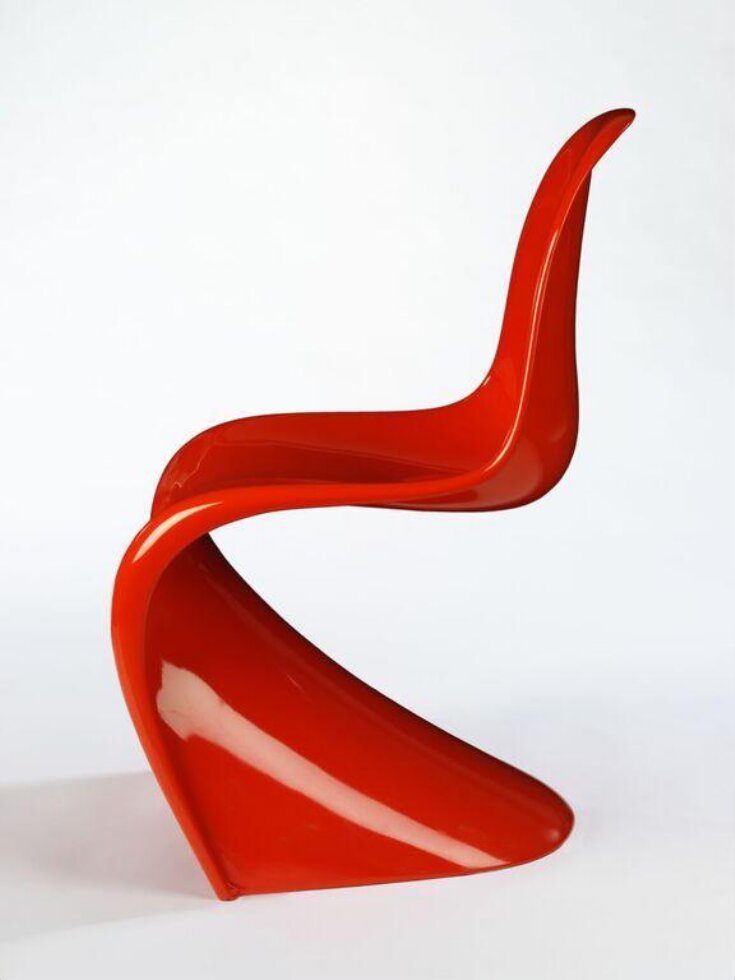
Early Panton Chair, side view, circa 1967–1968
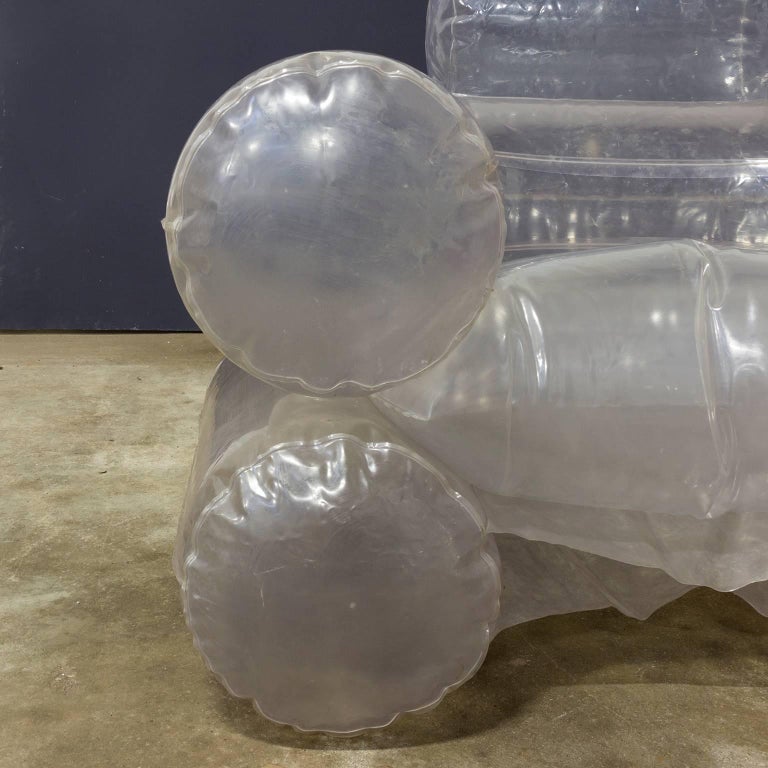
Blow up the image; the seam at the end of the armrest is visible.
Visiona II, general view of the blue room
Research Concept
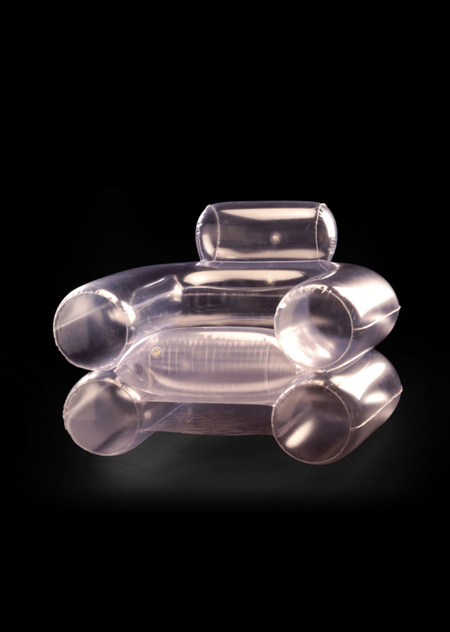
The Werner Panton chair has no rear legs. In profile, it is clear how the backrest transitions into the seat, and the support curves down to rest on the floor. Next to it, Selene by Nico Majistretti looks almost like a conventional chair. It has four legs, and each is where you would expect to find one. Only upon closer inspection do you notice that the legs, seat, and backrest form a single unit. It was this pairing that inspired me to begin. Objects designed on a similar principle look completely different. This suggests that judging the extent to which plastic has altered their structure based on a single silhouette is difficult [12, 18]. The choice was made to focus on domestic objects from the 1960s–1970s because these items allow us to trace how new materials transformed familiar actions. This makes it interesting to examine even something as simple as a plate. For Massimo and Lella Vignelli’s stackable tableware, the edge shape becomes clearer when viewing several plates stacked together. In contrast, with the inflatable Blow chair, one is drawn to examine a single detail. Through the transparent shell, you can see the seam connecting its parts. In the inflatable chair, this seam runs along the edge of the armrests and backrest, helping to reveal how its volume is constructed. In both cases, a small detail explains the entire object’s structure [3, 17].
Panton Chairs in Varna Restaurant in the Danish city of Aarhus
Photographs are grouped in pairs and into small series. Chairs are easier to compare from the side and at a consistent scale. The Componibili modular cabinet should be shown with the door slid open and in several assembly configurations. For the KD 28 lamp by Joe Colombo, the same angle is crucial both before and after it is turned on. In the first shot, the side opening appears as a dark cutout in the casing. In the second, it glows, making its role in the lamp’s design more apparent. For the Brionvega TS 502 radio receiver, it is sufficient to open the casing slightly to see the speaker and controls. A simple hand movement is placed between the two frames. This makes it easier to understand why the object has two halves [4, 5, 9, 15].
Panton Chair
The cabinet and dishes initially seem like an odd pairing. However, when you observe how the sections are stacked upon one another, the resemblance to a stack of plates becomes quite apparent. The edge of each item is designed to account for its neighbor. In the dishes, this helps compactly store the set, while in the furniture, it allows for adjusting the height of the cabinet. I was interested in tracing how one approach functions in two different scenarios. In one case, a person clears the table every day. In the other, they decide what item to use only after bringing it home [4, 5, 17].
Casamania
In the archival photographs of Werner Panton’s Visiona II, the viewer immediately perceives an entire room. The curves of the surfaces extend from the floor up to the seating areas, and the boundary between the furniture and the surroundings is not immediately obvious. In the Total Furnishing Unit project by Joe Colombo and Inzaghi Favata, the house is organized differently. Spaces for relaxation, food preparation, and storage are distributed among compact modules. Both projects demonstrate what a domestic setting could have looked like in the designers' vision. Next to them, I placed mass-produced items. The side table with a sliding door had its own small function. It could be opened even where a hinged door would not have had enough space [4, 5, 8, 21, 22]. The word «future» in the title arose because of this difference in scale. At the exhibition, one could immediately see a room that did not yet exist in an ordinary apartment. Changes were perceived differently at home. In the evening, a lamp was switched on, and one observed how its body changed. After lunch, plates were stacked on top of each other and the entire stack was placed on a shelf. Through these actions, it is clear how the designer’s concept became part of daily home life.
The Panton Chair designer — Verner Panton
The Panton Chair Family by Verner Panton
I suggest that plastic changed both the form of familiar objects and the way they could be used. The traces of these changes are visible in the details—in the rim of a plate designed to help stack dishes, or in a cabinet door that slides along the body instead of taking up space in front of it.
The edges, curves, and seams of an object tell a great deal about its form.
Vogue magazine cover featuring the Panton chair
In the photographs from the 1960s and 1970s, color and silhouette are immediately striking. If you look closely at the edge of a plate, the seam of a chair, or the curve of a lamp, it becomes clear why the designer chose that particular form. The rim helps stack the tableware. The seam joins parts of the shell that must retain air. The lamp body requires consideration twice—before and after being turned on. In each case, the plastic offers its own set of possibilities [2, 6, 9, 17].
Blow Chair
Why does one chair maintain its shape through air, while the other relies on its structure?
The Blow chair features rounded armrests and a high back. Through the transparent shell, you can discern the far edge of the seat and the seam line. If the air is released, the chair loses its volume. The task is reversed with the Werner Panton chair. Its rigid body maintains its form even when no one is sitting in it. In profile, it looks like a wide ribbon folded several times. The designs are nearly contemporaries, but even from photographs, it is clear that the word «plastic» says too little about these objects. Polyvinyl chloride was used for the Blow, while the Panton Chair material was varied by the manufacturer during production [3, 12].
Plastics entered household life long before the sixties. Bakelite was used for light switches, outlets, and radios. After the war, synthetic materials became more prevalent in other household items, including tableware and vinyl coverings. By the sixties, the question was much broader. Since a body can be molded, is it necessary for a chair to maintain the division between backrest, seat, and four legs? The most convenient way to answer this in furniture design is by examining photographs taken from the same height [14, 18].
Where did the chair’s back legs go?
Panton Chair
Let’s place Panton next to Selene by Nico Maggiastretti. On the Panton, the gaze moves almost non-stop from the backrest to the seat, then down to the floor. There are no rear legs. Where exactly does the seat end and the support begin? A clear boundary is not visible in the photograph. With Selene, parts of the chair are apparent at first glance. It stands on four legs, like many chairs before it, although the backrest, seat, and supports here also form a unified shape. The familiar silhouette is easily mistaken for a sign of standard construction. Only a different angle compels a closer look at the transition between the leg and the seat [12, 18].
Selene Chair
Panton Chair
Selene Chair
Panton Chair