01. INTRODUCTION
Red Bull is an Austrian energy drink brand founded in 1987 by Dietrich Mateschitz and Chaleo Yoovidhya. With 12.1 billion cans sold in 2023 and a presence in over 175 countries, it is the world’s leading energy drink brand, holding approximately 43% of the global market share and generating revenues of around €10.55 billion.
Red Bull official brand logo
Core positioning
Red Bull’s communication strategy is built on a simple but powerful idea: the brand does not sell a drink — it sells a lifestyle. Its iconic slogan, «Red Bull Gives You Wings,» encapsulates a positioning centred on extreme performance, courage, and the desire to push beyond limits. Unlike traditional consumer goods companies, Red Bull operates as a media and content brand first, with the product serving as an extension of that identity.
The brand maintains a premium price point above competitors, reinforcing a sense of exclusivity and quality. Its content-first approach is institutionalised through Red Bull Media House, a full-scale media production company that creates films, documentaries, music, and live events distributed globally — a rare model in brand communication.
Oracle Red Bull Racing RB20 Formula 1 car, 2024 season livery
Target audience
Red Bull’s primary audience is males aged 18–34: students and young professionals who are drawn to extreme sports, esports, and motorsports, and who identify with an urban, active lifestyle. They seek both physical energy and aspirational identity — the desire to achieve something extraordinary.
The brand’s secondary audience is broader, spanning ages 16–40, and includes gamers and esports fans, music festival-goers, professional athletes, and anyone who consumes Red Bull’s media content independent of the product itself. This expansive reach reflects the brand’s deliberate strategy of becoming a cultural institution rather than a product category.
02. COMMUNICATION CHANNELS
Red Bull maintains a dominant presence across all major social media platforms, with each channel serving a distinct communicative function within the overall strategy.
top left: Red Bull Instagram account; top right: Red Bull YouTube channel; bottom left: Red Bull TikTok account; bottom right: Red Bull Facebook page
On YouTube (28M+ subscribers, 13B+ total views), the brand publishes long-form extreme sports content, full-length documentaries, and live event coverage — positioning it as the world’ s leading brand-owned media channel. Instagram (32M+ followers) focuses on high-impact lifestyle photography and short video clips centred on athlete stories. TikTok (21M+ followers) is used for viral short-form content, challenges, and behind-the-scenes access. Facebook (64M+ followers) serves event promotion and community building, while Twitter/X (1.8M+ followers) handles real-time news and event updates. Twitch hosts esports tournaments and gaming streams.
left: Red Bull X/Twitter account; right: Red Bull Twitch channel
Beyond social media, Red Bull’s PR strategy is built on spectacle. The brand sponsors over 500 extreme sports events annually — from Formula 1 to cliff diving — generating vast amounts of earned media. Its athlete ambassador programme includes 700+ professional athletes worldwide who create authentic, credibility-driven content. Guerrilla marketing tactics such as university sampling campaigns and the iconic Red Bull-branded cars target youth demographics at street level.
top left: Red Bull Media House logo; top right: Red Bull TV logo; bottom left: The Red Bulletin logo; bottom right: Red Bull Records logo
Red Bull Media House further extends this strategy through Red Bull TV (a global streaming platform for adventure and sports content), The Red Bulletin (an international print and digital magazine with 2M+ monthly circulation), Red Bull Records (a music label connecting the brand to music culture), and over 100 original films and documentaries.
03. THEORETICAL FRAMEWORK
For this analysis, two communication theories are applied: the Elaboration Likelihood Model (ELM) and Uses and Gratifications Theory (U&G). These two frameworks approach communication from opposite ends of the process — one from the sender’s perspective, one from the receiver’s — and together they provide a complete analytical lens for understanding Red Bull’s strategy.
Elaboration Likelihood Model (ELM)
ELM explains how persuasive messages produce attitude change in receivers. The model proposes that people process persuasive messages through one of two cognitive routes, depending on their motivation and ability to elaborate on the message content.
The central route is activated when motivation and ability to process are high: the receiver carefully evaluates the arguments and evidence in the message. Attitude change achieved through the central route is durable, resistant to counter-persuasion, and strongly predictive of behaviour.
The peripheral route operates when motivation or ability is low. Here, the receiver does not engage deeply with the message content but instead relies on simple heuristic cues — source attractiveness, emotional music, production quality, celebrity endorsement — to form or change attitudes. Peripheral attitude change is less stable but can be highly effective for low-involvement consumer decisions.
Three key concepts are central to our analysis: elaboration (the degree to which a person thinks carefully about message arguments), peripheral cues (simple decision heuristics such as source expertise, visual spectacle, and emotional arousal), and motivation & ability (the two conditions that determine which route is activated). Red Bull deliberately minimises both — its content is designed for casual, low-involvement consumption on social media, not studied engagement.
Uses and Gratifications Theory (U&G)
U&G shifts the research question from 'what do media do to people? ' to 'what do people do with media? ' The theory positions audiences as active agents who selectively seek out and consume media content in order to satisfy specific psychological and social needs. This active audience assumption is the theory’s defining departure from earlier passive-effects models of media influence.
The framework identifies five core gratifications that audiences seek: diversion and entertainment (escape from routine, emotional pleasure), surveillance and information (monitoring events and staying informed), personal identity (using media to reinforce values and self-concept), social interaction (using shared media content as a basis for conversation and bonding), and escapism (vicarious experience of worlds beyond everyday reality).
Why these two theories?
ELM and U&G are complementary frameworks that together capture both sides of Red Bull’s communication. ELM explains how the brand persuades — through peripheral cues, spectacle, and emotional arousal — while U&G explains why audiences actively seek out Red Bull’s content and what needs it satisfies. Neither theory alone is sufficient: ELM without U&G tells us how persuasion works but not why audiences engage; U&G without ELM tells us what needs are met but not how the content produces attitude change. Together, they form a complete picture.
Both theories belong to the socio-psychological tradition in Craig’s typology of communication theory — a tradition that focuses on communication as a process of influence and meaning-making between individuals and groups.
04. ANALYSIS
ELM: Visual persuasion through the peripheral route
Red Bull’s social media and advertising strategy operates almost exclusively through the peripheral route of ELM. The brand rarely makes rational product claims — it does not publish nutritional comparisons, ingredient explainers, or performance studies in its consumer-facing content. Instead, every piece of communication is built around powerful visual and emotional cues designed to bypass deliberate evaluation and produce immediate, affective attitude responses.
Red Bull Instagram feed
On Instagram, high-contrast action photography of athletes mid-stunt serves as the primary persuasive medium. The image communicates the brand message entirely — no argument is needed. The visual association is direct: extreme achievement equals Red Bull. Captions are deliberately minimal — 'Believe.' 'No limits.' 'What’s your wings moment? ' — functioning as emotional triggers rather than informational claims.
Red Bull YouTube channel
On YouTube, fast-cut editing, driving music, and first-person POV footage create a visceral sense of excitement. The audience is made to feel the brand rather than think about it. Red Bull cans appear consistently in victory moments, records being broken, and peak experiences — functioning as a form of classical conditioning in which the can becomes associated with achievement and freedom.
ELM: Source credibility as peripheral cue
Max Verstappen as a Scuderia Toro Rosso driver, 2015 — early career supported by Red Bull’s athlete development programme
In ELM, the credibility and attractiveness of the message source function as powerful peripheral cues — enabling attitude change without requiring the audience to engage with the message content itself. Red Bull’s athlete ambassador programme is its primary mechanism for deploying this cue at scale.
Max Verstappen, three-time Formula 1 World Champion, is the most prominent example. His association with Red Bull Racing transfers athletic excellence — precision, determination, dominance — directly to the brand through a heuristic shortcut: if the world’s best driver trusts Red Bull, the brand must be exceptional. Felix Baumgartner, Nyjah Huston (X Games Gold medallist in skateboarding), and Matthias Walkner (Dakar Rally champion) perform the same function in their respective communities. Audiences do not need to evaluate the athletes' endorsement rationally — their fame and expertise serve as instant credibility signals.
U&G: Why audiences follow Red Bull
Red Bull’s content strategy maps directly and comprehensively onto the five gratifications identified by U&G theory. This alignment is not coincidental — it reflects a deliberate approach to content design that serves audience needs rather than simply broadcasting product messages.
Red Bull YouTube channel
Entertainment and diversion are met through extreme sports content, race highlights, and stunt footage — the core of Red Bull’s output across YouTube, Instagram, and TikTok. The informational need is served through event coverage, athlete news, and sports results; Red Bull’s social accounts function as primary news sources for fans of F1, cliff diving, and extreme sports. Personal identity gratification is addressed through athlete narratives centred on courage, overcoming failure, and pushing limits — content that allows audiences to affirm their own aspirational self-concept by association with the brand. Social interaction needs are met through viral moments that become shared cultural reference points; the Stratos jump is the clearest example, having been the most-watched live event in YouTube history at the time. Escapism is fulfilled through immersive first-person POV content and long-form documentaries that transport viewers beyond everyday reality.
Case study: Stratos Jump (2012)
Felix Baumgartner in a Red Bull wingsuit during freefall — extreme spectacle as a peripheral cue
The Stratos jump offers the clearest single illustration of how ELM and U&G operate simultaneously in Red Bull’s communication. From an ELM perspective, the event is a peripheral cue of unprecedented scale: the spectacle bypasses any rational evaluation of the brand, source credibility peaks through Baumgartner’s expert status and heroic act, and the emotional intensity — fear, awe, collective pride — produces powerful attitude change without a single product claim. From a U&G perspective, the event simultaneously delivers entertainment (an unprecedented live spectacle), information (a real-time world record), social interaction (a shared global experience), and identity (the audience becomes part of a historic moment). The jump is not merely a marketing stunt — it is a theoretically precise execution of dual-framework communication strategy.
Visual evidence: Instagram and YouTube
Red Bull YouTube channel
Red Bull’s Instagram (@redbull, 17M+ followers) provides systematic evidence for both frameworks. The visual aesthetic — extreme angles, motion blur, high saturation — is designed to communicate excitement without words, functioning as a pure peripheral cue in ELM terms. Athlete account takeovers leverage source credibility while simultaneously satisfying the U&G needs for identity and entertainment. Comment responses with personalised replies fulfil the social interaction gratification and create a sense of genuine community.
On YouTube, the brand’s content architecture maps cleanly onto U&G gratifications: long-form athlete documentaries satisfy informational and identity needs, live event streams create social experiences, tutorial content meets informational needs, and cinematic films like The Art of Flight (35M+ views) deliver entertainment and escapism at the highest production level. Across all platforms, the product is present but never the focus — it is the peripheral cue that connects all content back to the brand.
05. CONCLUSIONS & RECOMMENDATIONS
The analysis demonstrates that Red Bull has developed one of the most theoretically coherent brand communication strategies in contemporary marketing. Through the lens of ELM, the brand operates almost exclusively through the peripheral route — leveraging visual spectacle, athlete credibility, and emotional arousal to produce widespread attitude change without rational argument. Through the lens of U&G, its content strategy comprehensively addresses all five core audience gratifications: entertainment, information, personal identity, social interaction, and escapism. The two frameworks together confirm that Red Bull’s approach is not accidental — it is a systematic application of communication theory at scale. The brand’s move into esports is a particularly instructive example of U&G-driven strategic thinking: recognising that gaming audiences share the same gratification profile as extreme sports fans — entertainment, identity, social bonding — but remain underserved by competitors, Red Bull entered the space with tournaments, a dedicated gaming hub, and Twitch streaming long before most brands recognised the opportunity.
Recommendations
Despite its exceptional overall performance, the analysis reveals several areas for improvement. First, Red Bull’s near-total reliance on peripheral persuasion creates strategic vulnerability: when an athlete ambassador is involved in scandal, the brand suffers disproportionately because it lacks a central-route foundation. Developing more rational content — ingredient transparency, sustainability reporting, performance science — would build resilience.
Second, the brand’s communication is heavily male-coded. Applying U&G insights to the female audience segment — which shares the same gratification needs but is currently underserved by Red Bull’s content — represents a significant and largely untapped market opportunity.
Third, while Red Bull excels at broadcasting content, its dialogic communication remains limited. Greater investment in community management and user-generated content campaigns would strengthen social interaction gratification and build deeper audience loyalty.
Finally, as ESG concerns grow among younger audiences, Red Bull’s silence on environmental responsibility is an increasingly conspicuous gap. Introducing sustainability content would meet emerging informational and identity-based gratification needs while addressing a growing reputational risk.
Petty, R. E., Cacioppo, J. T. Communication and Persuasion: Central and Peripheral Routes to Attitude Change. New York: Springer-Verlag, 1986. 262 p.
Katz, E., Blumler, J. G., Gurevitch, M. Uses and Gratifications Research // The Public Opinion Quarterly. 1973. Vol. 37, No. 4. P. 509–523.
Craig, R. T. Communication Theory as a Field // Communication Theory. 1999. Vol. 9, No. 2. P. 119–161.
Red Bull GmbH. Red Bull official website [Electronic resource]. URL: https://www.redbull.com (accessed: 12.06.2026).
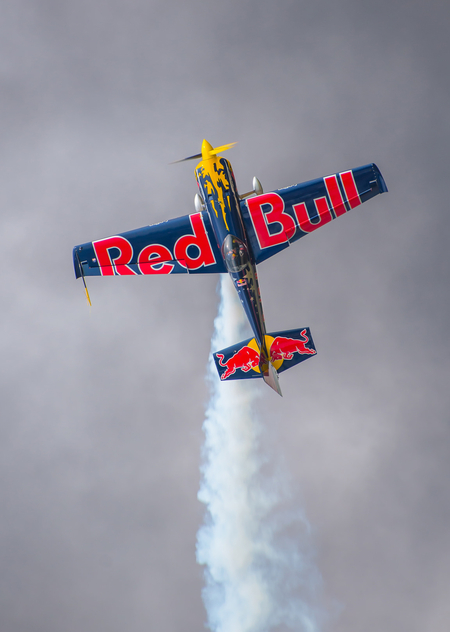
Cover: 1. Red Bull Air Race aerobatic aircraft in flight [Image]. Zukunftsinstitut. URL: https://www.zukunftsinstitut.de/zukunftsthemen/die-red-bullisierung-des-sports (accessed: 12.06.2026).
Red Bull. Official brand logo [Image]. The Wall Magazine. URL: https://thewallmagazine.ru/birthdayofthewall/red-bull-racing-logo/ (accessed: 12.06.2026).
Oracle Red Bull Racing RB20 Formula 1 car, 2024 season livery [Image]. F1 Report. URL: https://f1report.ru/news/f1-94213.html (accessed: 12.06.2026).
Red Bull [@redbull]. Official Instagram account [Screenshot]. Instagram, 2026. URL: https://www.instagram.com/redbull/ (accessed: 12.06.2026). Instagram belongs to Meta Platforms Inc., whose activities are recognized as undesirable on the territory of the Russian Federation.
Red Bull [@redbull]. Official YouTube channel [Screenshot]. YouTube, 2026. URL: https://www.youtube.com/@redbull (accessed: 12.06.2026).
Red Bull [@redbull]. Official TikTok account [Screenshot]. TikTok, 2026. URL: https://www.tiktok.com/@redbull (accessed: 12.06.2026).
Red Bull [@redbull]. Official Facebook page [Screenshot]. Facebook, 2026. URL: https://www.facebook.com/redbull (accessed: 12.06.2026). Facebook belongs to Meta Platforms Inc., whose activities are recognized as undesirable on the territory of the Russian Federation.
Red Bull [@redbull]. Official X (Twitter) account [Screenshot]. X, 2026. URL: https://x.com/redbull (accessed: 12.06.2026).
Red Bull [@redbull]. Official Twitch channel [Screenshot]. Twitch, 2026. URL: https://www.twitch.tv/redbull (accessed: 12.06.2026).
Red Bull Media House. Official logo [Image]. Production Base. URL: https://www.productionbase.co.uk/profile/516036/employer/Red-Bull-Media-House (accessed: 12.06.2026).
Red Bull TV. Official logo [Image]. DirecTV. URL: https://www.directv.com/insider/redbull-tv/ (accessed: 12.06.2026).
The Red Bulletin. Official logo [Image]. Red Bull. URL: https://www.redbull.com/gb-en/theredbulletin/projects/the-red-bulletin-playlists (accessed: 12.06.2026).
Red Bull Records. Official logo [Image]. Red Bull Records. URL: https://redbullrecords.com/demo-submissions/ (accessed: 12.06.2026).
Red Bull [@redbull]. Official Instagram feed [Screenshot]. Instagram, 2026. URL: https://www.instagram.com/redbull/ (accessed: 12.06.2026, two frames) Instagram belongs to Meta Platforms Inc., whose activities are recognized as undesirable on the territory of the Russian Federation.
Red Bull [@redbull]. Official YouTube channel — video feed [Screenshot]. YouTube, 2026. URL: https://www.youtube.com/@redbull (accessed: 12.06.2026, two frames).
Max Verstappen. Scuderia Toro Rosso, 2015 [Image]. Red Bull. URL: https://www.redbull.com/ru-ru/verstappen-to-red-bull-racing (accessed: 12.06.2026).
Red Bull [@redbull]. Official YouTube channel — video feed [Screenshot]. YouTube, 2026. URL: https://www.youtube.com/@redbull (accessed: 12.06.2026).
Felix Baumgartner. Red Bull wingsuit jump [Image]. Red Bull. URL: https://www.redbull.com/ru-ru/5-jumps-felix-baumgartner (accessed: 12.06.2026).
Red Bull [@redbull]. Official YouTube channel — video feed [Screenshot]. YouTube, 2026. URL: https://www.youtube.com/@redbull (accessed: 12.06.2026).