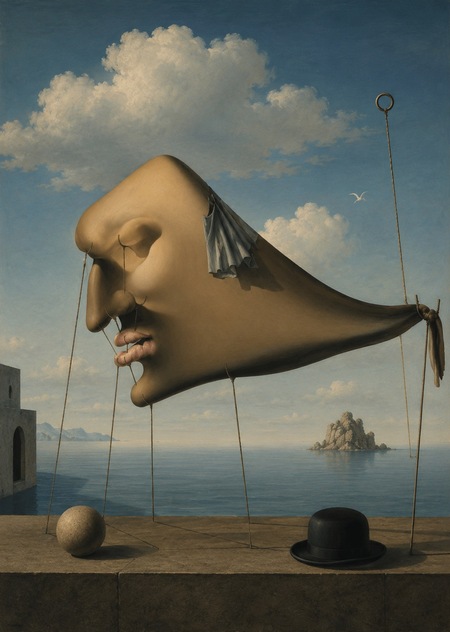
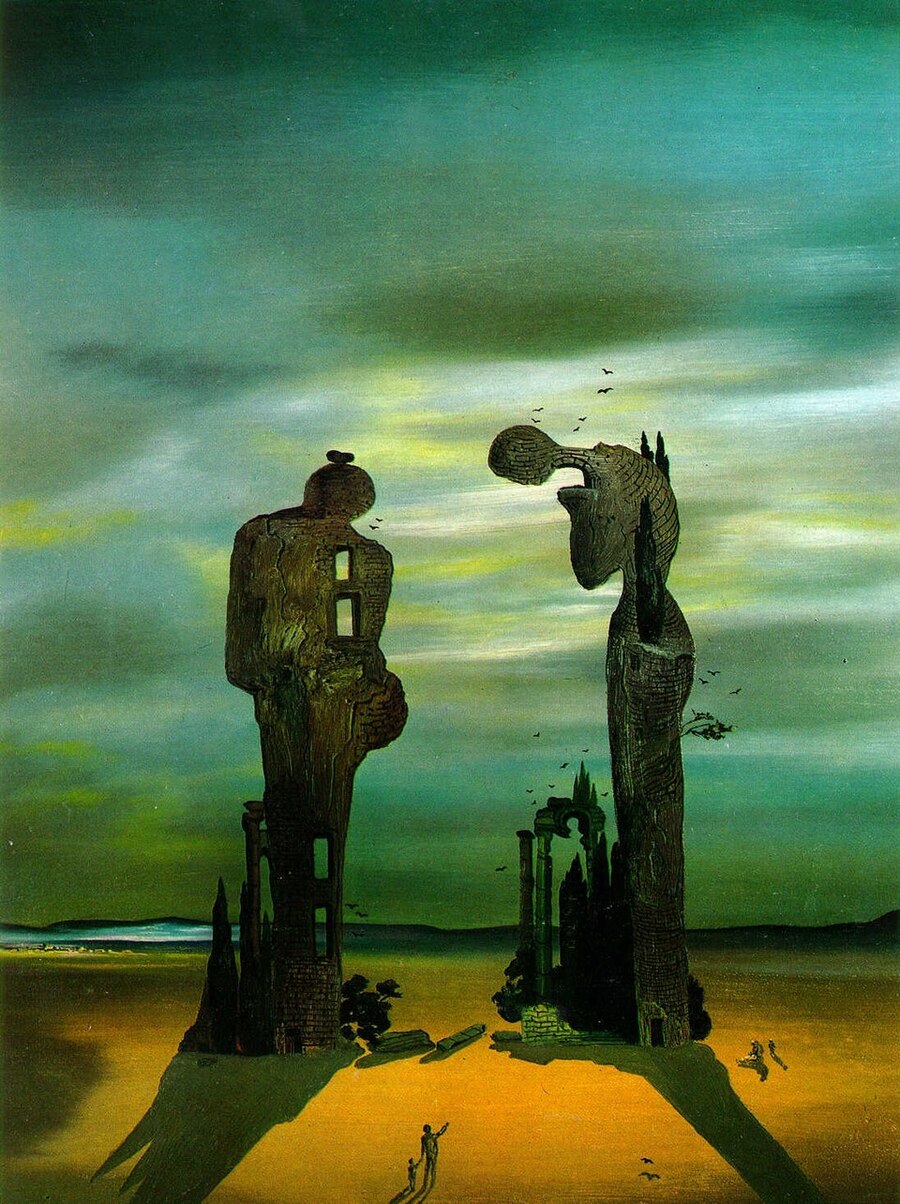
Salvador Dali, «Archaeological Reminiscence of Millet’s „Angelus“», 1935
Surrealism is an avant-garde artistic and literary movement that emerged in Paris in the 1920s and was formally established with Andre Breton’s First Manifesto of Surrealism in 1924. Defined by Breton as «pure psychic automatism», Surrealism sought to liberate thought from rational control and explore the unconscious mind as a source of artistic creation. In art history, it is often interpreted as an attempt to reconcile dream and reality into a higher form of experience. The movement developed through two principal tendencies: automatist practices based on spontaneity and chance, and illusionistic dream imagery characterized by precise representation of irrational scenes.
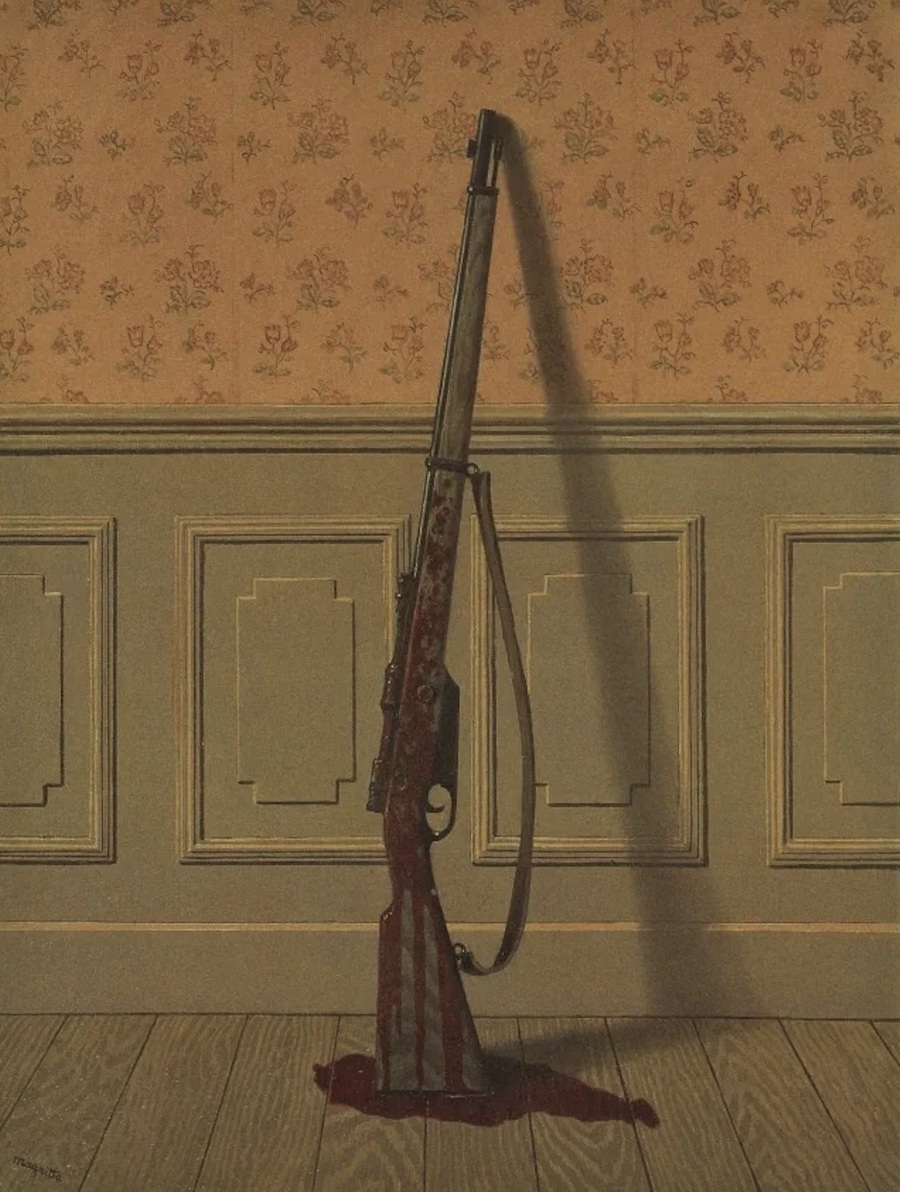
Rene Magritte, «The Survivor», 1950
The development of Surrealism was shaped by the cultural crisis that followed World War I and by a widespread rejection of rationalism, which many artists believed had contributed to the destruction of European civilization. The movement was strongly influenced by Dada, from which it inherited a spirit of rebellion, and by Sigmund Freud’s psychoanalytic theories concerning dreams, desire, and the unconscious. Surrealism combined artistic experimentation with a philosophical investigation of hidden mental processes and alternative forms of reality.
Salvador Dali, «The Persistence of Memory», 1931
Key works include Salvador Dali’s The Persistence of Memory (1931), which presents dreamlike landscapes populated by melting clocks and explores the instability of time;
Rene Magritte, «The Treachery of Images», 1929
Rene Magritte’s The Treachery of Images (1929), which questions the relationship between language, representation, and reality through the famous statement «This is not a pipe»;
Max Ernst, «The Elephant Celebes», 1921
Max Ernst’s The Elephant Celebes (1921), which combines unrelated forms into an enigmatic symbolic image. These works exemplify the Surrealist ambition to reveal realities beyond ordinary perception.
Salvador Dali, «Swans Reflecting Elephants», 1937
Among the principal practitioners, Salvador Dali developed the «paranoiac-critical method», transforming irrational associations into highly detailed images. Rene Magritte explored the ambiguity of representation and challenged conventional systems of meaning. Max Ernst experimented with automatic techniques such as frottage and collage, while Joan Miro employed biomorphic forms and automatism to create a highly personal visual language.
Rene Magritte, «The Meeting», 1927
Theoretical interpretation of Surrealism was shaped primarily by Andre Breton, whose First Manifesto of Surrealism established the movement’s central concepts of automatism and unconscious creativity. Sigmund Freud provided its psychological foundation through his theories of dreams and the unconscious. Louis Aragon and Paul Eluard further contributed to the movement’s literary and theoretical development.
Beloved imagination, what I most like in you is your unsparing quality.
Surrealism significantly influenced later artistic movements, including Abstract Expressionism, which adopted the Surrealist concept of automatism, as well as Conceptual Art, Performance Art, experimental cinema, and contemporary photography. Its emphasis on dreams, desire, chance, and unconscious processes transformed modern understandings of creativity and established a new conception of artistic practice as an exploration of subjective and psychological experience.
Breton, Andre. «Manifesto of Surrealism», 1924.
Breton, Andre. «From the First Manifesto of Surrealism.» In Harrison, Charles, and Paul Wood (eds.), Art in Theory 1900–1990: An Anthology of Changing Ideas. Oxford: Blackwell, 1992.
Freud, Sigmund. «The Interpretation of Dreams.» London: George Allen & Unwin, 1913 (original edition 1900).
Harrison, Charles, and Paul Wood (eds.). Art in Theory 1900–1990: An Anthology of Changing Ideas. Oxford: Blackwell, 1992.
https://en.wikipedia.org/wiki/The_Treachery_of_Images (Accessed 8 June 2026)
https://www.artsy.net/artwork/salvador-dali-the-persistence-of-memory (Accessed 8 June 2026)
https://en.wikipedia.org/wiki/The_Elephant_Celebes (Accessed 8 June 2026)
https://nikonova-alina.livejournal.com/1105609.html (Accessed 8 June 2026)