Content:
Section 1…. Concept Section 2…. A brief background about looting of African artifacts during the period of European colonialism. Section 3…. Collection assessment: A case study of Uganda Museum, Buganda Museum, Igongo Museum, Great Lakes Museum, Nairobi National Museum and Rwanda Museum. Section 4…. Some of the internationally recognized traditional and contemporary African artists who engage with themes of heritage and restitution. Section 5…. Technological applications in African museum settings Section 6…. Conclusion Section 7…. List of image sources & Bibliography
Section 1:
CONCEPT
The evaluation of collections by African museums represents a crucial movement in the global cultural landscape, catalyzed by the need to decolonize knowledge, restitute looted heritage, and redefine the purpose of museums in contemporary African societies. Museums worldwide are undergoing a profound transformation; this involves re-examining their responsibilities towards the collections. This process is particularly critical for the African museums, as many institutions hold collections with complex histories shaped by colonial legacies and historical power imbalances. There is a growing recognition of the need for museum practices that not only preserve collections but also address historical gaps, contextualize acquisition histories, and foster more equitable relationships with source communities.
This visual research proposes a comprehensive evaluation framework designed to meet the specific needs and contexts of African museums, aiming to empower them in their roles as dynamic centers of public engagement and cultural heritage. The visual study positions this evaluation not as a mere administrative process, but as a practice that is reshaping cultural identity, historical understanding, and international relations. «These works form an integral part of defining our identity and personality as family, as African family. We talk to them. They talk to us. We touch them at certain moments of our lives, from birth through life to death. It is through them that the living spirits of our people, of our history, of our culture interact and interface with us. They are not there, hence the void in our minds and in our hearts. We continue to cry for them to come back home, to complete that cultural, spiritual space» (Theo-Ben Gurirab)
The visual research investigates how African museums are moving from being passive storages of colonial collections to becoming active agents in reinterpreting and reclaiming their cultural narratives. The focus was put on: Looting of African artifacts and rethinking the power dynamics of their acquisition, assessment of museum collections, the African artists who engage with themes of heritage and restitution, as well as the technological applications in African museum settings.
There are numerous triggers for the topic selection and among them included the need for African-centered approaches to collection management. In order to simplify the research process, the following research question was formulated: How African museums implementing collection evaluation frameworks that address both international standards and local cultural contexts? For the smooth flow of research, the Hypothesis was also clearly stated: African museums are creating enormous evaluation models that integrate international museum standards with indigenous knowledge systems and address colonial legacies. The material selection of the visual research was based on the institutional reports, regional case studies, as well as publications from the past decade featuring the history of African museums.
Section 2:
A brief background about looting of African artifacts during the period of European colonialism
According to Sarah V. B. (2022). Collectors’ motivations were diverse: sometimes removing objects was motivated by a show of power, curiosity, religious purposes, and so forth. Often collected objects played important roles in the promotion of empire, illustrating the so-called primitiveness of African peoples, thus justifying the need for a colonial «civilizing mission.» Some of the objects were violently plundered during the conquest and «pacification» of colonies by European military forces. The best-known example is the plunder of the capital of the kingdom of Benin in 1897 by a British «punitive» expedition, during which the now famous Benin bronzes were removed from the royal court. The bronzes were military trophies and eventually became prestigious museum objects.
«The interior of Oba’s palace during the punitive expedition, with the looted Benin Bronzes in the foreground 1897», Paul Hudson, 2022.
It should be noted that in 1897, there was several attempts made by British expedition force to penetrate the Benin city during the traditional festival. They invaded, destroyed the property, and looted the loyal palace. A round 10,000 artifacts such as wood items, ivory, coral to mention but a few were stolen. These stolen items were later auctioned off to fund the military operations as well as stocking the Western museums and collections.
«Members of the punitive expedition in Benin surrounded by objects looted from the royal palace 1897» Paul Hudson, 2022.
It was clearly noted that after the killing of a smaller expedition of British officials and African carriers led by James Phillips, the Punitive Expedition to Benin included a large British force of about 1,400 soldiers and 2,500 carriers, led by Vice Admiral Harry Rawson arrived in 1897, this shameless group looted the African artifacts almost leaving the palaces with nothing other than destroyed infrastructures.
«A photograph captured by Félix Bonfils of a street vendor in Egypt selling mummies and other artifacts to tourists 1875» Paul Hudson, 2022.
Around 1875, selling of mummies and other artifacts to rich tourists was the order of the day, this was fueled by Victorian era fascination with ancient Egypt. The artifacts were always used for “ mummy unwrapping parties» as entertainment. Some times they were grounded into powder to create mummy brown the pigment which was used by the artists. This kind of trade involved a lot of exploitation but unfortunately there were no laws to protect these artifacts.
Amadou-Mathar M’Bow -1974. Paul Hudson, 2022.
Sarah V. B. (2022). Continues to articulate that in 1978, Amadou-Mahtar M’Bow, the Senegalese director of UNESCO, called upon the global public to consider restitution of cultural heritage removed during colonialism. He argued that being robbed of cultural objects, human remains, and art equaled the removal of collective memory and a sense of self. He called for the creation of bilateral agreements to enable the return of heritage, but also pointed out the responsibility of individual cultural institutions in the Global North to share collections. Ironically, it was the shortcomings of a UNESCO convention that brought M’Bow to this position. With the 1970 Convention on the Means of Prohibiting and Preventing the Illicit Import, Export and Transfer of Ownership of Cultural Property, UNESCO attempted to address the issue of the loss of cultural heritage in formerly colonized countries.
Some of the famous African looted artifacts during the colonial period.
Chimbidzikai M. (2025) asserts that:
«…. Above all else, we need to acknowledge that returning artefacts to their rightful owners is not just about the politics of value. It is a process that is meant to rehumanize what had been classified as objects. True justice lies in granting these communities the autonomy to determine how their artifacts are preserved, interpreted, and engaged with globally. This self-determination is not merely a right. it is the foundation of healing.»
In the process of collection evaluation by the African Museums, one of the strategies taken was to demand for the looted Artifacts during the period of colonialism. The need to interpret and preserve the artifacts by the rightful owners triggered this movement which was spearheaded by some of the African lions like Amadou-Mathar M’Bow.
Section 3:
Collection assessment: A case study of Uganda Museum, Buganda Museum, Igongo Museum, Great Lakes Museum, Nairobi National Museum and Rwanda Museum.
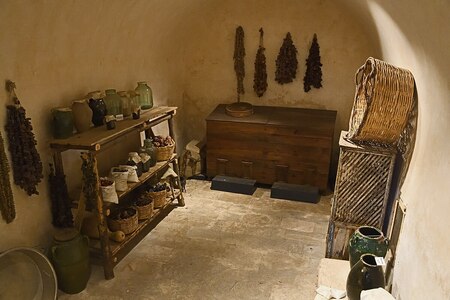
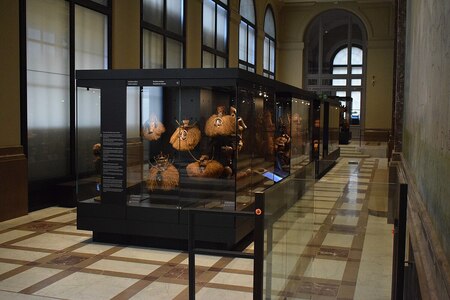
Dosseman, Urfa City museum storage-2019 (On the left) Jean Housen, African Royal Museum-2019 (On the right)
Urfa City museum storage is situated in a large mansion (or maybe two) next to the Kara Musa mosque and close to the small stretch of city walls. It is of a type one often see: lots of items, gifted by locals and arranged along the lines of trades, crafts, or in reconstructed interiors from a not-too-distant past, and some showcases about the old history, with maybe some items like a mammoth’s tooth, or with some reconstructions shown on paintings on the walls (with Göbeklitepe nearby the reconstructions were spectacular). I hardly give captions as I think the pictures and their names explain themselves. (Dosseman, 2019).
«Part of the Uganda Museum ‘s building showing the entrance to the exhibition hall» Solomon, 2020.
Uganda National Museum (UGM) is Uganda’s national and the oldest museum in East Africa, established in 1908 at Lugard’s fort (currently Buganda Museum) on Old Kampala Hill in Kampala city. Its current building (Fig. 6) was established in 1954 and designed by the architect Ernst May. The collection grew from archaeological and paleontological excavations by scientists such as Edward Wayland, Bishop J. Wilson, and Church Hill among others from 1920 to 1940 (Pers. comm., see also: Rivard, 1984; Ogura, 2005; Demissie, 2012; Byerley, 2019). Objects recorded during the survey included home tools, cultural wears, and models of indigenous houses, musical instruments, a collection of Ugandan music, material from science and technology such as an old vintage car of Captain Lugard, and photographs depicting the history of the country. However, the museum also had a considerable collection of natural history specimens including round skins, and bones of mammals, birds and reptiles, as well as a geological and paleontological collection containing many fossils. The reptile wet collection is the oldest collection in Uganda. (Solomon. S, 2020)
The detailed assessment for the Uganda museum. Solomon. S. (2020)
The pie-chat above shows a detailed assessment for the Uganda museum’s collections, exhibitions, management research and infrastructure. The author clearly explains the details as follows: Quality criteria: 1) very low quality, 2) low quality, 3) moderate quality, 4) high quality, 5) very high quality. The credit goes to Solomon Ssebuliba for this enormous evaluation. This assessment depicts how African museums are moving from being passive storages of colonial collections to becoming active agents in reinterpreting and reclaiming their cultural narratives. For detailed information about this assessment, you can follow the link attached on the list of image sources.
«Fort Lugard’s house turned into Buganda Museum. Behind the museum is the Old Kampala mosque» . (Solomon. 2020)
Some researchers asserts that Fort Lugard’s house became the Buganda Museum, while others disagree with this, but the amazing history about it, is that it was the original location for the Uganda Museum which was founded in 1908. When the museum’s collection grew, it was moved from Fort Lugard to Makerere University in 1941 and then to its current home on Kitante Hill in 1954.
«Igongo Museum» Solomon. 2020
In 2009, a museum named Igongo was established by entrepreneur James Tumusiime to preserve and promote the culture of southwestern Uganda. It was constructed on the former grounds of the Ankole Kingdom’s King Omugabe Kahaya II and opened in 2011 by President Museveni. It is a multifaceted institution featuring a cultural hamlet, a museum, and a reconstructed royal palace from the Mpororo Kingdom.
«Great Lakes Museum» Solomon. 2020
The «Great Lakes Museum» in Uganda was opened in 2014 with the main aim of preserving and showcasing the history and culture of the local tribes along the road connecting Ntungamo and Kabale. It displays artifacts from different tribes such as the Bakiga, Banyarwanda, Ankole and Baziba peoples, as well as modern relics like phones and cameras.