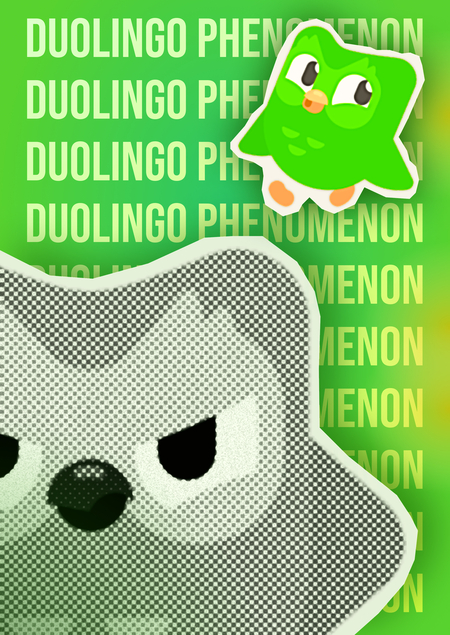

Duolingo
Duolingo is the world’s most popular language-learning platform and the most downloaded educational app. The company’s mission sounds ambitious: to make education free, fun, and accessible to all. However, behind this apparent simplicity lies one of the most well-thought-out and psychologically precise attention-retention systems on the market. Instead of traditional textbooks, Duolingo uses mechanics borrowed from mobile RPGs and match-3 games. Lessons are broken down into short sessions, users earn experience points (XP), lose «lives» for mistakes, and compete in global leagues. This approach blurs the line between education and entertainment.
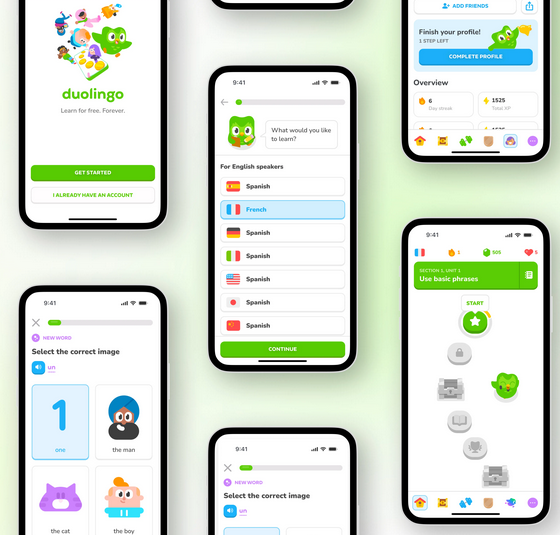
Duolingo App
The app’s visual style is built on soft shapes, a bright color palette, and flat design. The key objective of the interface is to reduce cognitive load and the user’s fear of making mistakes. The friendly graphics contrast with the complexity of learning new languages. The green owl named Duo has gone from a static, flat logo to a fully-fledged 3D character. Today, Duo is not just an app icon. He is an independent hero with a developed narrative, acting as the main conduit for the company’s communication strategy.
Duo evolution
The company uses a multi-level approach to communicating with its audience. Internal communication happens directly within the app via push notifications and email newsletters. External communication is carried out through social networks, where the brand abandons corporate formality. TikTok has become the brand’s main viral platform. Duolingo’s account contains almost no educational content. Instead, viewers are shown short, humorous videos where a life-size mascot of Duo the owl participates in trends, dances, and stalks users.
TikTok screenshots collage 1
TikTok screenshots collage 1
In text (X) and visual (Instagram*) formats, the brand maintains the image of a cheeky, sarcastic, and all-knowing character. *The activities of Meta Platforms Inc. and its social networks Instagram and Facebook are banned in the Russian Federation.
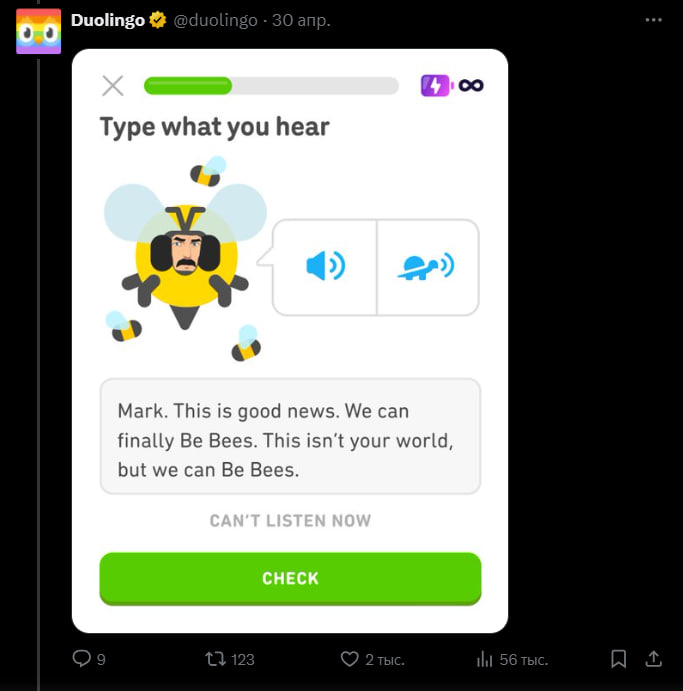

Duolingo publications
Public relations (PR) is a strategic communication process that builds mutually beneficial relationships between organizations and their publics. This two-way communication process implies that not only society changes, but the organization itself does too. Duolingo constantly adapts its Tone of Voice, sensitively reacting to the community’s response. Classic educational platforms use the language of utility and productivity. Duolingo’s PR strategy is built on newsjacking and absurdity. The brand communicates with the audience in the language of internet culture, erasing the barrier between a global corporation and an ordinary user.
Commentary
One of the key success factors has been the brand’s willingness to laugh at itself. For years, users created memes about the Duolingo owl being an aggressive stalker who will find you if you don’t complete your Spanish lesson. Instead of fighting this negative or frightening image, Duolingo’s PR department made it official. The company capitalized on user-generated content, turning the «aggressive owl» into its main marketing asset. Interaction with users in the comments is conducted in the first person (on behalf of the owl). This forms a unique emotional connection: users return to the profile not for news about updates, but to see how the mascot will reply to another follower.
Aggressive Duo
The brand regularly launches shock content to generate organic reach. For example, collaborations where Duo appears in unexpected places (at concerts, in other companies' offices) or «takes hostage» the families of those who lost their streak. Duolingo’s social networks are not a product showcase, but a fully-fledged entertainment channel. They sell not language lessons, but belonging to a global insider club united by shared humor.
Genshin Impact X Duolingo collab
To deeply understand the effectiveness of Duolingo’s communications, we will apply two concepts: Uses and Gratifications Theory for analyzing audience behavior on social media, and Politeness Theory for analyzing the mechanism of push notifications. The Uses and Gratifications Theory radically shifts the focus of media research. Its main premise is that the audience is active. Instead of asking what media does to people, the theory studies what people do with media.
According to the theory, the audience pursues specific goals in media consumption to satisfy their needs. Media constantly competes with other resources to fulfill these needs. Users turn to media for various gratifications. Motives such as the need for diversion—the desire to escape from daily routine—and affective motivation—the search for emotional engagement and pleasure—stand out. For an educational app, this means direct competition with Netflix or YouTube.
Doulingo VS Book
The second theory necessary for our analysis was developed by Brown and Levinson. This theory explains how people use politeness strategies to manage their own and others' identities (or «face») in interpersonal communication. Central to understanding Duolingo’s messaging is the concept of «negative face.» This is a person’s need and desire to act freely, without restrictions or imposition from others.
Duo «negative face»
In communication, certain actions disrupt this comfort. Face-threatening acts (FTAs) include everyday things like requests, criticism, and threats. Usually, to minimize the threat, people use various strategies, such as negative politeness, where the speaker acknowledges the listener’s discomfort and uses apologies and softening phrasing when making requests. On the opposite end of the spectrum is the strategy of direct action. The bald-on-record strategy means committing an FTA directly, where the speaker makes no attempt to soften the blow. Using bald-on-record allows one to achieve the desired outcome directly but carries social risks. The person commits a face-threatening act without attempting to appease the interlocutor.
Why do millions of people follow an educational app on entertainment networks? The answer lies in motivation. Users go to Duolingo’s TikTok not for utilitarian purposes (studying grammar), but solely for affective motivation—to get emotions. Realizing that media competes with other resources to satisfy needs, Duolingo stopped competing with other language schools. They began competing with meme pages and entertainment bloggers for the right to satisfy the audience’s need for diversion. Absurd humor and absurd scenarios involving a giant owl fulfill the audience’s need for escapism. Users actively choose this content because it provides them with emotional release and a sense of belonging to a subculture of «those who got the joke.»
Let’s move on to Politeness Theory. Study reminders are a classic problem for educational products. Ordinary apps use negative politeness, trying not to scare off the client: «Please find a minute for a lesson.» Duolingo acts differently. Their famous notifications («You missed your Spanish lesson. You know what happens to those who miss lessons») are a direct assault on the user’s freedom. The brand intentionally attacks the client’s «negative face,» imposing actions upon them.
Duolingo notifications
The app uses the purest bald-on-record strategy. Duo the owl commits a face-threatening act (FTA) absolutely directly, without any attempts to soften the message or flatter the user. Such notifications often cross over into passive aggression («These reminders don’t seem to be working. We’ll stop sending them for now»). This causes massive cognitive dissonance for the user: the program is making them feel guilty.
Duolingo notifications