Navigation
- Concept
- 1920s–1930s. Emancipation and Daily Life
- 1960s–1970s. The Working Woman and Her Emotional World
- 1980s–1990s. Critical Reflection and Female Subjectivity
- Conclusion
- Bibliography
- Image Sources
Concept
Soviet animation, throughout nearly seven decades of its existence, served a dual function: on one hand, it was a tool for ideological education, and on the other, it was a space for artistic experimentation and authorial expression. Within this space, female figures held a unique position. They not only reflected the official rhetoric of equality but also engaged in a complex dialogue with it. This visual study is dedicated to how Soviet animation constructed and represented female labor—both physical and emotional—and how female imagery evolved from the heroic worker-figures of the early Soviet period to the reflective, weary, and ironic characters of the late Soviet era.
The relevance of this topic stems from the fact that Soviet animation, as a mass art form, shaped the perceptions of several generations of viewers regarding societal norms, gender roles, and the social value of labor. For a long time, the contribution of women to animation—both in directing and artistic design—remained on the periphery of academic focus. Only in recent years have studies emerged that systematically examine female subjectivity within Soviet animation. Although Soviet animation was subject to less ideological control than feature films or literature, animators were still compelled to operate within prescribed boundaries that gradually loosened over time. Female directors, such as the Brumberg sisters, Olga Khodateeva, and later Elena Prorokova, utilized animation to illuminate the female perspective and issues that fell outside the official canon.
How did the visual language of Soviet animation code female labor and female archetypes, and how did these codes shift depending on the historical period and the author’s perspective? Visual representation refers not only to the narrative content but also to the plasticity, color, composition, animation style, and how its movement and appearance are constructed on screen. The research material consists of Soviet animated films created from the 1920s through the 1990s, including both canonical works from Soyuzmultfilm and lesser-known auteur pieces in which the female theme is clearly articulated.
Emancipation and Daily Life. Women’s Labor as a Revolutionary Project (1920s–1930s)
Early Soviet animation developed within a context of radical restructuring of gender relations. Women were conceived as equal participants in building the new society, and animation aimed at the mass audience actively incorporated this thesis into its visual repertoire.
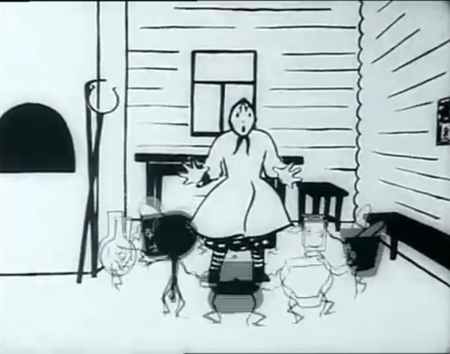
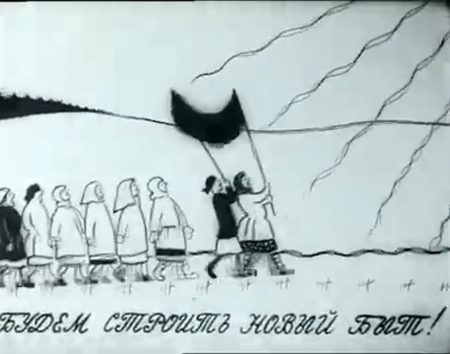
A prime example is the film «Grozny Vavila and Aunt Arina» (1928), whose plot centers on the conflict between domestic labor and public engagement. The heroine, Aunt Arina, prepares to attend a women’s meeting on March 8th under the slogan «Let’s build a new life!» while her husband Vavila demands «shchi and kasha» and perceives his wife leaving the house as a catastrophe.
«Grozny Vavila and Aunt Arina» (1928), directed by Nikolai and Olga Khodatevy
«Grozny Vavil and Aunt Arina» (1928), directed by Nikolay and Olga Khodatevy
«Grozny Vavila and Aunt Arina» (1928), directed by Nikolai and Olga Khodateyeva
Visually, the black-and-white film contrasts two spaces: the enclosed, cramped space of the pantry filled with pots and pans, and the open, communal space of the gathering into which Arina breaks out. Women’s labor here is framed not as an intrinsic value, but as something that must be overcome or redistributed for the sake of socially useful activity.
«Grozny Vavila and Aunt Arina» (1928), directed by Nikolay and Olga Khodatyevy
«Grozny Vavil and Aunt Arina» (1928), directed by Nikolay and Olga Khodatevy
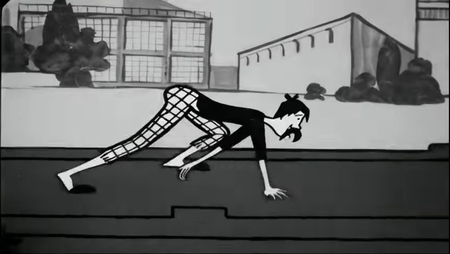
However, during this period, more complex images also emerge. In the film «One of Many» (1927), the heroine is depicted as a naïve dreamer who falls asleep and finds herself in Hollywood, where she confronts a world alien to a Soviet person.
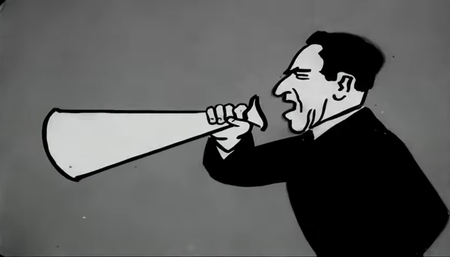
«One of Many» (1927), directed by Nikolai Khodatayev
It can be said that visually, the heroine is contrasted with exoticized Hollywood images. Her simple appearance contrasts with the decorative, excessive femininity of Western stars. This contrast is significant because Soviet animation, even at an early stage, begins to encode the proper definition of womanhood by rejecting outward flashiness in favor of functionality and naturalness.
«One of Many» (1927), directed by Nikolai Khodateyev
«One of Many» (1927), directed by Nikolai Khodataev
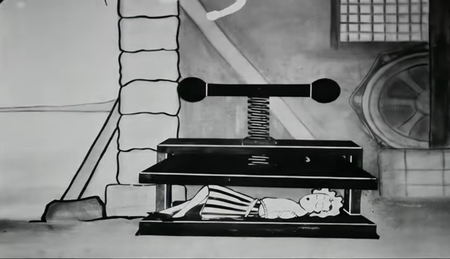
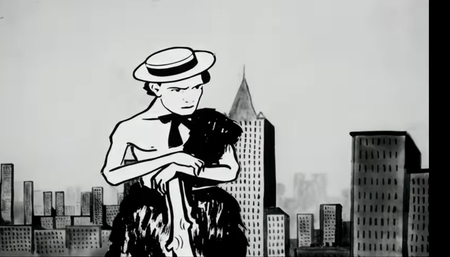
«One of Many» (1927), directed by Nikolay Khodataev
The Working Heroine and Her Emotional World (1960s–1970s)
The post-war and Thaw periods were marked by a search for a new visual language in which women’s labor could be shown not only as an ideological necessity but also as a space for personal experience.
«The Queen’s Companion» (1962), directed by Irina Gurvich
In the film «The Queen’s Satellite» (1962), the main character, Galina Mayak, a collective farm worker, is portrayed as a strong, competent worker who operates complex agricultural machinery and even steers a thunderstorm cloud to water beets.
«The Queen’s Satellite» (1962), directed by Irina Gurvich
«Queen’s Companion» (1962), directed by Irina Gurvich
Her work is visualized through confident movements and the interaction with machines and nature as equal partners. It is notable that Galina’s foil is Neroba, the lazy foreman, whose incompetence and penchant for alcohol are emphasized through caricature-like, awkward physicality. Female labor is asserted here as the norm through the contrast with male dysfunction—a motif that would be repeatedly featured in Soviet animation.
«The Queen’s Satellite» (1962), directed by Irina Gurvich
«The Queen’s Companion» (1962), directed by Irina Gurvich