ESSAY
When the iron bridge in Henichesk was slated for scrap, its history had to be researched in Vienna. Local entrepreneurs and activists reached out to Waagner-Biro—the firm that constructed such bridges. They recognized the design, but no specific documentation for this particular bridge was found.
This occurred in 2016. By that time, the bridge had served trains, cars, and fishermen, yet nobody could tell its entire story from beginning to end.
The Henichesk spans were brought in in 1951, replacing a wooden bridge destroyed in the war. Prior to that, according to directories, they stood over the Dnipro River near Belarusian Orsha. Beyond that, the confusion begins: it is not reliably known what stood between Orsha and Henichesk, and where the structure served before being relocated.
However, the bridge’s design can be traced without access to archives. It is the Roth-Waagner system, invented by the young engineer Friedrich Roth during the First World War. The bridge is assembled from individual parts—requiring minimal equipment and allowing for fast construction. Fourteen such bridges were built before the Second World War. The company Waagner-Biro, established in 1854, still exists today. The new dome over the Reichstag in Berlin was also one of its works.
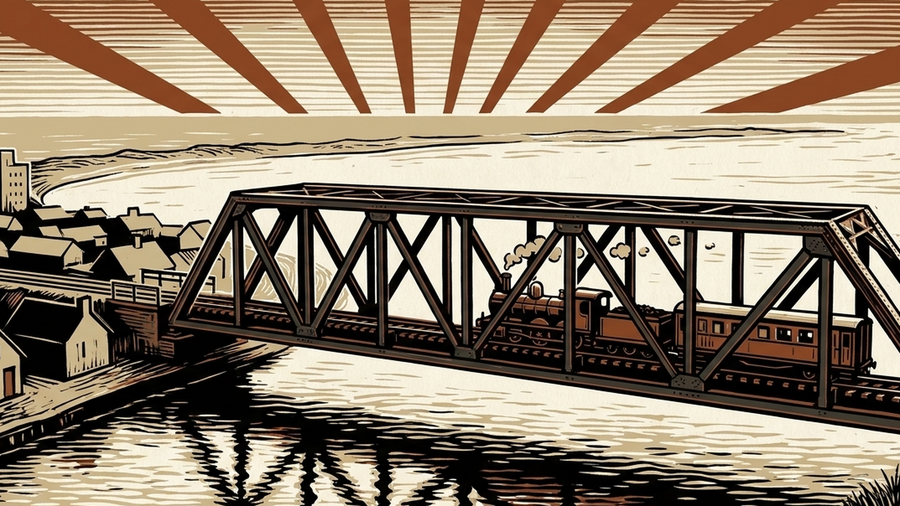
On the railway bridge in Genichesk, a «cuckoo» ran a couple of times a day: a steam locomotive and one passenger car. The Valki—Genichesk—Novoalekseevka line connected the city to Strelka; this line was also used to transport sand from the quarries. Later, a storm nearly destroyed the structure. The railway line was not repaired; trucks were used instead. When a concrete bridge was built half a kilometer away, the old bridge was left to fishermen and divers.
In the spring of 2016, they announced its demolition. The townspeople stood up for the bridge; a group from Urban-COYC arrived at the end of August. That is when the request was submitted to Vienna. Gaps in the history remain, but they defended the bridge.
Now, the administration of the Genichesk District calls it the city’s calling card and a monument to European engineering heritage. There was a lack of documentation that could explain its past, but there were enough people who cared about its future.
Cross the bridge at sunset. From the walkway, you can see Genichesk and the spit. Try to imagine that «cuckoo» here, with only one car: it needed an entire bridge, too.
Ninth Flight
Put the bag from the crate away and sit down. No, it’s not trash. There’s a hammer in there. An old one, but better than the current ones.
I’ll show you the rivet later. First, I’ll explain why people put their hands on it. Otherwise, people come in asking, «Where do I touch? What should I wish for?» As if the bridge has nothing better to do.
In the autumn of '51, they brought iron to Genichesk. A whole trainload. The farms had German lettering, the crates had numbers, but they hadn’t brought anyone to explain which way was up.
Ignat, the foreman, walked between the wagons scratching his neck. Behind him was Mishka—sixteen years old, his father’s boots, his father’s hammer, and only his own cap. He really wanted to be called Mikhail. Ignat always forgot.
— Will this be a bridge? — the guy asked.
— No, a samovar. Take the lids to the guardhouse. The diagrams are on them, don’t break them.
Mishka picked up the planks. On the ninth lid, the drawing was strange: the arrows pointed from top to bottom. He turned it over and looked. Someone from the construction site yelled at him not to sleep, and the guy slipped the lid under the tarp.
Ignat fed him and taught him; he didn’t bother him with small tasks. While others built a bridge, he was constantly asked to fetch and carry. Mishka announced he was going up. Down on the ground, he declared, «I’m not scared,» and climbed up, his boot sticking to the metal. The jeers from below were worse than the height.
It wasn’t more than two hundred paces across. You could see people on the other side, but you couldn’t walk over—the war had burned the wooden bridge. The wind from Azov would prevent launching a boat, and they had to wait for bread for weeks on the Strelka. That’s when they started building, in this weather.
For two weeks, Mishka climbed the trusses. He’d shake, press his belly against the metal, and search his pockets as if something were missing. Ignat, below, grumbled about him digging around. The guy replied—he lost a rivet. And his pockets were practically bursting from them.Nine spans remained. In the morning, the radio reported a storm by evening, gusts up to twenty meters per second. Ignat turned it off and headed toward the water. Mishka followed.«We won’t make it?»«Praskovya is on the shore this morning. Her granddaughter is waiting for medicine. Go tell her we won’t make it.»The guy didn’t go. He pulled out a hammer.By two o’clock, the span hung on the cables; the last four trusses just wouldn’t connect. There was half a finger’s width left. Ignat measured, and Mishka hammered. His palm swelled from the blows, but the gap remained the same. The guy was already starting to resent the hammer—his father would probably have handled this ages ago.«Stop, ” Ignat said. „The metal isn’t to blame.“Mishka wanted to snap back. Instead, he looked at the joint. They were supporting it from below, pulling it from above…
Top to bottom! He rushed toward the hut so fast that Ignat shouted after him, «Where are you going with the tools?» The cover had to be pulled out from under the whole stack. Mishka brought it and brushed off the dust.
«I noticed that back then. I thought they drew it incorrectly.»
Ignat leaned over the diagram. He ran his finger over it for a long time, turning the board.
«They drew it like this. We’re not like that. It has to be lowered from the top. We can’t hold it steady in the wind with just one rope. Call for people.»
By three o’clock, forty people were gathered on the shore. Praskovya walked six versts on the sand with her granddaughter; she settled the girl behind the crates and also took up a rope.
«Grandma, where are you going?» someone shouted.
«I was pulling nets when you weren’t around. Move over.»
Mishka laughed. Then he saw where he needed to climb, and his laughter stopped. The last truss was swaying slightly in the wind. From up there, he needed to show Ignat when to lower the span. The guy clipped in and climbed up. The hammer was in the way. He slipped it into a belt loop; they called up from below, but he didn’t answer. Water glistened under his sole. I wish everyone would leave, so they wouldn’t see him climb back up.
«Well?» Ignat shouted.
Mishka opened his mouth. «Pull» — just one word, and they will pull, and he’ll manage somehow…
«Stop!»
The people on the shore froze.
«What is it?»
«I can’t. Wait.»
Ignat said nothing. He raised his hand—wait.
Mishka shifted his foot. Then the other. He leaned his knee against the metal, tightened the safety strap. Someone called from below, asking how much longer it would take. Praskovya answered so clearly it could be heard over the wind.
Now the guy could see the joint. The gust pushed the span, and people clung to the cable. Not quite right: the tighter they held, the further the trusses spread apart.
«Pull back!» he yelled.
«It’ll carry us away!»
«Just a little! Ignat, I see it!»
The foreman gestured. They handed over the cable, the span swayed, and Mishka managed to show: here. Four trusses settled into place. The hammer, hanging near his stomach, he couldn’t quite feel. He drove the last rivet a minute before the storm hit.
He crawled down the ladder on all fours. No one on the shore was laughing. Praskovya pressed an empty mug into his hands: hold it; I’ll pour something in a moment.
During the night, the first train was missed. Ignat and Mishka sat under a tarp, drinking hot water with dried raspberries. The guy kept moving the hammer closer to the fire—to dry the handle.
«Aren’t you going to want the bridge home?» he asked.
«Home where?»
«Where they brought it from.»
«I don’t know where.» Ignat took a sip and burned his mouth. «There’s work for him here too.»
By morning, they took flour to Strelka and brought back fish. Praskovya received her medicine later that night.
She came to thank him, but Ignat told her: thank the guy.
«This?» She stroked the truss. «Look at this. The metal is foreign, but the bridge is ours now.»
Ignat drove a spare rivet on the inside of the ninth span.
«As a keepsake, Mikhail. Place your hand here. So it will return.»
The young man didn’t even immediately extend his hand. His name was Mikhail.
Later, they built a concrete bridge nearby, and the fishermen and divers stayed on the iron structure. Then, in the spring of '16, they decided to scrap it. People came back to the shore. They say that all of Genichesk passed through our clamp. The bridge remained.
Here it is. You can get it off the decking. Is it warm? I lean on it while I talk. I’ve fished here for half a century; it’s a comfortable spot.
Yes, Misha is me. I’m ninety-one. Put your hammer back. They can still be used.