Bible history is one of the foundations of classical art, opening an almost unlimited field for the artist to reflect on the design of the world and the place of man in it. It is clear that the most dramatic part of the New Testament, which speaks of the suffering of Christ, his death on the cross, and his resurrection, has a special place in the series of Bible stories. What’s interesting is trying to figure out exactly what artists and viewers are trying to find here.

The film from A. Tarkovsky’s «Stalker». 1979
The classic culture was based on the Triad of Truth-Beauty, Art and Religion, naturally united in seeking answers to questions about the meaning of existence, to which philosophy had taken seriously. However, in today’s secular world, which has gone through the process of «filming» and «opium for the people», it is much more difficult to maintain this link. Today’s painter rarely refers directly to Christ’s image by speaking directly about human dignity, humility, or mercy. Rather, the artist will choose the path to be followed by referring to certain elements of the iconography associated with Bible history.

The film from A. Tarkovsky’s «Stalker». 1979
A geek stacker in despair tells his wife how to show people the way to the Zone over and over again, where they can find happiness and salvation, but it’s useless because they don’t believe in anything! And Gorčakov, who hasn’t found a place for so many years and finally believes in something, takes over the ritual of carrying out a burning candle from one side of the bathing suit to the other. And a few times it’s embarrassing to see if anyone’s watching him. Like the audience, he needs time to believe.
Working with Bible stories as such is not an easy task. In the field of modern art after Philosophy, the artist needs, on the one hand, to be tactful and sensitive in speaking of sacred and, on the other hand, to maintain an intellectual distance to what is actually a matter of faith, that is, a non-critical conviction. Few authors have managed to maintain this delicate balance.


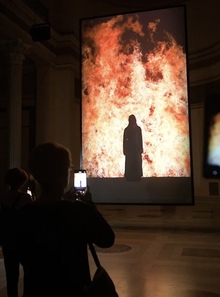
Bill Viola. The Martyrs in St. Paul’s Cathedral. 2014
Bill Viola. The video from Katerina’s Room. 2001
However, in the case of Bill Viola, one of the few craftsmen who is highly valued by believers and art critics, it is not only in the noble form that he gives to his video works (approaching them to classical paintings) but also the special state of calm vision that they communicate to the audience.
Bill Viola. Video footage from «Emerging». 2002
The story of Fear is certainly the most tense and difficult part of the newfound history. We see Christ being betrayed by his disciples, soldiers taking him into custody, tormenting him, insulting him, trying to break him. However, he remains steadfast, sacrificing himself in the name of those in need of salvation. He’s overpowering everything, and he’s trampling on death itself. This story is equally full of pain and greatness. Therefore, the visual language used by the artist must reflect this depth.
Piero della Francesca. Resurrection. 1463
The cycle of Fear begins from the entrance of the LORD to Jerusalem, and ends with the resurrection, and, behold, a great earthquake has been made; for the angel of the LORD cometh down from heaven, and cometh down, and pulleth away the stone from the door of the coffin, and siteth on it… saying, Do not be afraid, for I know that you seek Jesus the crucified; he is not here; he is raised up, as he said.
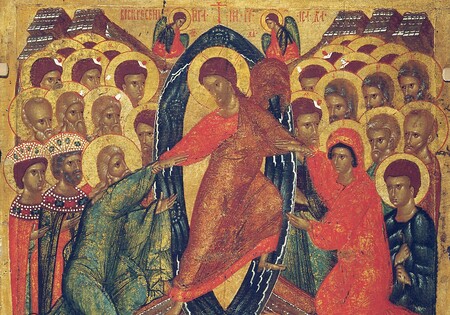
In both the Middle Ages and the classical era, the story of the last days of Christ’s life and his return was a whole. And even though the believer was more likely to see frightening images of flour on the walls of the altar or on the fresco — covered walls of the temple, he knew that Easter was behind the Good Seven, as spring came after winter.


Mattias Grunewald. Isengeima altar. Okay. 1512-1516 (fragments: Christ’s mourning and Resurrection)
However, twenty-first-century artists tend to see only the first part of this story. For someone who’s been through World War I like Otto Deeks, it’s as if only the first piece of the altar has always been discovered.
Mattias Grunewald. Isengeima altar. Okay. 1512-1516 (fragment)
In 1932, Deeks wrote a picture of War, using the shape of a medieval altar to remind us of the sound of guns and the bursting light gas — on the eve of a new war. «The bottom of the painting is calm. The lives of soldiers are no longer in danger. What’s dead can’t be killed. Their eyelids are closed, they’re in deep sleep forever. The strong breasts are still, and the heart will never be broken again. The brave warriors were pressed side by side, and they were to lie forever in their brother’s grave. On the right side of the painting, everything ended as it should have been. The bodies will forever lie on an empty field, without the past and without the future. A soldier carries a wounded comrade, being bravely tired. From that moment on, he’s only got one today. And today is eternity.» [1].
Otto Deeks. War. 1932 (fragment)


Georges Ruo. Christ’s curse. 1923 Georg Baselitz. Head. 1986
Artists sometimes write the image of Christ in the most expressive manner possible, as if it were the very surface of the paper, the canvas, the body of the artist, the soul of an spectator who could not turn away and forget.


Rudolf Schwartzögler. Second action. 1965 Bruce Herman. Holy head. 1994
Jean Fotier. The hostage’s head. 1943-1944
Pain and guilt become insufferable, and human suffering cannot be separated from the destruction of the entire world. It is the human, personal beginning in the image of Christ that becomes the most important thing for artists.


The film from Martin Scorsese’s «The Last Temptation of Christ». 1988 Julian Grayter. It’s to the autoportrait. 1987 (this painting became the cover of the soundtrack for the Scorsese film)