
Example of a story icon
Astropass is a partnership program that offers stories instead of purchase bonuses. With it, users can unlock the next chapter of their character’s story in the mobile app for every product or service they buy from partner brands.
This presentation outlines the Astropass communication brief developed as part of the elective course.

Logo
People love stories. Astropass loves telling them.
«Communication Theory in the Context of Design»
Communication theory provides the conceptual foundation for understanding how meaning is produced, transmitted, and interpreted across various media.
In the context of design, communication does not occur through words alone; instead, it is constructed through visual elements, symbolic systems, interaction patterns, and the user’s engagement with these forms.
Loading phone screen
The course defines communication as a systemic symbolic process, which means that meaning emerges through coded structures and contextual cues rather than simple message delivery. Design operates in the same way: visual choices, spatial hierarchies, and interface behaviors function as acts of communication.
Because communication is embedded within cultural frameworks, users interpret signs according to shared cultural knowledge, expectations, and symbolic associations. This makes cultural context essential to understanding how design acquires meaning.
Craig’s metamodel offers additional analytical insight: the cybernetic tradition highlights information flows and feedback loops, the socio-cultural tradition explains how communication reproduces shared practices, and the semiotic tradition clarifies how meaning is constructed through signs. These perspectives illuminate how design communicates on multiple levels simultaneously.
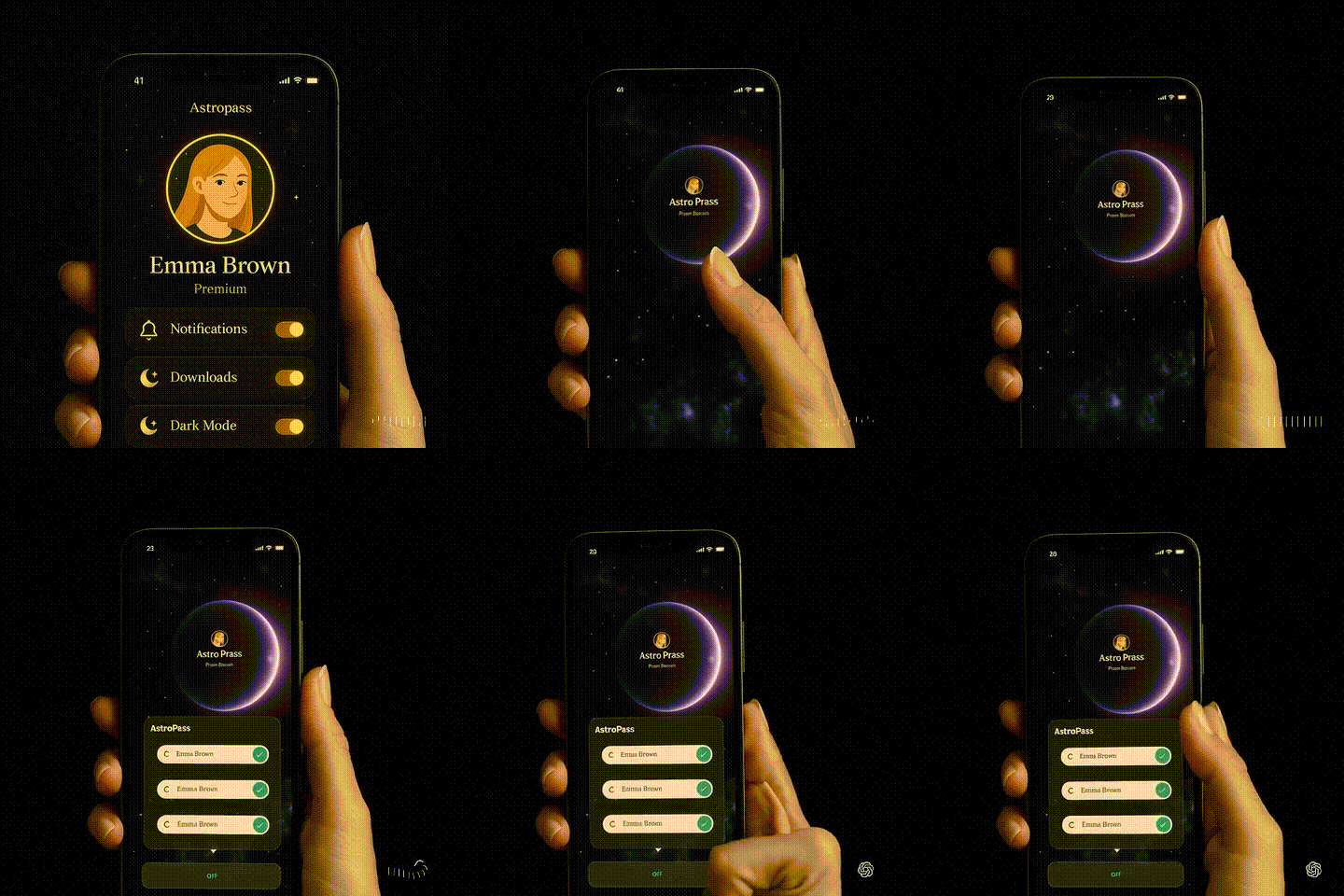
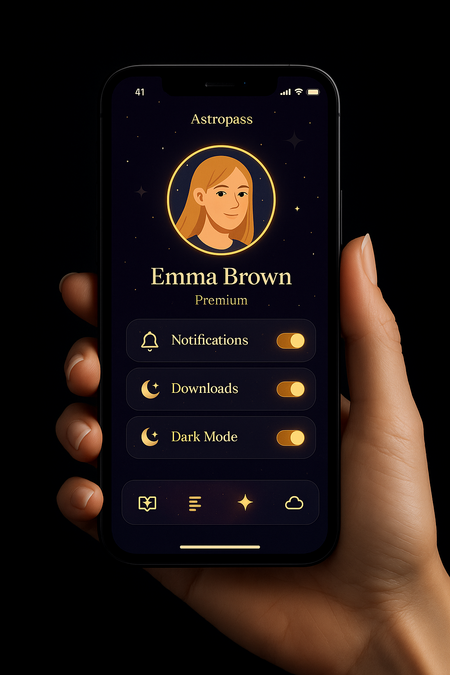
User’s profile & How to use
A key concept emphasized in the course is that meaning is co-constructed. Designers can encode messages, but users actively interpret and reinterpret them based on their own experience. Therefore, effective design anticipates interpretive variability and builds flexible structures for meaning-making. The Narrative Paradigm further explains why storytelling is a powerful communicative strategy: humans tend to process information through narrative coherence and emotional resonance. Media ecology adds another layer by showing that the medium itself shapes how messages are perceived. Mobile devices, for example, enable short, frequent, intimate interactions that require appropriately paced forms of communication.
Affordances also function as communicative cues, indicating how users can or should interact with an interface. Finally, impression management theory helps explain the role of digital avatars as tools for identity performance. Individuals express aspects of themselves through mediated representations, and avatars become symbolic extensions of the self.
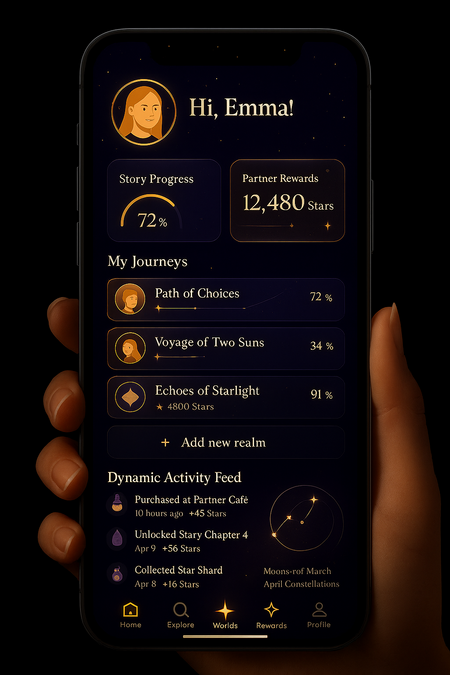
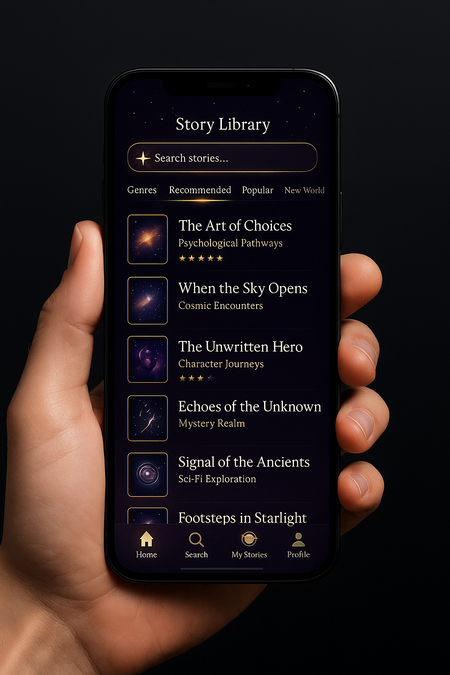
Progress of the partnership & Story library
Together, these theories demonstrate that design is not merely aesthetic — it is a structured communicative system that shapes how meaning is produced and interpreted.
These principles directly inform the conceptual foundation of the Astropass project.
«General Audience Presentation»
An example of how a user interacts with the app
An example of how users interact with the app on the TV
Astropass is designed to reimagine how people engage with everyday purchases. Within the partner program, transactions at participating cafés, stores, or service locations generate narrative value rather than economic benefit. When a user buys an item from an Astropass partner, they do not receive cashback or traditional loyalty bonuses; instead, the purchase unlocks a new chapter in a personalized story. This framework transforms consumption into a narrative experience, reframing routine transactions as meaningful components of an ongoing fictional universe.
The central idea of Astropass is that ordinary actions can produce symbolic outcomes. Each purchase triggers a prediction or narrative fragment that is added to the user’s avatar’s journey. Over time, these fragments form a cohesive storyline shaped by the user’s real-world behavior.
The slogan «Your digital passport to new worlds» communicates this logic clearly: participation in the partner program becomes a way of influencing a digital narrative.



Users & Their Avatars
Rather than appealing to rational incentives like discounts or point accumulation, Astropass emphasizes emotional and symbolic engagement. Users interact with the system not to recover monetary value, but to receive reflective, imaginative content. This creates a distinct form of loyalty grounded in curiosity and narrative continuity.
The visual environment of Astropass supports this experience through a cosmic aesthetic that evokes reflection and imagination. Constellations, astral motifs, and soft gradients create a sense of thematic continuity across the interface and offline partner materials. The integration of visual elements across digital and physical touchpoints strengthens the perception that each purchase opens a gateway into a larger storyworld.
Astropass offers several user-facing features: episodic narrative updates, personalized predictions, avatar development, and the ability to share select story moments. The system includes three avatar archetypes ( Starborn, Emberkind, and Tidewalker) which serve as interpretive filters for narrative content. Each archetype provides a distinctive tone and thematic orientation, allowing users to experience stories aligned with their preferences.
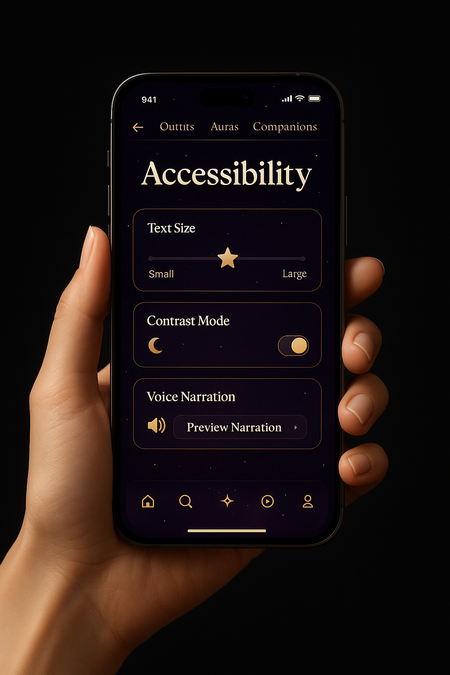
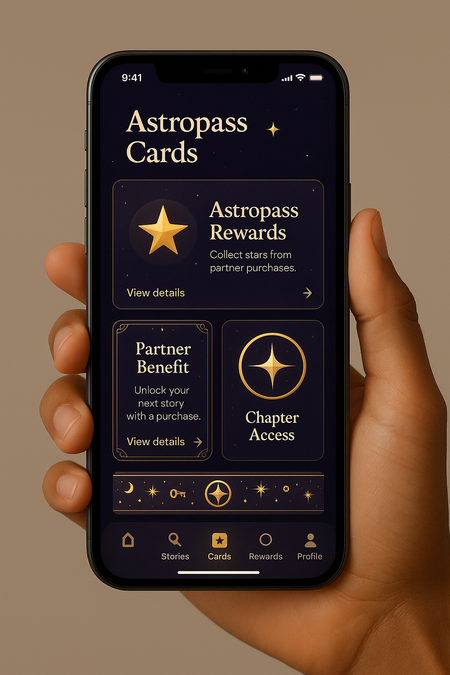
Accessibility & UI phone screen
The app’s interface is organized around a story feed that displays narrative chapters, a dashboard showing avatar development, a marketplace for optional cosmetic items, and accessibility settings. Users can adjust text size, contrast, or enable narration, ensuring broad usability. Predictions and chapters can also be saved offline, supporting engagement in various environments.
By retaining data locally and providing minimal data collection, Astropass emphasizes privacy and positions the narrative as a personal, introspective experience. Additional physical materials, such as branded cards and packaging at partner points of sale, extend the symbolic universe into the offline environment.
In total, Astropass offers general users a means of transforming routine purchases into moments of symbolic and narrative significance. The partner program becomes a narrative ecosystem in which consumption is reframed as creative participation.
«Professional Audience Presentation»
A visual example–instruction for using the feature
A visual example–instruction for using the feature
A visual example–instruction for using the feature
Astropass is positioned as an innovative partner program that substitutes traditional transactional incentives with narrative engagement. Instead of offering cashback, discounts, or loyalty points, Astropass rewards purchases made at partner locations with curated narrative content. Each purchase generates a story chapter or prediction, transforming routine consumer behavior into participation in a dynamic narrative system.
Astropass presents a novel approach to customer retention and brand differentiation. The target demographic is primarily young adults aged 18-30. It shows strong interest in personalized content, symbolic meaning, and narrative-based digital experiences. This demographic frequently consumes short-form media, uses mobile devices as primary communication tools, and demonstrates openness to hybrid digital-physical ecosystems.
Creator
Audience segmentation is guided by three archetypes:
Explorer — drawn to novelty and discovery, likely to appreciate evolving narrative structures. Jester — values playfulness, unpredictability, and -experimentation within the system. Creator — seeks introspective, symbolic, and aesthetically cohesive experiences.
Understanding these audience types allows Astropass to tailor narrative tone and communication strategies to distinct user motivations.
Jester