Navigation
Concept
PART 1: THE GENESIS OF MODULAR THINKING. Chapter 1. What is a module and why did it become the primary tool for order. Chapter 2. Art as laboratory: from the Bauhaus to post-war minimalism. Chapter 3. Systemic art: Sol LeWitt, Donald Judd, and the aesthetics of serialization. Chapter 4. Swiss design: the reinvention of the module as a functional instrument. Chapter 5. The modernist grid in action: Hoffmann and Neuburg.
PART 2: THE ANATOMY OF THE GRID: THREE STAGES OF TRANSFORMATION. Chapter 6. The module as a cell: Wolfgang Weingart. Chapter 7. Anti-grid: David Carson and the collapse of modernist order. Chapter 8. The module as code: digital adaptability.
PART 3: MUTATIONS AND RETURN Chapter 9. Three grids: a comparative analysis.
Conclusion
Concept
The transformation of the typographic grid in the second half of the 20th to the early 21st century reflects a shift from the modernist belief in universal order to postmodern fragmentation and digital adaptability. Interest in this topic stems from the fact that the modular grid evolved from an aesthetic category into an object of rebellion and reinterpretation. The parallel development of systems art in the 1960s (Sol LeWitt, Donald Judd) allows us to view modular thinking as a broader cultural phenomenon.
Material selection was based on three criteria. The chronological criterion covers the period from the 1950s through the 2010s, highlighting three phases: the modernist grid, deconstruction, and digital adaptability. The typological criterion focuses on cross-cutting examples—the poster and the magazine spread. The contextual criterion introduces systems art as a necessary parallel.
The structure is organized chronologically with elements of typological analysis. The work is divided into three sections: «The Genesis of Modular Thinking, ” „Anatomy of the Grid: Three Stages of Transformation, ” and „Mutations and Return.“
When selecting sources, priority is given to representative works documented in literature.
The key question is: how and why did the modular grid transition from a rational structure to a fragmented and adaptive tool, and how does this relate to systems art?
The goal is to demonstrate that the grid’s change in states was not accidental, but reflected a shift in cultural attitudes toward order—from the modernist faith in the system through postmodern rebellion to digital reflection and the re-emergence of the module as a conscious aesthetic citation.
SECTION 1: THE GENESIS OF MODULAR THINKING
Глава 1.
What is a module and why has it become the primary tool for order
Modular by Le Corbusier (1946)
A module is a proportionate unit that forms a whole through repetition. Unlike arbitrary grids, where columns and fields can be anything, a modular structure is built upon strictly equal, interchangeable elements. The module establishes not just an order, but a mathematically predictable, reproducible order. It is this quality—repetition without distortion—that made the module a central tool of post-war rational thought.
Unité d’habitation, Marseille, Le Corbusier (1952)
Before becoming a tool of graphic design, modular thinking was established in architecture and engineering. As early as the 1920s, Le Corbusier developed the «Modulor"—an anthropometric system of proportions based on the golden ratio and the human body. In post-war construction, the module became an economic imperative: housing blocks were assembled from standardized concrete panels. Here, the module was not an aesthetic choice, but a prerequisite for efficiency. However, by the 1950s, this engineering principle began to permeate art and design, transforming from a technical necessity into an artistic category.
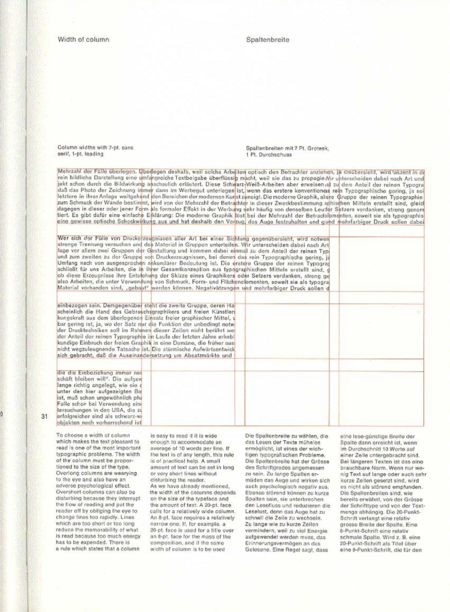
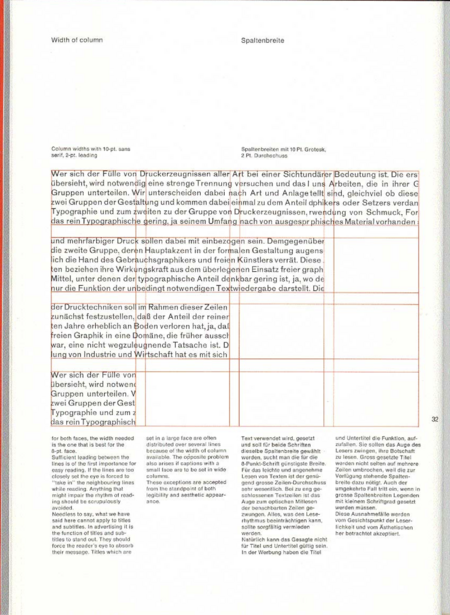
Modular grid from Grid Systems, Muller-Brockmann (1981)
The fundamental difference between a modular grid and a standard layout grid lies in predictability. A standard grid defines axes and margins but allows for varying column widths, arbitrary padding, and free composition. A modular grid rigidly divides the space into equal cells, and any graphic solution is constructed from these cells, much like building blocks. This is not merely a layout tool—it is an entire philosophy: form follows the module.
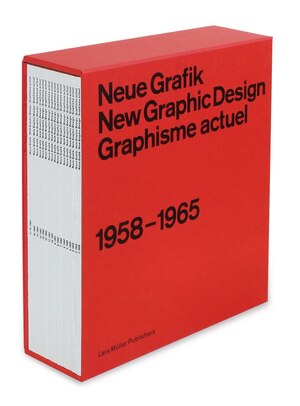
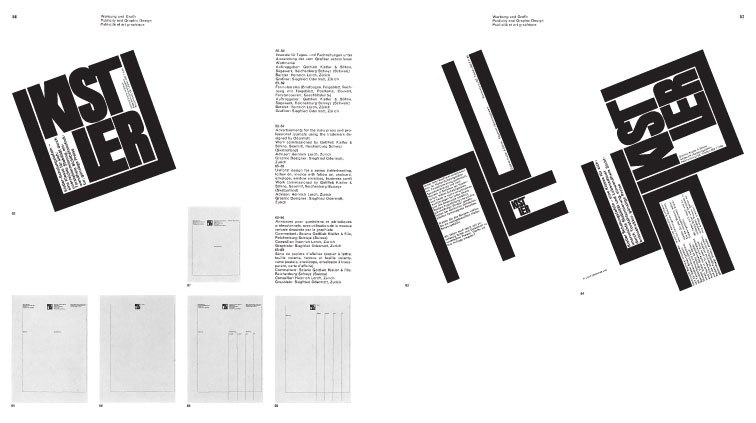
Spread from the journal «Neue Grafik» (1958)
The modular grid solidified its status as the primary tool for order precisely after World War II, and this was no coincidence. A culture that had survived catastrophe sought forms that guaranteed clarity, neutrality, and functionality. The modernist project—in architecture, art, and design—promised a universal language free from national rhetoric and subjective arbitrariness. The modular grid became the visual embodiment of this promise: it does not express emotion, it belongs to no one personally, and it functions the same way in any country. Order, understood as an ethical value.
Глава 2.
Art as a Laboratory: From the Bauhaus to Post-War Minimalism
El Lissitzky’s poster «Beat the Whites with the Red Wedge» (1920)
The first radical attempt to replace painterly randomness with a system came through the experiments of Soviet Constructivists. El Lissitzky, in the poster «Red Wedge Beats Whites» (1920), structures the image as a montage of geometric planes governed by distinct axes. While a modular grid does not yet exist here, a key principle is evident: the visual form is not «created» by a free gesture, but assembled from predefined elements. Composition is understood as construction. This principle would become the foundation of all subsequent modular thinking.
Photogram by Laszlo Moholy-Nagy (1925)
In the mid-1920s, László Moholy-Nagy took the next step. He introduced the photogram—an image created without a camera by arranging objects on photosensitive paper. The photogram is inherently modular: it is constructed from repeating, rhythmically organized elements, and its composition is governed not by subject matter, but by the logic of light, shadow, and plane. The artist’s subjective choice is limited to selecting and positioning the objects—the light handles everything else. This was a significant move toward the autonomy of visual structure.
Albrecht Heubner. Composition exercise from Jost Schmidt’s course. Bauhaus, 1930–1933
By the early 1930s, the principle of systematic composition permeated foundational art education. At the preparatory course of Josef Albers in the Bauhaus, students were tasked with creating a visually compelling composition using a limited set of identical modules. There was no narrative, no figuration—only the relationships between elements. The module transformed from a mere artistic technique into a pedagogical tool that disciplined sight and thought.
Donald Judd. Untitled (Stacks). 1965
By the 1960s, the geometric tradition—initiated by the Constructivists and continued at the Bauhaus—evolves into minimalism. Artists discard not only figuration but also expressive gesture, moving away from the composition as a vehicle for personal expression. Donald Judd exhibits «Untitled (Stacks)”—a series of identical rectangular elements separated by equal intervals. Form becomes merely form, and structure becomes the sole content. Minimalism completes the transformation of art into a laboratory of pure systems.
Author’s diagram — a horizontal timeline from 1920 to 1965 featuring four points. Above each point is a miniature of the corresponding work, accompanied by a caption.
Thus, by the mid-1960s, modular thinking transitioned from a pedagogical exercise in the Bauhaus through technological experimentation to the philosophy of minimalism. Art served as a laboratory where the module was understood as an independent aesthetic value—a pure structure not reliant on narrative or expression. Now, this principle was ready to move beyond art and become a functional tool in the hands of the designer.
Глава 3.
Systemic Art: Sol LeWitt, Donald Judd, and the Aesthetics of Seriality
1
2
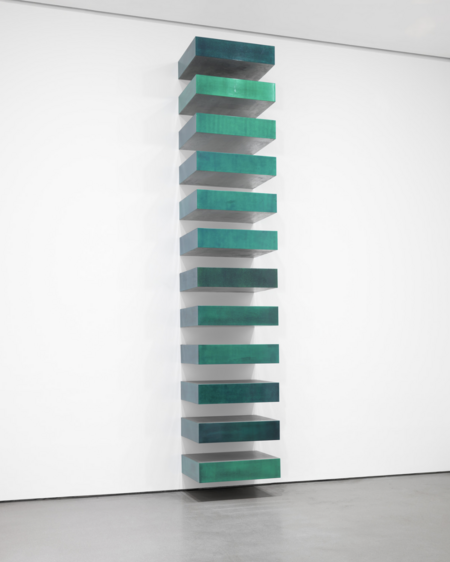
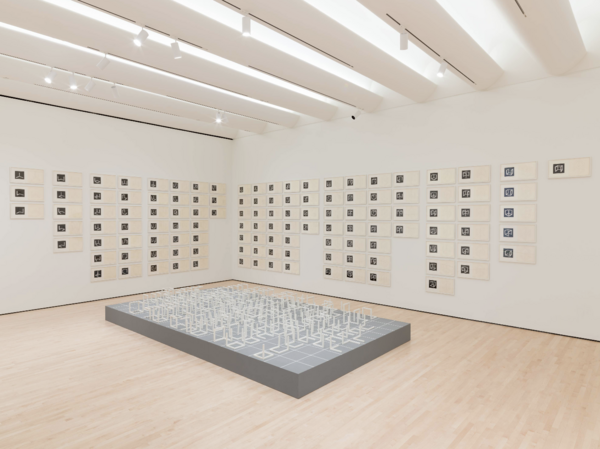
1 — Sol LeWitt, «Incomplete Open Cubes, ” 1974 2 — Donald Judd, „Untitled (Stacks), ” 1965
In 1974, Sol LeWitt created one of the most famous modular works in art history—"Incomplete Open Cubes.» This series consists of 122 sculptures, each representing a variation of a cube constructed from identical rods. They all start with the same basic module—a cube—but each variation omits some edges. The result is a catalog of all possible combinations, ranging from an almost complete cube to a barely sketched corner. The system generates the form, rather than the form generating the system.
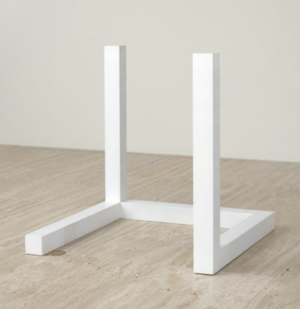
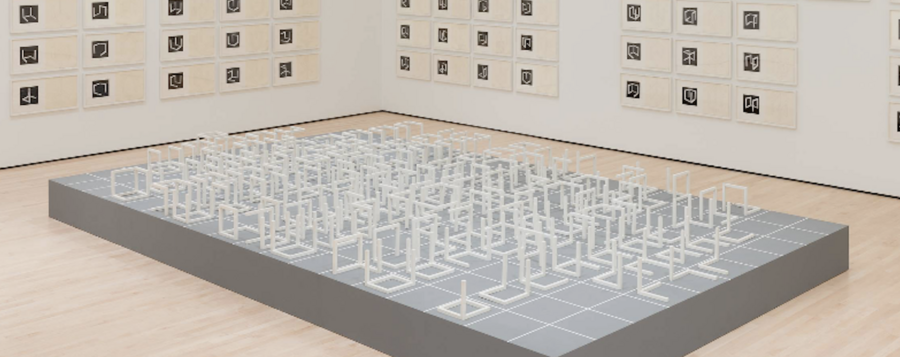
Sol LeWitt, «Incomplete Open Cubes, ” 1974
Upon closer inspection, every LeWitt cube is an exercise in modular logic. The basic unit remains unchanged: an 8×8x8 inch cube assembled from standard rods. Variations arise not from changes in proportion or material, but solely from element exclusion. This is purely algorithmic thinking: set a rule and iterate through all possibilities. LeWitt called this the «art-making machine, ” emphasizing that his role was not in execution, but in inventing the rule.