«POST-SCROLL» — a media outlet focusing on digital culture, internet trends, and the influence of artificial intelligence. The project presents a content strategy, a six-month thematic plan, and ten publication samples across various formats: from in-depth analyses to visual cards and short video scripts.
From Trend to Meaning.Every «POST-SCROLL» piece answers three questions:01 / Origin? — how the internet phenomenon emerged.02 / Mechanism? — why it went viral and what role AI played.03 / Significance? — what this trend reveals about contemporary digital culture.Our goal is not to retell trends, but to explain them.
How We Speak to Our AudienceOur style is accessible, curious, and slightly ironic. We discuss digital culture without jargon or unnecessary hype.Three Editorial Principles:01 / Context Over Speed. We explain the origins of trends, not just report on them.02 / Simple Explanations for Complex Topics. We make technology and internet phenomena understandable to everyone.03 / Facts Over Impressions. We verify sources and separate real events from AI-generated content.The main question: what do internet trends tell us about ourselves and our culture?
What We Explore
«POST-SCROLL» examines the internet not merely as an entertainment space, but as a reflection of contemporary culture.
Our focus centers on three areas:
01 / Internet Trends — how memes and viral formats emerge and propagate.
02 / Artificial Intelligence — how neural networks are changing the creation and perception of content.
03 / Digital Culture — how technologies influence human creativity, communication, and behavior.
We investigate not only what becomes popular, but why it happens.
From Monthly Theme to Specific Publications
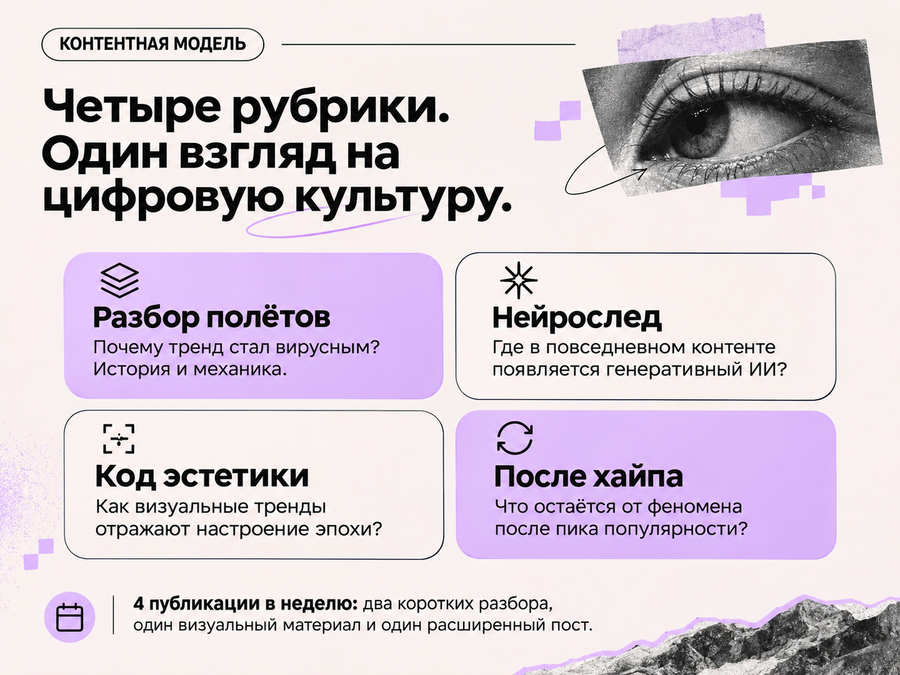
Each month is dedicated to one direction of digital culture, explored through four media sections.
Our Content Plan:
01 / Analysis — We explain the origins of trends and the reasons for their popularity.
02 / Visual Content — We explore memes, digital aesthetics, and AI-generated imagery.
03 / Video — We concisely and visually break down internet phenomena.
Publication Rhythm: Four pieces of content per week, totaling about 100 over six months.
The primary goal is to build a cohesive narrative of digital culture’s evolution, rather than a collection of random news items.
NEUROSLEED / Telegram
#
The Blogger Who Doesn’t ExistVirtual influencers have photos, style, personality, and followers. But behind their appearance is not a real person, but a digital character.
Designers, scriptwriters, and content specialists create their image. Sometimes they use generative AI for this purpose.
Why do we follow those who don’t exist?
Because on social media, we interact not only with people but also with the images they create.
Question: Does the influencer’s reality matter to us if their content evokes genuine emotion?
NEUROSLEED / Telegram
#
Who wrote the song — a human or an algorithm?Creating music no longer always requires instruments, a studio, and professional musical training.
Generative models are capable of producing melodies, arrangements, and synthetic vocals based on a text prompt.
But this technology raises a new question: what makes music authored?
The idea, the performance, the emotion, or the method of production?
AI does not negate creativity, but it changes our perception of the musician’s role.
Would you listen to a song created entirely by a neural network?
FLIGHT ANALYSIS / Telegram
#
Why is it impossible to stop scrolling?You open a social network for five minutes, and an hour later you’re still watching videos.
The recommendation feed adjusts to your behavior: your views, reactions, skips, and interest in specific topics.
Every interaction helps the system select the next piece of content more accurately.
This creates a personalized stream, where there is always something interesting to find.
The main currency of digital culture is our attention.
And the question is no longer just what we watch, but who is choosing it for us.
CONTENT EXAMPLE / NEUROSLEDS
#
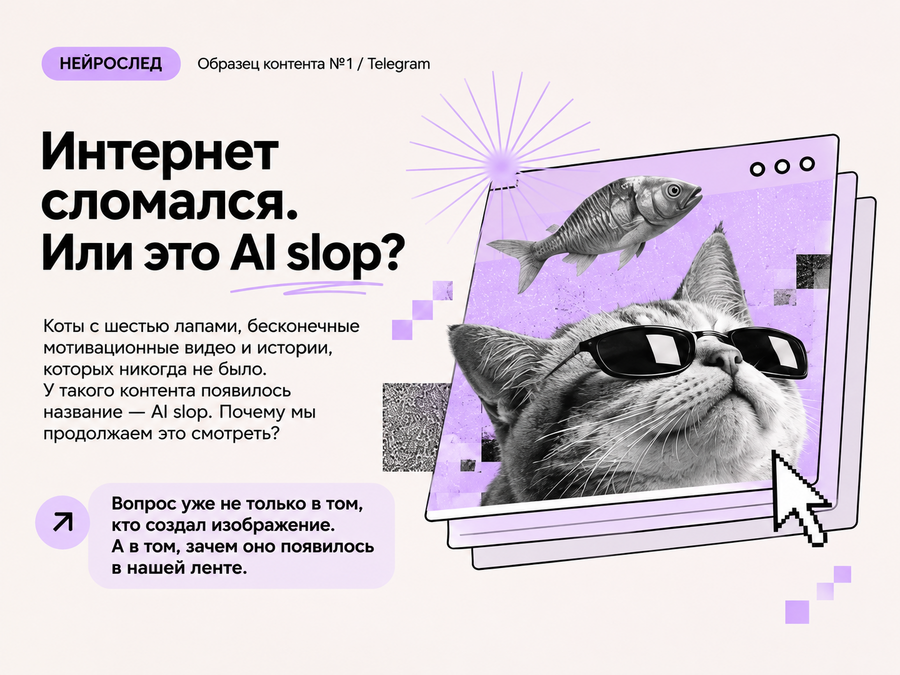
Do neural networks have their own signature style?Perfect faces, smooth textures, uniform lighting—sometimes it seems like all AI-generated images look alike.
Why does this happen?
Neural networks are trained on massive datasets of images and can reproduce common visual patterns.
However, the final result also depends on the human: their ideas, prompts, and creative decisions.
Conclusion: The problem isn’t that AI creates images, but that we are increasingly using it in the same way.
POST-HYPE / Telegram
#
Does the Internet Remember Everything? Or Not?Old photographs, forgotten memes, deleted websites, and conversations gradually transform into digital memories.
It seems as if everything is saved forever on the internet. But pages disappear, platforms close down, and links break.
Yet, fragments of the past suddenly resurface: old jokes become new trends, and forgotten aesthetics return to fashion.
Digital memory is simultaneously infinite and fragile.
Perhaps the future of the internet depends not only on what we create, but on what we manage to preserve.