
The author’s reasoning about how communication theory works in the field of game design
Video games are a cultural practice capable of shaping the audience’s attitudes toward specific themes or issues. Unlike other forms of art, games create an interactive space in which the setting or narrative of the original work can change through player interaction.
From a theoretical perspective, video games can be understood as a form of mediated communication, where developers construct a message and players interpret it through their own personal experience.

Squirrel Games studio mascot in the lounge area
Referring to the Rhetorical tradition, games can be seen as combining Logos (the logic of game rules and systems), Pathos (emotional engagement through narrative and atmosphere), and Ethos (trust in the developer and the coherence of the game world). Thus, a game becomes not only a form of entertainment, but also an argument constructed in an interactive form.
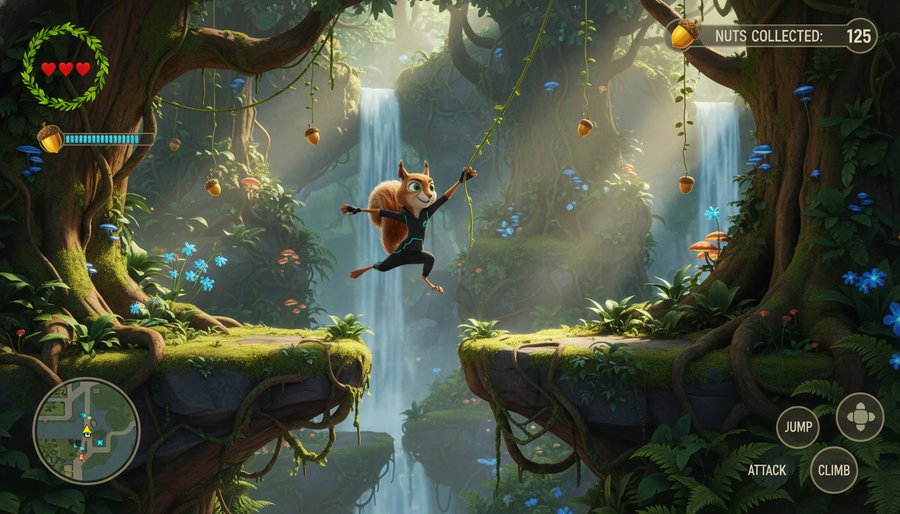
Screenshot from the game «Nutty Madness» by Squirrel Games
The Semiotic tradition makes it possible to analyze games as systems of signs and symbols. Visual elements and interface solutions often function as carriers of meaning, which players interpret depending on their cultural and social context. At the same time, meaning in games is not given directly but emerges through interaction with these sign systems.
For example, at the gameplay level, nuts can be perceived both as material objects in the game world and as icons within the player’s interface. When a nut-item is collected, the player receives feedback — such as glowing particles or a sound effect — which signals that the item has been picked up and added to the interface counter.
Squirrel Games studio at the 2025 video game festival
Finally, the Critical tradition emphasizes that game media are not neutral. They reflect and reproduce specific ideologies, power relations, and social norms. Analyzing games from this perspective makes it possible to view them as part of a broader cultural discourse that shapes perceptions of the world, identity, and social processes.
Presentation of the brand for a general audience
Our brand is the game studio Squirrel Games, which uses games as a means of communication. Through in-game markers, interactions, and narrative decisions, the studio seeks to emphasize the importance of caring for the world we live in.
The mission of the brand is to create games that inspire a respectful attitude toward nature, as well as to make eco-friendly practices part of everyday life.
The Squirrel Games studio logo in different color variations
Brand values:
Care for nature and people — a responsible attitude toward the environment and respect for players and employees;
Transparency and honesty — open communication, clear decisions, and sincere dialogue with the audience;
Sustainable development — long-term involvement in projects and opportunities for career growth.
Visual identity of the brand
Our mascot is a Squirrel. This creature is associated with nature, care, thriftiness, and attentiveness to resources. It acts as a mediator between the brand and the audience, making communication soft and friendly, as if the dialogue were taking place with a friend.
Studio mascot. Front view
The color palette is dominated by green and turquoise shades, with a bright orange accent. Green conveys a sense of calm and harmony. Turquoise is associated with energy and flow, helping us show that caring for nature can be modern and relevant. Orange is the color of the mascot, adding warmth and emotional expressiveness to the brand. The palette can be considered limited, but it does not overload perception and helps maintain a consistent emotional tone of the brand.
Brand color palette


Squirrel Games merchandise
A respectful attitude toward nature is also fostered within the team. The working environment and «healthy» everyday habits reinforce the studio’s values. For example, instead of a traditional smoke break, a Squirrel Games developer is encouraged to take a healthy snack, such as a small pack of nuts — caring for their own health while avoiding harm to the environment.
The office environment also creates conditions that support calm focus and deep immersion in work. The interior uses colors and forms inspired by natural motifs. As a result, the office is perceived not as a strictly functional workspace, but as a comfortable and «living» environment.
Snack for Squirrel Games studio employees


Office spaces of the Squirrel Games studio
From the perspective of the Socio-psychological tradition, regular exposure to such an environment influences employees’ attitudes and behavior. Eco-friendly practices gradually become perceived as a social norm within the team. At the same time, the logic of Politeness theory is evident: the studio does not impose values directly, but offers gentle alternatives, preserving employees’ autonomy and respecting their face. Eco-friendly behavior is shaped through a comfortable environment and choice, rather than through prohibitions or sanctions.
Presentation of the brand for a professional audience
Having introduced Squirrel Games to a broader audience and outlined our values and creative vision, we now move to a more detailed perspective on how these ideas are translated into production.
This section is aimed at developers, industry professionals, and potential partners, focusing on our technological choices, production processes, and our approach to community engagement, player research, and data-driven analysis.
Squirrel Games studio as the organizer of its own convention
We are Squirrel Games — a PC and console game development studio focused on creating experiences with a strong ecological message at their core. We develop our projects in Unreal Engine 5 and work within a Scrum-based production pipeline to keep our process transparent, structured, and efficient.
The Squirrel Games team
Our studio is organized into dedicated departments, including art, programming, and narrative design. Tasks are assigned directly to the leads of these departments, who then break them down and distribute them within their teams. This structure allows us to maintain clear communication, consistent quality, and a well-coordinated workflow across all disciplines.
Improving games through objective and interpretive player research
Objective Research: The Quantitative Foundation
The first phase involves rigorous objective research, which concentrates on the explanation of collected data and the distinction between dependent and independent variables. This quantitative approach relies on continuous collection of in-game metrics:• Player Activity Statistics — Tracking where players congregate and spend time (e.g., frequently visited locations). • Behavioral Data — Analyzing common gameplay choices, such as frequently utilized weapons and significant player decisions within the game narrative.
Objective research aims to establish generalizable patterns and identify key influences within the game environment. For instance, statistical data might show that a specific area in game, such as the «Greenheart Forest» location, is frequently visited by players.