The Yaroslavl State Historical, Architectural and Art Museum-Reserve traces its origins back to the Yaroslavl museums established in the 19th century: the Ancient Stores and the Museum of the Natural-Historical Society.
It all began with the activities of the Yaroslavl Provincial Scientific Archive Commission. Initially, its work involved organizing archival files and documents; however, the commission members aimed to study and preserve the entire cultural and historical heritage of the Yaroslavl region. In 1895, the Chronicle Archive—which became the name of the historical museum—was established under the commission. In the 1920s, the Chronicle Archive was renamed the Yaroslavl Historical Museum, and in 1924, several museums were merged into the unified Yaroslavl State Regional Museum. Since 1959, the exhibits and exhibitions of the museum-reserve have been housed in the former Spaso-Preobrazhensky Monastery—a monument of architecture and painting from the 16th–19th centuries—and since 1971, the museum has been called the Yaroslavl Historical and Architectural Museum-Reserve.
Today, it is the region’s largest museum, housing the most extensive collections, among which the portrait collection of the Yaroslavl School stands out above all others.
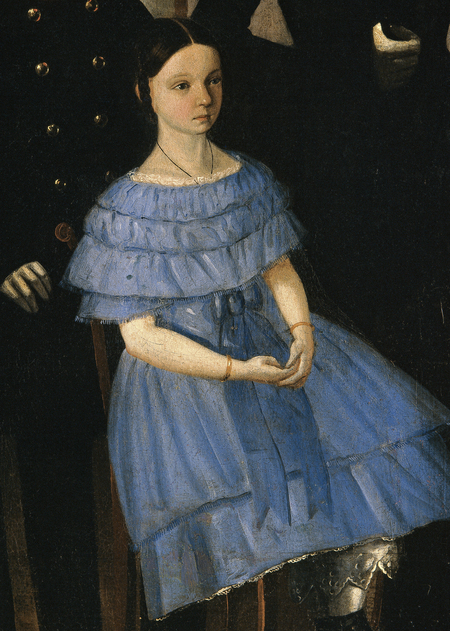
Yaroslavl portraits have traditionally been categorized as «primitives,» amateur, or semi-professional art. The tradition of the Yaroslavl portrait dates back to the «Parsun» of the Petrine era, when Russian icon painters adopted European oil painting techniques. This is why the characters depicted in early portraits resemble iconographic saints: their figures are flattened and ethereal, and their eyes are wide open. In Moscow and St. Petersburg, «Enlightenment» followed one another—classicism succeeded Baroque, and realism followed Romanticism—but in the Russian provinces, and specifically in Yaroslavl, during the same period, the Renaissance arrived after the Middle Ages of the 17th century. Many portraits painted by Yaroslavl masters in the 18th–19th centuries bear a strong formal resemblance to Italian and German examples from the 15th–16th centuries.
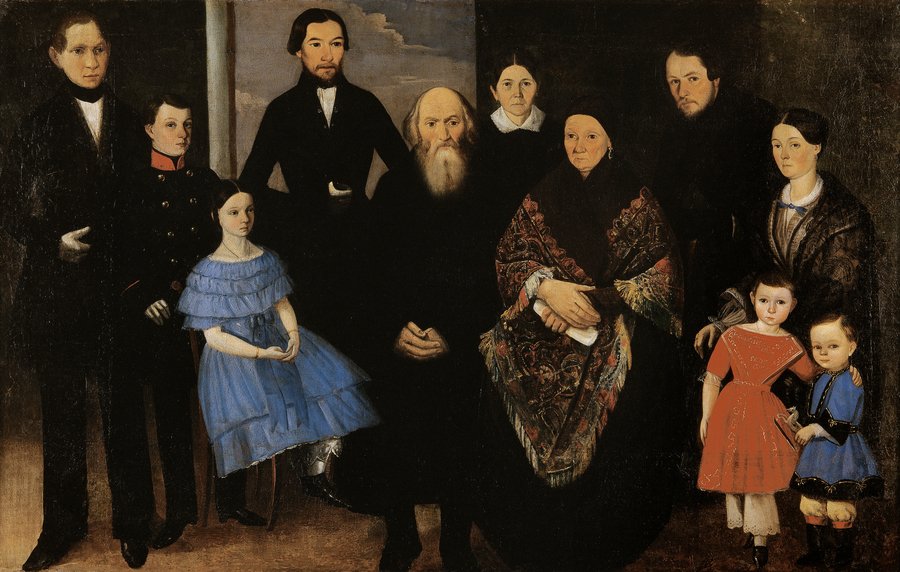
Unknown artist. Portrait of a merchant family. First half of the 19th century.
The reason lies not in provincial backwardness—it’s that the Russian provinces had their own rhythm of development and their own historical dimension. As a result, a unique school of merchant and noble portraiture developed on the Yaroslavl land, complete with its own rules and even strict canons. Yaroslavl portraits are laconic and unsophisticated; many of them follow the same canon: frontal poses, occasionally with a slight three-quarter turn, and pyramidal figures. The women’s hands are often placed on their waists, which lends an absolute sense of closure to the figures. Yaroslavl portraitists refined this canon and occasionally pushed it to a formula that was almost equivalent to the canons of Ancient Egypt.
However, the Yaroslavl artists were clearly striving for documentary realism in their images. This is why viewers often experience a degree of discomfort: the portrait subjects are depicted with intense focus—with no distance established by the particular skill of an individual artist. Clients certainly valued painterly mastery, but in the medieval sense: the portrait needed to be executed well, and the subject had to be recognizable. What the artist contributed to that was up to them. It is therefore unsurprising that many pictorial masterpieces exist among the Yaroslavl «primitives,» even though the names of the artists have not been preserved.
In addition to this unique collection of 130 items, the museum boasts collections of monetary treasures, Russian artistic silver, rare books, silk art fabrics, and much more. Another feature of the Yaroslavl Museum is the exhibit in the natural science department. Here, complex landscape panoramas featuring modern and prehistoric animals have been created for visitors. The focus is on artistic design and spectacle.
Wolf Family. Lotovo Station Area. Biogroup Authors: N. V. Kuznetsov, A. F. Buldygin, N. I. Suloyev, V. V. Nikonov