Rubricator
(01) Introduction (02) Communication Channels (03) Theoretical Framework (04) Analysis (05) Conclusion & Recommendations (06) Bibliography & Image Credits
(01) Introduction
Red Bull logo
Brand Description
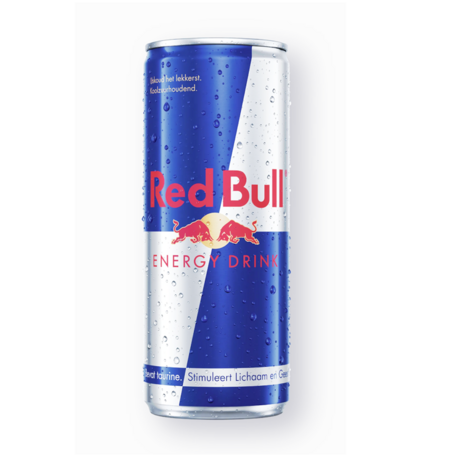
Red Bull is an Austrian energy drink brand founded by Dietrich Mateschitz in 1984, inspired by a ready-to-drink tonic from Thailand called Krating Daeng. More than just a beverage, Red Bull is a media and lifestyle empire. It operates under a unique business model where it produces a functional drink but markets it exclusively through high-adrenaline sports, cultural events (music, art, esports), and owned media properties (Red Bull Media House, Red Bull Records, Red Bull TV).
The brand is instantly recognizable by its silver-and-blue slim can, two charging red bulls, and the iconic slogan: «Red Bull gives you wiiings.»
Core Positioning
Premium Energy — Function Over Flavor
Unlike competitors who use flavor variety as a key consumer attraction strategy, Red Bull develops its range of flavors as an extension of its core product. Flavor diversity is not the foundation of the brand positioning; instead, it serves as a way to adapt a functional energy product to different taste preferences while maintaining a consistent focus on energy and performance.
Different Red Bull flavors
Red Bull × Formula 1
Red Bull positions itself as the original and most effective energy drink for high-performance individuals. Unlike competitors that focus on volume or flavor variety, Red Bull positions on three pillars:
Superior Efficacy: It famously contains 80mg of caffeine, taurine, and B-vitamins in a standardized 250ml can. The brand avoids large portion sizes (no 500ml or 1-liter cans), reinforcing that it is a precise «tool» for energy, not a soft drink.
Aspirational Association with «No Limits»: Red Bull does not sell an energy boost for staying awake at a desk. It sells the fuel for extreme achievement. Through its sponsorship of Formula 1 (Red Bull Racing), cliff diving, wingsuit flying, and esports, the drink becomes a symbol of breaking boundaries.
Media Authority: Uniquely, Red Bull positions itself as a credible publisher of action sports content. It owns TV channels and magazines, making the drink secondary to the lifestyle it broadcasts.
Target Audience
Red Bull has two concentric layers of target audience:
- Primary Audience: Young Male «Achievers» (Ages 16–30).
Demographics: Predominantly male, students or young professionals, lower-to-mid income but high disposable spending on lifestyle. Psychographics: Highly competitive, risk-tolerant, obsessed with mastery in a niche (skateboarding, gaming, coding, music production).
Target Audience
- Secondary Audience: Active Lifestyle (Ages 18-35).
Demographics: Mixed gender, urban, professionals in high-pressure jobs. Psychographics: They may not do backflips on a motocross bike, but they admire those who do. They consume Red Bull to feel part of an «elite energy tribe.»
Robin Goomes, Hannah Bergemann and Georgia Astle on the Women’s Rampage 2025 podium
(02) Communication Channels
Red Bull’s communication strategy is fundamentally different from traditional beverage marketing. Rather than relying on conventional advertising, the brand has transformed itself into a media powerhouse that creates and distributes its own content.
Social Media Presence
Red Bull maintains an active presence across major social platforms, but with a very specific content strategy. The brand treats its social channels not as product catalogs, but as media networks that publish high-adrenaline, cinematic content.
Flying Through London’s Tower Bridge (World First) From Red Bull Youtube Channel
Events
Red Bull Slide-In Tour
They invest heavily in sponsoring, hosting, and broadcasting events that align with their «extreme energy» positioning.
Red Bull Valparaíso Cerro Abajo
Natural Selection Tour Snowboard
(03) Theoretical Framework
Theory 1: Elaboration Likelihood Model (ELM)
The Elaboration Likelihood Model (Petty & Cacioppo, 1986) explains how people process persuasive messages. The theory proposes two routes of persuasion:
- Central Route — individuals carefully evaluate information and arguments before forming attitudes.
- Peripheral Route — individuals rely on visual cues, emotions, attractiveness, or social status rather than detailed information.
In brand communication, the peripheral route is often used when consumers are not highly involved with product information. Visual imagery, celebrity endorsements, exciting experiences, and emotional storytelling become persuasive tools.
Red Bull’s communication strategy strongly relies on the peripheral route by associating the brand with extreme sports, adventure, achievement, and excitement rather than discussing product ingredients or functional benefits.
Theory 2: Dialogic Theory
Dialogic Theory (Kent & Taylor, 1998) argues that effective public relations should encourage two- way communication between organizations and their stakeholders. According to the theory, organizations should:
- encourage interaction
- respond to audiences
- build relationships
- maintain ongoing conversations
- create opportunities for engagement
Social media platforms provide ideal environments for dialogic communication because audiences can comment, share, react, and directly interact with brands. Red Bull uses multiple social media channels to engage with followers through comments, user-generated content, event participation, and interactive campaigns.
(04) Analysis
Analysis through the Elaboration Likelihood Model
Example 1: Red Bull Stratos
The Stratos campaign is one of Red Bull’s most famous communication initiatives. Instead of promoting product features, the campaign creates an emotional association between the brand and extraordinary human achievement.
According to ELM, consumers process this message through the peripheral route. The dramatic visuals, world record attempt, and media attention generate excitement and admiration. As a result, consumers transfer these positive emotions to the brand itself. Red Bull is therefore perceived as a symbol of courage, innovation, and limitless performance.
By jumping from the stratosphere, Felix Baumgartner and Red Bull Stratos set three world records
Example 2: TikTok Extreme Sports Video
The video contains minimal product information and focuses primarily on entertainment and excitement. From an ELM perspective, persuasion occurs through:
- visual intensity
- music
- athlete performance
- emotional arousal
The audience forms positive attitudes toward the brand without carefully evaluating the product itself. This demonstrates peripheral-route persuasion.
Video from the Red Bull TikTok account
Analysis through Dialogic Theory
Example 3: Instagram* Comment Interaction
Dialogic Theory suggests that communication should encourage interaction. The comment section demonstrates:
- audience participation
- community building
- brand visibility
- social engagement
Even when Red Bull does not respond to every comment, the platform enables continuous dialogue among followers and strengthens brand loyalty.
Comments under Red Bull’s Instagram* video
Example 4: User-Generated Content
User-generated content reflects dialogic communication because audiences become active participants rather than passive receivers. The strategy increases:
- engagement
- trust
- authenticity
- emotional connection
Dialogic Theory argues that such interaction strengthens long-term relationships between organizations and stakeholders.
Video from official Instagram* account @domtomato
(05) Conclusion & Recommendations
Conclusion
The analysis demonstrates that Red Bull has developed one of the most distinctive communication strategies in the global beverage industry.
Through the Elaboration Likelihood Model, it becomes evident that the brand primarily relies on peripheral-route persuasion by connecting itself with excitement, achievement, and extreme experiences.
Through Dialogic Theory, Red Bull shows strong audience engagement across social media platforms by encouraging participation, interaction, and community building.
Overall, the company’s communication strategy effectively strengthens brand recognition, emotional attachment, and customer loyalty.
Recommendations
(01) Increase Direct Interaction Although engagement levels are high, Red Bull could respond more frequently to comments and questions to strengthen dialogic communication.
(02) Expand User-Generated Content Campaigns Encouraging more user-created videos and challenges would increase audience participation and authenticity.
(03) Diversify Lifestyle Representation The brand could feature a broader range of consumers beyond extreme athletes, making the brand more relatable to everyday users.
(04) Strengthen Educational Content Red Bull could occasionally provide more information about product ingredients, functionality, and responsible consumption to balance emotional and informational communication.
(*)Meta has been declared an extremist organization and banned in the Russian Federation.
Calhoun, C. Communication as Social Science (and More) // International Journal of Communication. — 2011. — Vol. 5.
Craig R. T. Communication Theory as a Field // Communication Theory. — 1999. — Vol. 9, No. 2. — P. 119–161.
Croucher S. M. Understanding Communication Theory: A Beginner’s Guide. — New York: Routledge, 2016.
Rosenberry J., Vicker L. A. Applied Mass Communication Theory: A Guide for Media Practitioners. — 2nd ed. — New York: Routledge, 2017.
Block M. Red Bull’s Brand as Powerful as Its Beverage [Electronic source] // NPR. — 2012. — 15 Oct. — URL: https://www.npr.org/2012/10/15/162963633/red-bulls-brand-as-powerful-as-its-beverage (10.06.2026).
Red Bull GmbH History [Electronic source] // Funding Universe. — URL: https://www.fundinguniverse.com/company-histories/red-bull-gmbh-history/ (10.06.2026)
We Analyze Red Bull’s Content Strategy [Electronic source] // Storimake. — URL: https://storimake.com/en/we-analyze-red-bulls-content-strategy (11.06.2026)
Red Bull Website (https://www.redbull.com)
https://www.redbull.com (11.06.2026)
https://www.redbullcontentpool.com (11.06.2026)
https://www.redbull.com/nl-nl/events?filter.countryCode=NL&filter.toggle.date=upcoming&filter.toggle.live=all (11.06.2026)
Official YouTube Channel https://www.youtube.com/watch?v=sNEwYPa7yok (12.06.2026)
https://ru.pinterest.com/pin/1131881318912834521/ (11.06.2026)
https://ru.pinterest.com/pin/831406781239277345/ (11.06.2026)
Official TikTok account @redbull https://www.tiktok.com/@redbull? _r=1& _t=ZS-97BcQQR31LY (11.06.2026)
Official Instagram* account @domtomato url:https://www.instagram.com/p/B3MjGinlp2e/?igsh=ZXFzODN0NnpycTJy (11.06.2026)
Cover: Official Instagram* account @redbull url: https://www.instagram.com/p/BsLFmUeDyqC/?utm_source=Pinterest&igshid=8aaa93d0eptu&utm_medium=organic&epik=dj0yJnU9cWFVR193WVZYU19aSW41eFBvbF8xQjdRR2xZTlR1eHEmcD0wJm49MW1qem5OQXNST0RFMnZrMTVMZUh4QSZ0PUFBQUFBR291d09z (11.06.2026)